
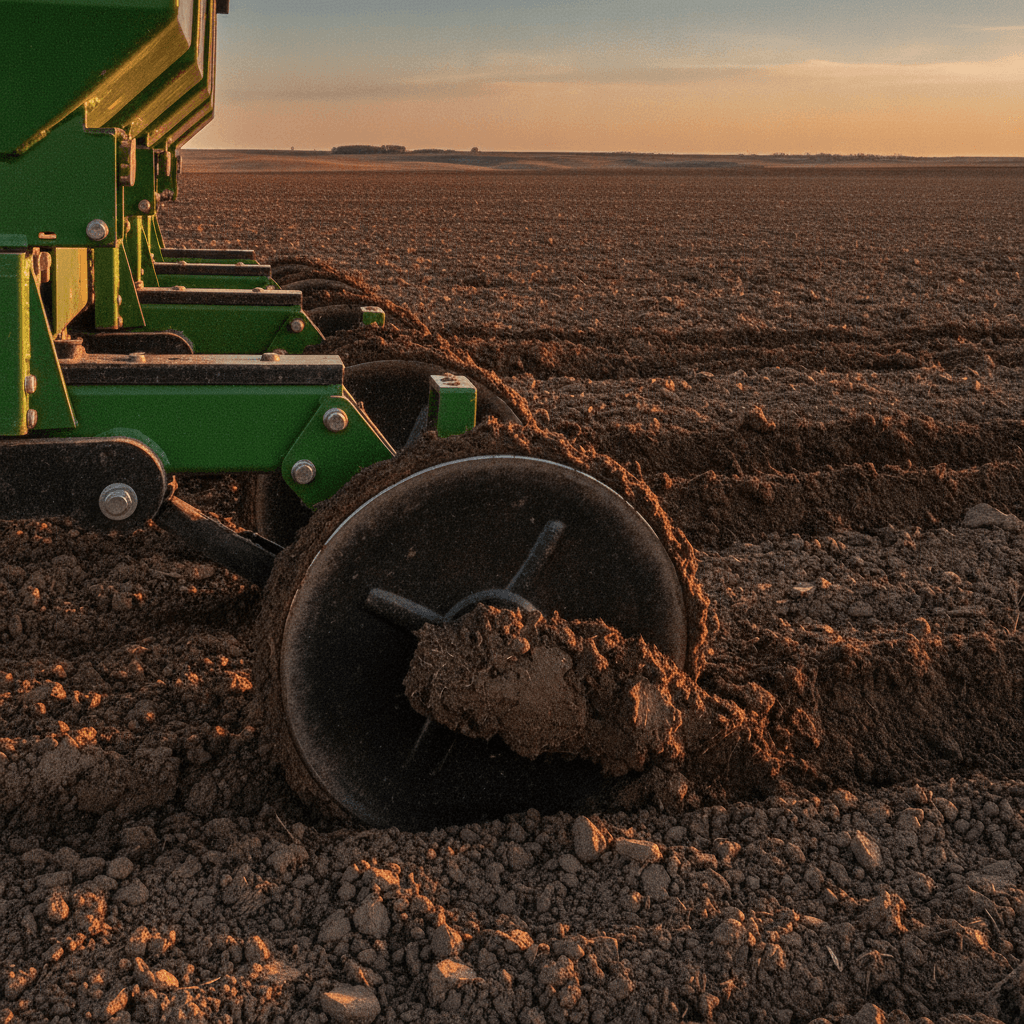
How Do Farmers Near Ipswich Know Whether Their Planter’s Closing Wheels Are Actually Sealing the Seed Trench — Or Just Smearing Mud Over an Open Slot?
Your closing wheels are one of the last things that touch the trench before the soil surface closes over — and if they’re smearing wet mud instead of firming soil around the seed, you’ve already lost the stand before the seed ever sees moisture. For farmers near Ipswich planting corn and soybeans through the heavy, wet soils that show up every spring across north-central South Dakota, this is a real and repeatable problem. The good news is it’s diagnosable. The frustrating part is that most equipment content out there focuses on what closing wheels do in dry or average conditions — not in the gumbo soils that define a wet April across the Northern Plains.
- What a Properly Sealed Seed Trench Actually Looks Like
- Why Wet Soils Near Aberdeen and Huron Make This Worse Every Spring
- The Wheel Retainer Connection Most Operators Miss
- How to Diagnose Whether Your Trench Is Sealing or Smearing
- Where Curved Spoked Gauge Wheels Fit Into This
- What the Competitors' Content Doesn't Tell You
- Frequently Asked Questions
- Ready to Sort Out Your Row Units Before Next Planting Season?
What a Properly Sealed Seed Trench Actually Looks Like
When your closing system is working right, the seed sits at consistent depth, the trench walls firm up from both sides, and you’ve got good seed-to-soil contact. You can go back after a pass, dig a few seeds at random, and find them sitting snug in a closed slot — not floating in a mud pocket, not sitting in an open crack, and not smeared sideways by a wheel that tracked through standing water at the row unit.
What you don’t want to find: seeds sitting in a smeared, glazed slot that dried into a hard cap before emergence. That’s what happens when your closing wheels pushed wet clay sideways across the trench instead of pressing it down and in from both sides. The trench looks closed from the surface. It isn’t. You’ll see it at emergence — uneven stands, skips that don’t match the meter, or a row that simply fires on three out of four seeds when the planter said it was 98% singulation.
Why Wet Soils Near Aberdeen and Huron Make This Worse Every Spring
The black clay and gumbo soils running through Edmunds, Brown, and Beadle counties don’t behave like loam in Kansas. When you’re forced into the field during a tight planting window after a wet stretch — and every April gives you at least one of those — the soil has enough moisture that closing wheels can smear instead of seal. The closing wheel isn’t at fault in the abstract. The problem compounds fast when other parts of the row unit aren’t doing their job upstream: gauge wheels running inconsistent depth, a worn opener creating an oversized trench, or — and this one gets ignored more than it should — a gauge wheel that’s physically shifted off its mount because the wheel retainer isn’t keeping it locked in place.
A gauge wheel that’s walking laterally even a quarter inch from where it should be changes the trench geometry. When that happens, the closing wheels are trying to seal a trench that isn’t quite where they expect it. In heavy soils, the margin for error is almost zero.
The Wheel Retainer Connection Most Operators Miss
This is the gap that most competitor content doesn’t address cleanly: the relationship between a stable gauge wheel position and effective trench closure downstream. Closing wheel articles focus on closing wheel designs — rubber vs. cast iron, spiked vs. smooth, spring pressure settings. That’s all legitimate. But if the gauge wheel itself is drifting off its axle mount because the wheel retainer isn’t doing its job, you’ve introduced variability upstream that no closing wheel design can fully compensate for.
Jung Enterprise’s Wheel Retainer is built specifically to prevent gauge wheels from dislodging off the planter row unit during field operation. It’s a straightforward part with a focused job: keep the gauge wheel exactly where it belongs, pass after pass. If the gauge wheel is stable, the trench is consistent. If the trench is consistent, the closing wheels can do what they’re designed to do — seal it cleanly, even in difficult soils.
How to Diagnose Whether Your Trench Is Sealing or Smearing
You don’t need a lab. You need to walk the field right after a planting pass and dig. Here’s what to check:
- Dig 10–15 seeds at random across a row — not all from one spot. Look at where each seed is sitting relative to the trench wall and how firmly the soil is packed around it.
- Check for glazed or smeared trench walls. In wet conditions, a smear means the closing wheel pushed clay sideways under load. A sealed trench should show soil that’s been compressed in from both sides, not sheared.
- Look at the surface. If you see a hairline crack running the length of the row that wasn’t pressed shut, your closing wheel pressure may be too light — or the trench was too wide to begin with because something upstream shifted.
- Check gauge wheel position mid-field, not just at the end of the row. A gauge wheel that looks fine at the headland can walk off its mount by the time you’re 600 feet into a long pass over rough ground.
- Compare row-to-row. If two or three rows consistently show worse trench closure than the others, that points to a mechanical issue on those specific row units — not a field-wide soil problem.
Where Curved Spoked Gauge Wheels Fit Into This
Trench consistency starts with depth control, and depth control starts with gauge wheels that aren’t carrying a load of mud into the trench. Jung Enterprise’s Curved Spoked Gauge Wheels use an open-spoke design that sheds mud instead of packing it. In the clay soils around Ipswich and across north-central South Dakota, a solid-face gauge wheel in a wet field isn’t just inefficient — it’s actively building up material that transfers into the trench geometry and makes the closing wheel’s job harder.
Field-tested to just 1/16″ of wear after 13,000 planted acres over three seasons, these wheels are built to maintain consistent running dimensions so your depth setting stays true across the entire field — not just the first hundred acres of a dry spring day.
What the Competitors’ Content Doesn’t Tell You
If you’ve looked around at what Yetter, Schaffert, Copperhead Ag, or Exapta publish on this topic, you’ll find plenty of content on closing wheel styles, down pressure, and row unit settings. What’s largely missing is a straight answer to the upstream question: how does gauge wheel stability affect closing wheel performance? And what does the wheel retainer — often the cheapest, most overlooked part on the row unit — have to do with the quality of your seed trench at the end of a 12-hour day in difficult soils?
At Jung Enterprise in Ipswich, that’s the kind of practical, whole-row-unit thinking that drives every part we make. The steel ring, the wheel retainer, the gauge wheel — they’re not independent products. They work together, and the trench quality you see at emergence reflects how well every one of those parts did its job upstream.
Frequently Asked Questions
Can a loose or missing wheel retainer actually affect trench closure?
Yes. If the gauge wheel drifts laterally even slightly off its mount, the trench geometry changes — and closing wheels tuned for a specific trench width will either over-close or under-close that trench. In heavy soils near Ipswich and Aberdeen, that mismatch shows up as smearing or open slots at emergence.
How much closing wheel spring pressure is right for heavy clay soils in South Dakota?
There’s no universal number, but most operators in gumbo soils run more pressure than the OEM baseline. The key is matching pressure to conditions: too light and the trench doesn’t seal, too heavy and you create compaction directly over the seed. Start at a mid-range setting and walk your rows after each field entry to adjust.
Is an open-spoke gauge wheel better than a solid wheel for wet field conditions?
In most Northern Plains conditions — especially the wet springs common across central and north-central South Dakota — yes. An open-spoke design like Jung Enterprise’s Curved Spoked Gauge Wheels sheds mud instead of packing it, which keeps the gauge wheel running true and reduces the mud load transferred into the seed trench.
How do I know if the seed trench smearing I’m seeing is a closing wheel problem or a soil condition problem?
Compare multiple rows on the same pass. If smearing is consistent across all rows, it’s likely a soil condition or closing wheel setting issue. If it’s isolated to specific row units, check those row units for gauge wheel drift, worn openers, or closing wheel spring failure. A row-unit-specific pattern almost always points to a mechanical cause upstream.
Does Jung Enterprise’s Wheel Retainer fit multiple planter brands and gauge wheel sizes?
Yes. Jung Enterprise’s parts are designed for compatibility across multiple OEM brands and gauge wheel sizes — not just one planter line. If you’re running a mixed equipment setup or managing multiple planters across a custom operation in Nebraska, Minnesota, or North Dakota, check the product page or contact the team directly to confirm fit for your specific configuration.
Ready to Sort Out Your Row Units Before Next Planting Season?
If you’re seeing uneven stands, smeared trenches, or inconsistent emergence across your corn or soybean fields, the fix usually starts with understanding what’s happening upstream — not just at the closing wheel. Jung Enterprise is based in Ipswich and builds patented, American-made gauge wheel parts field-tested in the same conditions you’re farming. Whether you need a Wheel Retainer to stabilize your gauge wheel position, or you want to talk through your whole row unit setup, reach out directly.
Contact Jung Enterprise at (605) 281-0497 or through the contact page — and get the right parts on before the window opens.