
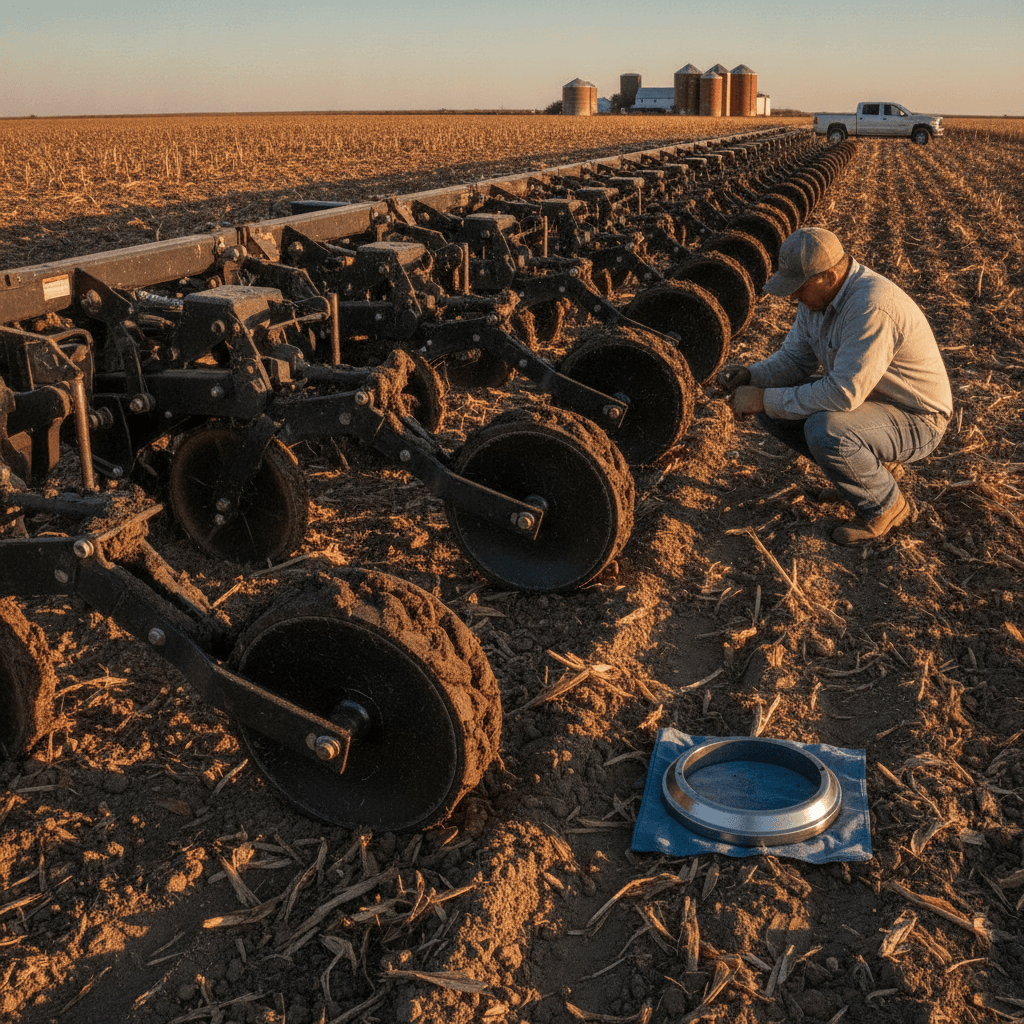
How Much Does a Worn Gauge Wheel Actually Cost You Per Acre Near Bismarck?
If you’re farming near Bismarck or anywhere across the Northern Plains, the honest answer is: more than most operators realize — and more than most equipment manufacturers will put a number on. Worn gauge wheels don’t announce themselves with a warning light. They just quietly let your planting depth drift, let mud pack into the tire, and let your seed placement get sloppy. By the time you notice, you’ve already planted a few hundred acres off-spec. This article breaks down the real cost of running worn or plugged gauge wheels, and when upgrading to better hardware actually pencils out.
- What Gauge Wheels Actually Control — And Why Precision Slips Quietly
- The Mud Problem on Northern Plains Clay Soils
- Calculating the Per-Acre Cost of a Worn Gauge Wheel Tire
- What Competitors Don't Tell You About Gauge Wheel Upgrade ROI
- When to Replace vs. When to Upgrade
- Frequently Asked Questions
- Talk to Jung Enterprise Before Next Planting Season
What Gauge Wheels Actually Control — And Why Precision Slips Quietly
Gauge wheels ride on either side of your planter row unit and control how deep the opener disc cuts into the soil. When they’re in good shape, that depth is consistent. When a gauge wheel is worn down, cracked, or packed with mud, the row unit starts riding inconsistently — up and down — and your seed depth varies with it.
Research from university extension programs consistently shows that planting depth variation beyond a quarter inch starts hurting emergence. Uneven emergence means some plants are lagging a week behind neighbors, and in corn, a one-leaf delay on even a fraction of your stand can cost you 5–10 bushels per acre on those plants. Soybeans are slightly more forgiving, but late emergence still affects canopy closure and weed pressure.
Across a 1,000-acre corn operation, if 15% of your stand has emergence issues tied to depth inconsistency, that’s 150 acres worth of reduced yield potential. At current corn prices, you can do that math quickly. The gauge wheel isn’t a glamorous part, but it’s the one setting the depth every inch of the field.
The Mud Problem on Northern Plains Clay Soils
Near Bismarck and across much of North Dakota, South Dakota into the Aberdeen area, and western Minnesota, you’re frequently dealing with heavy clay and gumbo soils that pack and smear under wet spring conditions. Standard rubber gauge wheel tires collect mud in the tire channel, build up into a solid ring, and start riding on a mud platform instead of the soil surface. When that happens, your effective gauge wheel diameter grows — and your depth control goes right out the window.
Farmers running planters and air seeders in these conditions know the drill: stop, clean mud off the gauge wheels, start again. In a short planting window, that downtime adds up fast. An hour of cleaning time on a 24-row planter is an hour you’re not putting seed in the ground. Do that twice a day for a week and you’ve burned 10+ hours that could have been planting acres.
This is one of the biggest gaps in how most equipment manufacturers address gauge wheel performance — they focus on wear, but they don’t put real numbers on what mud buildup costs in downtime, fuel, and replanting risk. At Jung Enterprise in Ipswich, this is exactly the problem our Curved Spoked Gauge Wheels are designed to solve. The open-spoke design sheds mud instead of packing it, keeping your depth consistent through conditions that would plug a standard tire solid.
Calculating the Per-Acre Cost of a Worn Gauge Wheel Tire
Here’s a straightforward way to think about this. Pull out your gauge wheels at the end of a season and measure the tire lip. If you’re seeing significant wear — and if you’ve been running in abrasive sandy loam or running high acres — you’re likely already losing depth control you can’t feel from the cab.
Consider these cost contributors:
- Yield loss from depth variation: Even a modest 3–5 bu/ac loss on 20% of your acres from uneven emergence adds up to real money across a 2,000-acre operation.
- Replanting costs: In a bad year with severe stand issues tied to poor depth control, partial replanting runs $30–$60/acre when you factor in seed, fuel, and labor.
- Downtime and labor: If you’re hand-cleaning gauge wheels twice a day during wet planting conditions, figure your hourly cost of equipment and labor and multiply it out. It’s not insignificant.
- Tire replacement frequency: Standard rubber gauge wheel tires wear through the lip, and that wear accelerates in hard or abrasive soils. If you’re replacing them every 2–3 seasons, that’s a recurring cost that can be dramatically reduced with tire lip protection.
The Steel Ring from Jung Enterprise addresses the tire lip wear problem directly. It mounts over the outer edge of your existing gauge wheel tire with six screws, protects the lip from wear, and — this is the part competitors don’t offer in a single piece — doubles as a built-in scraper that knocks mud out of the tire channel as the wheel turns. You don’t need a separate scraper part. It’s patented (US 11,707,013 B2 and related patents), American-made, and field-tested to show just 1/16″ of wear after 13,000 planted acres over three seasons. For operators near Fargo or Bismarck who put hard miles on their planters, that kind of durability is worth paying attention to.
What Competitors Don’t Tell You About Gauge Wheel Upgrade ROI
Browse through the product pages of the major gauge wheel and planter attachment brands, and you’ll find plenty of product specs. What you won’t find is an honest breakdown of cost per acre, or a frank comparison of what you’re spending on replacement tires and downtime versus what an upgraded wheel system costs over the same period.
The calculation is straightforward if you’re willing to run it. Take your current cost of gauge wheel tires per planter row, multiply by replacement frequency, add in downtime hours per season, and compare that to the cost of a system that’s proven to last significantly longer with less maintenance. For most operators in the Northern Plains, the math on upgrading to our Steel Ring comes out favorably within two to three seasons — often sooner if you’ve had a wet spring that cost you planting days.
When to Replace vs. When to Upgrade
If your gauge wheel tires still have good lip depth and you’re not seeing depth variation issues, straight replacement with quality OEM-spec tires makes sense. But if you’ve been replacing the same tires every two seasons, or if mud buildup is a recurring problem in your soil conditions, that’s the signal to think about a different approach rather than just buying the same part again.
Ag dealers and distributors in South Dakota, North Dakota, and Minnesota who stock planter parts know what their customers are coming back for year after year. If gauge wheel tires are a frequent reorder, that’s worth a conversation about whether there’s a better solution to put in front of your customers. Jung Enterprise works with dealers directly — reach out if you’re interested in stocking products that solve the repeat-replacement problem.
Frequently Asked Questions
How do I know if my gauge wheel tires are worn enough to affect depth accuracy?
Check the tire lip — the outer edge that contacts the soil surface and controls depth. If you can see visible wear or the lip has rounded off, your depth consistency is already affected. A worn lip of even 1/8″ translates directly to shallower seed placement than your row unit is set for.
Can I add a steel ring to my existing gauge wheel tires, or do I need new wheels?
The Jung Enterprise Steel Ring mounts onto your existing gauge wheel tire with six screws. You don’t need to replace the wheel itself — just add the ring to protect the lip and gain the built-in scraper function. Check compatibility with your gauge wheel size before ordering.
Does the open-spoke gauge wheel design actually shed mud better than standard tires near Bismarck?
Yes, and it matters most in the heavy clay and gumbo soils common across the Northern Plains. A standard closed tire face collects mud that compacts and builds up. An open-spoke design lets mud pass through rather than pack in, which keeps your gauge wheel riding on actual soil rather than a mud platform.
How long does a Jung Enterprise Steel Ring last compared to a standard gauge wheel tire?
Field testing shows only 1/16″ of wear after 13,000 planted acres over three years. That’s a longer service life than most standard rubber tire lips in abrasive or high-acre conditions.
Do these products fit air seeders and no-till drills, or only row-crop planters?
Jung Enterprise products are compatible with planters, air seeders, and no-till drills across multiple OEM brands. If you’re running no-till or strip-till in North Dakota or Minnesota and dealing with gauge wheel issues, the fitment options are worth checking on your specific equipment.
Talk to Jung Enterprise Before Next Planting Season
We’re based in Ipswich, South Dakota, and we build these products for the conditions farmers in this part of the country actually deal with — short planting windows, wet springs, hard clay soils, and no tolerance for equipment that costs you days. If you want to know whether our Steel Ring, Curved Spoked Gauge Wheels, or Wheel Retainer are the right fit for your planter setup, reach out directly.
No pressure, no sales pitch — just a straight conversation about your equipment and whether our products solve your problem. Contact Jung Enterprise here or call us at (605) 281-0497.