
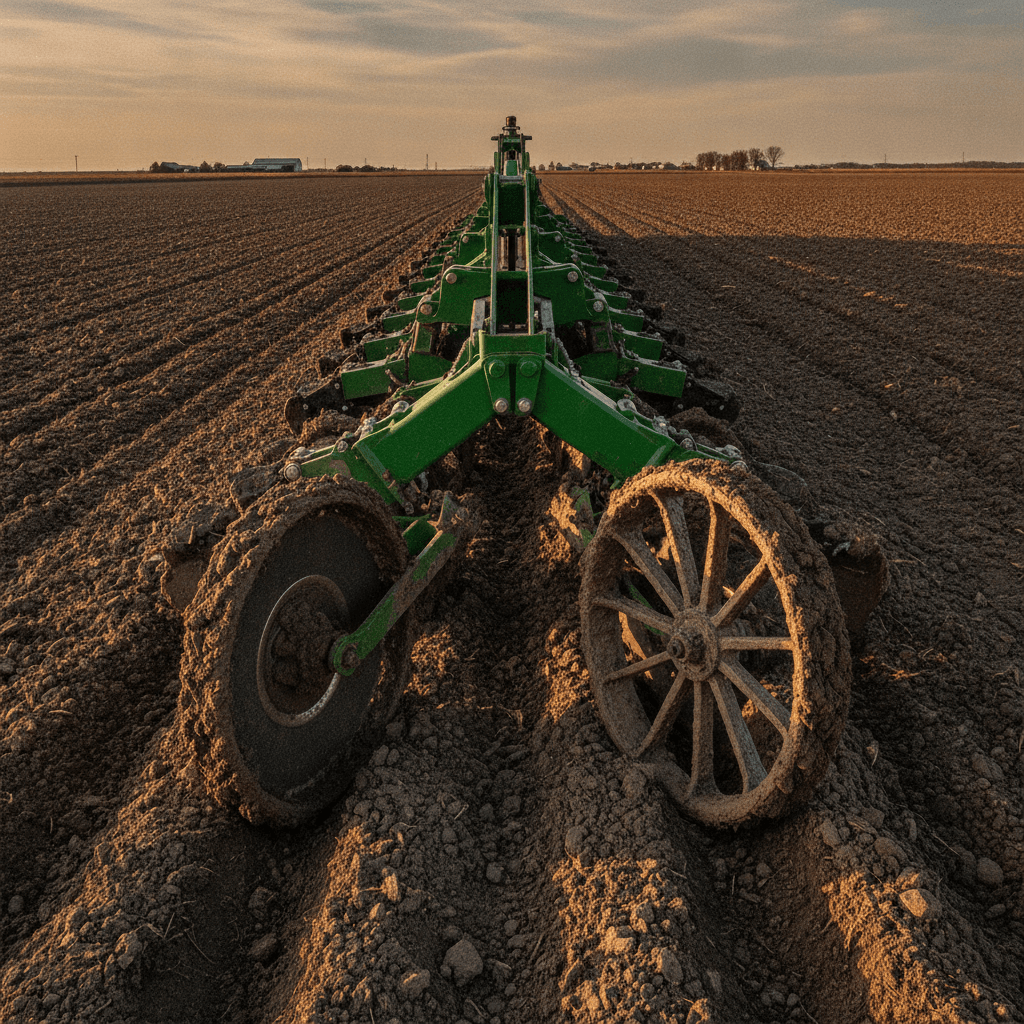
Why Do Curved Spoked Gauge Wheels Outperform Solid Gauge Wheels in Wet Spring Conditions Near Fargo?
The short answer: curved spoked gauge wheels shed mud. Solid wheels pack it. Near Fargo and across the Red River Valley into eastern North Dakota and northwestern Minnesota, spring soils are notoriously wet, heavy, and sticky. When a solid gauge wheel starts carrying mud, it stops functioning as a depth-control tool and starts acting like a clogged roller that pushes seed placement all over the map. Curved spoked wheels are specifically designed with open spoke geometry so that mud passes through rather than building up — and that design difference shows up directly in your stand counts.
- The Core Problem With Solid Gauge Wheels in Wet, Heavy Soils
- What the Curved Spoke Design Actually Does — and Why the Curve Matters
- What the Competitor Options Don't Tell You About Spoke Design
- No-Till and Strip-Till Applications: Where This Matters Most
- Fitting Curved Spoked Gauge Wheels to Your Planter or Drill
- Frequently Asked Questions
- Ready to Stop Fighting Mud-Packed Gauge Wheels?
The Core Problem With Solid Gauge Wheels in Wet, Heavy Soils
Solid gauge wheels were engineered for a reason — they’re simple, they’re strong, and they work fine in dry, loose conditions. But the Northern Plains doesn’t give you many dry, loose planting windows. You get a week, maybe ten days if you’re lucky, and half of it the ground is either too wet to run or drying out fast enough that you’re chasing it.
In those wet conditions, solid wheels build up a mud pack on the running surface and between the wheel face and the furrow wall. That layer of mud does two things you don’t want. First, it raises the effective diameter of the wheel, so your depth setting is no longer accurate — you think you’re planting at two inches but you’re running shallower. Second, it transfers lateral pressure unevenly against the seed trench, which can push seed sideways or cause the furrow to collapse inconsistently. Either way, your emergence is patchy and your stand is weaker before you even get the planter back to the shed.
Farmers running no-till and strip-till in heavy clay ground see this problem amplified. The soil structure holds moisture longer, and residue adds another layer of material that can stick to a solid wheel and compound the plugging. If you’ve been fighting this near Fargo or anywhere in the Red River corridor, you know what a frustrating morning it is to pull your planter out and realize your gauge wheels are caked solid by row three.
What the Curved Spoke Design Actually Does — and Why the Curve Matters
An open-spoke gauge wheel solves the mud-packing problem by giving debris somewhere to go. But not all open-spoke designs are created equal. A straight-spoke wheel opens up the face but can still trap soil in the corners where spokes meet the hub or rim. A curved spoke design is a meaningful improvement — the curve creates a continuous wiping action as the wheel rotates, directing mud and crop residue outward and off the wheel rather than letting it settle and pack in the pockets.
At Jung Enterprise in Ipswich, the curved spoked gauge wheels are built around exactly this principle. The spoke geometry isn’t just about looks — it’s functional. As the wheel turns through wet, sticky soil, the curve deflects material outward with each rotation. The wheel stays cleaner through the pass, which means the contact surface stays consistent, which means your depth reading stays accurate from the first row to the last.
That’s not a small thing during planting. Consistent depth placement is one of the highest-leverage variables you control at the row unit. Half-inch depth swings across a field can mean four to five days of emergence variation in corn, and once you’ve got that kind of variability in your stand, you’ve already given up yield — before weather, before pests, before anything else enters the equation.
What the Competitor Options Don’t Tell You About Spoke Design
Most of the major gauge wheel suppliers offer open-spoke wheels in their product lines. What they don’t spend much time explaining is the difference in spoke geometry and what it means in real field conditions. If you’ve browsed competitor catalogs looking for a side-by-side explanation of curved versus straight spokes, the performance tradeoffs in heavy clay soils, or field data on mud-shedding performance, you’ve probably come up empty.
Jung Enterprise has run their curved spoked gauge wheels through 13,000 planted acres over three years and logged only 1/16 inch of wear over that period. That’s a durability number worth paying attention to — it means you’re not replacing these wheels every season, and the open-spoke design doesn’t compromise structural integrity to get the mud-shedding benefit. You get both.
No-Till and Strip-Till Applications: Where This Matters Most
If you’re running a no-till drill or a strip-till planter in heavy residue country — and a lot of farmers near Fargo and into western Minnesota and eastern South Dakota are — the curved spoked design pays for itself faster. Residue wraps around solid wheels and solid-spoke wheels far more aggressively than it does around a clean, curved spoke. That means less stopping to pull material out from around your row units and more acres per day during the window you have.
For custom planting operations running across multiple farms, that uptime difference compounds. Every hour you spend cleaning plugged gauge wheels is an hour you’re not planting — and in a short spring window, an hour lost early in the day can mean you don’t finish the last field before rain moves in. Jung Enterprise’s full product line is built for exactly this kind of working environment, where downtime isn’t just inconvenient, it’s directly tied to revenue and yield.
Fitting Curved Spoked Gauge Wheels to Your Planter or Drill
One practical question that comes up: do these wheels fit your equipment? Jung Enterprise’s curved spoked gauge wheels are designed to fit planters, air seeders, and no-till drills across multiple OEM brands and gauge wheel sizes. Before you order, confirm your gauge wheel diameter and hub configuration — most row-crop planter setups across the Corn Belt and Northern Plains use common sizing that these wheels are built to match. If you’re not sure, reach out directly and get confirmation before you’re sitting in the shop trying to make something fit the night before you want to plant.
Frequently Asked Questions
Will curved spoked gauge wheels work in dry conditions too, or are they only better in mud?
They perform fine in dry conditions. The curved spoke design doesn’t hurt you in lighter soils — it just gives you a meaningful advantage when things get wet. There’s no downside to running them year-round.
How do I know if my current gauge wheels are affecting my planting depth?
If you’re seeing inconsistent emergence across a field — especially after planting in wet conditions — depth variation is a likely culprit. Check your gauge wheels for mud buildup mid-pass and look at whether the running surface is staying clean. If you’re pulling caked wheels at the end of a row, your depth data is already compromised.
Are open-spoke gauge wheels weaker than solid wheels?
Not when they’re built to the right spec. Jung Enterprise’s curved spoked gauge wheels showed only 1/16 inch of wear over 13,000 acres across three seasons. Structural integrity isn’t sacrificed for the open-spoke design — the curve distributes load across the spoke geometry efficiently.
Do these wheels fit no-till drills, or just row-crop planters?
They fit planters, air seeders, and no-till drills. If you run a no-till drill in heavy residue near Fargo or across North Dakota and Minnesota, the mud-shedding benefit is arguably even more important than it is on a standard row-crop planter.
Where is Jung Enterprise located, and do they ship to North Dakota?
Jung Enterprise is based in Ipswich, South Dakota, and ships to farmers, dealers, and distributors across the Northern Plains — including North Dakota, Minnesota, Iowa, and Nebraska. You don’t have to be local to order, and lead times are reasonable when you plan ahead of planting season.
Ready to Stop Fighting Mud-Packed Gauge Wheels?
If wet spring conditions near Fargo — or anywhere across the Northern Plains — have been costing you planting time and stand consistency, curved spoked gauge wheels are one of the most direct fixes you can make to your row units before next season. Jung Enterprise manufactures them in Ipswich, field-tests them under real conditions, and backs them with honest durability numbers. Reach out to Jung Enterprise to ask about sizing, compatibility with your planter or drill, and how to get product before the spring rush hits.