
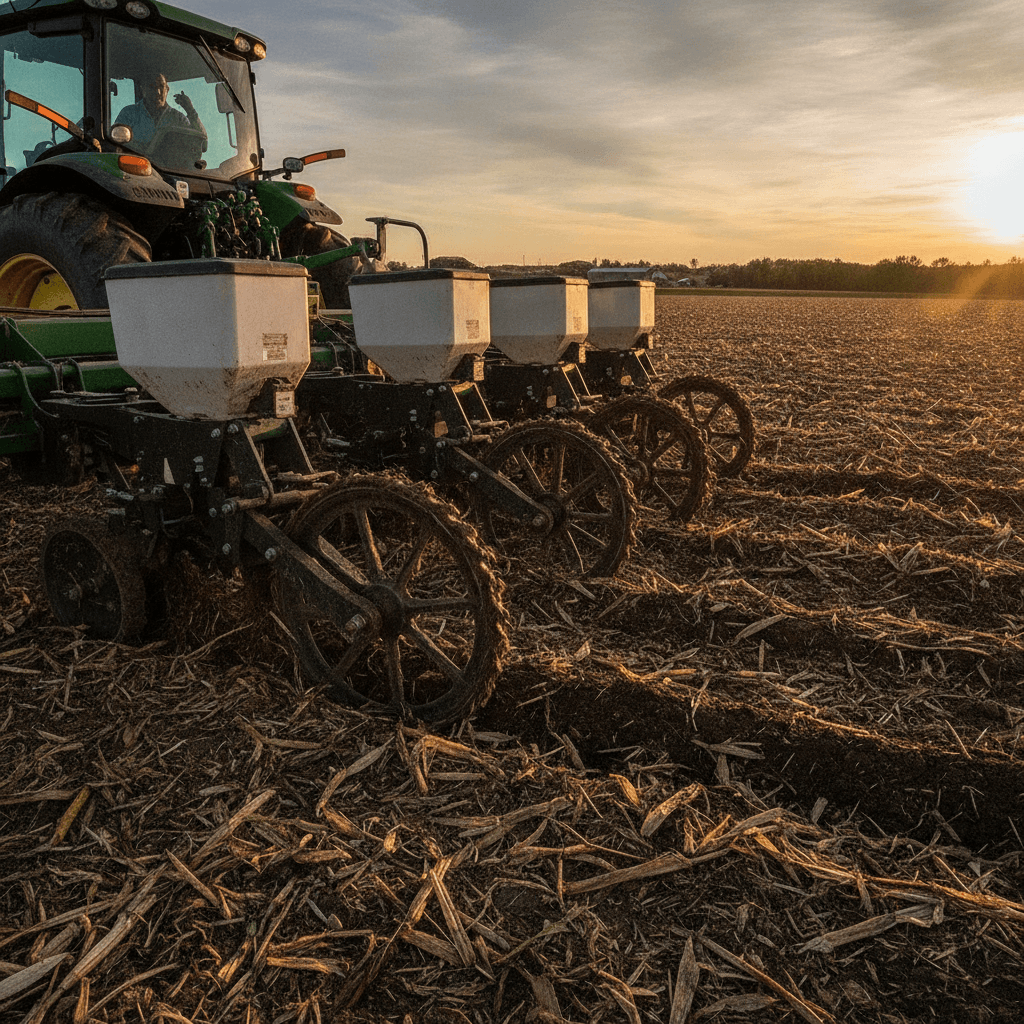
How Do Custom Planters Near Mitchell Know Whether Their Curved Spoked Gauge Wheels Are Actually Cutting Through Wet Residue — Or Just Riding on Top of It?
If you’re custom planting near Mitchell and you’ve had back-to-back wet springs, you already know the problem: your gauge wheels roll into a field with six inches of matted corn stalks and standing moisture, and somewhere between the headland and the first full pass, you stop knowing whether your planter is actually reading the ground — or floating on residue like it’s surfing. The answer matters a lot when you’re getting paid to put corn or soybeans in the ground at a consistent two-inch depth across someone else’s acres.
The issue isn’t always visible from the cab. Gauge wheels riding on residue instead of cutting through to the soil surface can throw your planting depth off by a half-inch or more without triggering an alarm on your monitor. By the time you pull a row unit and check, you’ve already planted thirty acres with variable emergence baked in. That’s the part most gauge wheel marketing doesn’t address directly — and it’s the part that matters most to a custom operator with a tight planting window and a reputation to protect.
What Happens When a Gauge Wheel Rides Residue Instead of Soil
A gauge wheel’s job is simple: run at the soil surface and control how deep the disc opener puts the seed. If the wheel is sitting on compressed residue rather than firm ground, you’re controlling depth off a floating reference point. The opener thinks it’s at two inches. It might be at one and a quarter. Or it might vary row to row depending on residue distribution.
In South Dakota’s corn-on-corn country — especially in the Mitchell and Huron areas where no-till and strip-till acres have grown steadily — this is a real-world problem every spring. Heavy stalks from the previous season don’t break down evenly over winter. You get mats of material that are partially decomposed on top, wet underneath, and dense enough to hold a gauge wheel off the ground on certain rows while adjacent rows cut through cleanly.
A gauge wheel that sheds residue well — one with an open spoke design that pushes material out rather than packing it — is much more likely to find the actual soil surface. A solid or nearly-solid wheel design tends to carry residue with it, build up a ledge of packed material, and progressively lose contact with real ground. The design difference isn’t subtle. It shows up in your stand.
What Open-Spoke Curved Design Actually Does in the Field
Jung Enterprise’s Curved Spoked Gauge Wheels are built around an open-spoke design specifically to address residue shedding in heavy no-till conditions. The curved spoke geometry isn’t cosmetic — it channels residue and mud out and away from the contact zone rather than letting it accumulate between spokes and pack into a plug.
This matters most in the kind of conditions custom planters near Mitchell deal with in a wet April: partially thawed soils, standing water in low spots, and corn residue that’s wet enough to stick to anything that spins slowly. A wheel that can’t shed that material quickly enough starts to lose ground contact, and once it does, your depth control is guesswork.
The field proof isn’t just theory. These gauge wheels have been tested to only 1/16 inch of wear after 13,000 planted acres over three seasons. That’s the kind of durability number that matters to a custom operator who doesn’t want to swap wheels mid-season across multiple farms or show up to a customer’s field with equipment that’s been limping along since the third week of planting.
Why Most Competitor Content Misses This Specific Problem
Here’s something worth noting: if you go looking for detailed guidance on how gauge wheel spoke design affects residue shedding performance in wet conditions specifically, you won’t find much. Most competitor product pages describe gauge wheels in terms of material, width, and compatibility — not how the spoke geometry interacts with wet, matted residue at the soil surface. That’s a real gap, because for a custom planter running no-till acres in eastern South Dakota or southern Minnesota, spoke geometry and residue shedding behavior are often the deciding factor in whether depth control holds up across a full day’s planting.
Knowing your gauge wheel’s material hardness or its hub compatibility doesn’t tell you whether it’s going to stay in contact with the soil when the field conditions go sideways. Custom operators need both — and the residue shedding question deserves a straight answer.
Signs Your Current Gauge Wheels Are Riding Residue, Not Soil
- Uneven emergence within rows: If seeds from the same row are emerging at different times, depth inconsistency is a likely cause — and gauge wheel behavior is one of the first things to check.
- Residue visible between spokes after a pass: If you pull a row unit after a field run and find packed material wedged between the spokes or around the hub, the wheel wasn’t shedding it cleanly.
- Depth variation from row to row: Pull seeds from different row units after planting and measure placement depth. More than a quarter-inch of variation across rows in the same field is a flag.
- Gauge wheel not spinning freely after stops: Packed residue and mud can lock up a wheel between field entries, which means it may not be spinning freely — or at all — for the first few feet of the next pass.
If you’re seeing more than one of these, the gauge wheel design is worth examining before next planting season. Switching out worn or residue-prone wheels before you’re back in the field near Sioux Falls, Huron, or Mitchell is a lot less painful than diagnosing stand problems from the combine six weeks later.
Frequently Asked Questions
Do curved spoked gauge wheels work on both planters and air seeders?
Yes. Jung Enterprise’s curved spoked gauge wheels are compatible with multiple OEM planter and air seeder brands and gauge wheel sizes. If you’re running an air seeder on small grains or cover crop acres in addition to your row crop planter, check compatibility directly with Jung Enterprise to confirm fit for your specific row unit configuration.
How much does gauge wheel spoke design actually affect seed depth in wet residue?
Enough to matter. In wet, heavy residue, a wheel that packs and carries material can lose soil contact by a quarter-inch or more per pass. Over a full planting day, that’s enough depth variation to affect emergence timing and stand uniformity — especially for corn, where uniform emergence is closely tied to yield.
What’s the realistic lifespan of a quality curved spoked gauge wheel in no-till conditions?
Field testing on Jung Enterprise’s gauge wheels shows only 1/16 inch of wear after 13,000 planted acres over three seasons. For most custom operators in the Mitchell or Huron area running 2,000–4,000 acres per season, that’s multiple years of service without replacement — assuming correct installation and normal field conditions.
Can I replace gauge wheels myself, or do I need a dealer?
Gauge wheel replacement is a straightforward shop task for anyone comfortable with basic planter maintenance. Jung Enterprise’s products are designed for practical, field-side installation. That said, if you’re an ag dealer near Mitchell or Sioux Falls and want to stock these for your customers, Jung Enterprise works with dealers and distributors — it’s worth a call to discuss that relationship.
Is there a gauge wheel option that also addresses tire lip wear at the same time?
Yes. Jung Enterprise’s Steel Ring is a separate product that mounts to the gauge wheel tire lip to prevent wear and act as a built-in scraper. If you’re dealing with both residue shedding issues and tire lip wear — which often go together in heavy no-till conditions — running both the curved spoked gauge wheels and the steel ring together gives you a more complete solution than either part alone.
Ready to Sort This Out Before Planting Season?
If you’re a custom planter near Mitchell, or you’re managing your own no-till acres and you’re not confident your gauge wheels are actually finding the soil surface in wet residue, this is worth solving now — not during the second week of May when the planting window is half gone and every hour counts.
Jung Enterprise is based in Ipswich and builds patented, American-made gauge wheel solutions that are field-tested across the Northern Plains. Take a look at the full product lineup or reach out directly to talk through what your setup needs.
Contact Jung Enterprise at (605) 281-0497, email help@jungenterprise.net, or visit the contact page to get started. Don’t wait until you’re in the field to find out your gauge wheels aren’t doing their job.