
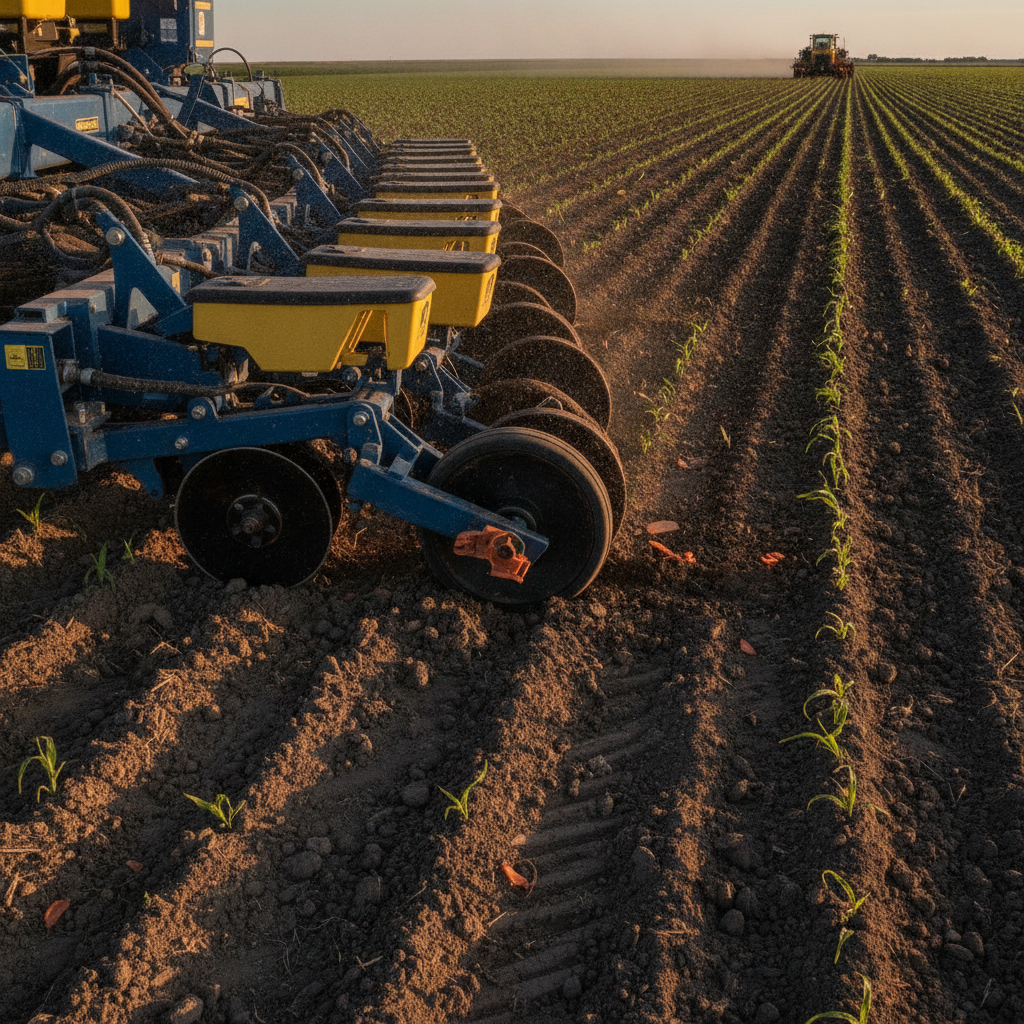
How Do Custom Planters Near Ipswich Know Whether Their Wheel Retainer Is Actually Preventing Mid-Season Gauge Wheel Dislodgement — Or Just Hoping It Never Happens?
If you’re running a custom planting operation near Ipswich, a gauge wheel that pops off mid-field isn’t a minor inconvenience — it’s a full stop in the middle of someone else’s planting window. The honest answer to whether your wheel retainer is doing its job is this: if you haven’t checked it recently, you don’t actually know. Most operators find out the hard way, and usually at the worst possible time. Here’s how to think through it before that happens.
What a Wheel Retainer Actually Does — and Why It Gets Overlooked
The wheel retainer’s job is straightforward: it keeps the gauge wheel seated on the planter row unit hub so it doesn’t dislodge during field operation. That sounds simple, but the forces working against it aren’t. Every time you hit a field entry at speed, cross a waterway, drop off a terrace, or pull through heavy residue in no-till corn ground, that gauge wheel takes a sideways jolt. Without a properly functioning retainer, that’s all it takes.
The reason this part gets overlooked is that it doesn’t wear out the same way a tire or a bearing does. There’s no visible tread to eyeball, no grinding noise to tip you off. A retainer either holds or it doesn’t — and if it fails, it usually does so fast and without warning. For custom planters running long days across multiple farms between Aberdeen and Huron, that’s a problem. You’re not running your own equipment on your own schedule. You’re on someone else’s clock.
The Failure Mode Most Operators Don’t Consider Until It Happens
Gauge wheel dislodgement during a planting run isn’t rare — it’s just rarely talked about in product literature. Most competitor content focuses on depth control, mud shedding, and tire wear. What’s largely missing from that conversation is what happens when the retainer itself is the weak link.
When a gauge wheel comes off mid-row, a few things happen in quick succession. The row unit loses its depth reference entirely. You’re now dragging hardware that can damage the disc opener or the seed tube. Depending on your speed and soil conditions, you may also tear up the seedbed in that row before the operator even notices. By the time you’re stopped, inspected, and back in the field, you’ve lost time you can’t get back — and potentially planted a strip of bad seed placement that won’t show up until emergence.
For custom planters who invoice by the acre, that downtime doesn’t just cost yield. It costs your reputation with the customer you’re working for that day.
What to Actually Check Before the Season Starts
A wheel retainer inspection isn’t complicated, but it needs to be deliberate. Here’s what to look at during your pre-season walkdown:
- Fit and seating: The retainer should hold the gauge wheel hub snugly against the row unit arm. If you can move the wheel laterally by hand with any real force, the retainer isn’t doing its job.
- Visible wear or deformation: Look for any cracking, bending, or spreading of the retainer clip or ring. These parts can deform slowly over a full season and still look functional until they’re not.
- Corrosion or rust buildup: Especially relevant after a wet South Dakota spring. Rust in the contact area can prevent the retainer from seating fully even when it looks fine from a distance.
- Compatibility with your current gauge wheel: If you’ve swapped gauge wheels mid-season or between seasons without replacing the retainer, it may not be the right fit for what’s running now. Don’t assume it crosses over without confirming.
If anything looks marginal, replace it before the first acre. The cost of a wheel retainer is a fraction of the cost of a field breakdown, and significantly less than the cost of a damaged disc opener or a customer conversation about a replant.
Why Custom Planting Operations Need a Higher Standard Than Owner-Operators
A farmer running his own planter on his own ground has some flexibility. If something goes wrong, he can pull back to the shop, fix it, and get back out before dark. A custom planter doesn’t have that margin. You’re often running from one customer’s farm to the next with no buffer between jobs, sometimes crossing county lines between Aberdeen and Fargo territory in the same week during peak planting. Every row unit on every planter needs to be right before you leave the yard.
That’s the practical case for not treating the wheel retainer as an afterthought. It’s a small part with outsized consequences when it fails — exactly the kind of thing that deserves its own line on your pre-season checklist, not just a visual pass during a general inspection.
Jung Enterprise’s Wheel Retainer is built to address this directly — designed to keep the gauge wheel securely in place across the full range of field conditions, including the rough entries, the uneven terrain, and the heavy residue situations that put the most stress on this connection point. It installs clean and is built to stay put through a full season of custom planting work.
What Competitors Don’t Tell You About Wheel Retainer Selection
Browse through most competitor product pages — Yetter, Schaffert, Copperhead Ag, and others — and you’ll find solid coverage of depth control, mud shedding, and tire protection. What you won’t find is much practical guidance on the wheel retainer as a standalone maintenance point. It tends to show up as a bundled accessory or a brief mention in compatibility notes, not as a component that deserves its own inspection protocol and replacement schedule.
That’s a gap worth filling, because for custom planters running high daily acre loads across Northern Plains conditions — gumbo clay, heavy spring moisture, rough field access — the retainer is under more stress than on a lighter-use operation. It deserves more attention than a footnote.
If you’re buying replacement gauge wheels or other planter components, ask specifically about the retainer that goes with them. Confirm it’s sized right for your row unit and your gauge wheel diameter. And replace it on the same cycle as your other wear parts, not just when something goes wrong.
FAQ: Wheel Retainers for Custom Planters Near Ipswich
How often should a wheel retainer be replaced on a high-acre custom planting rig?
There’s no fixed mileage equivalent, but most operators running 5,000 or more planted acres per season should inspect retainers carefully at the end of every season and replace any that show deformation, corrosion, or loose fit. Don’t carry a marginal retainer into a new planting year.
Can a wheel retainer from one gauge wheel brand work with another manufacturer’s gauge wheel?
Not always. Fit is specific to hub diameter and row unit arm geometry. If you’ve swapped gauge wheel brands or sizes, confirm the retainer is matched to the new setup. Assuming crossover compatibility is one of the more common sources of mid-season problems.
What’s the actual risk if I run a season with a worn retainer and the wheel doesn’t come off?
The wheel staying on doesn’t mean the retainer is working correctly — it may just mean you got lucky with field conditions. A worn retainer that stays on in dry ground may fail in a rough, wet field entry. The risk isn’t constant; it spikes exactly when you can least afford it.
Does Jung Enterprise’s Wheel Retainer fit multiple planter brands and row unit sizes?
Yes. The Jung Enterprise Wheel Retainer is designed for compatibility across multiple OEM brands and gauge wheel sizes used on common planters, air seeders, and no-till drills. Contact Jung Enterprise directly to confirm fitment for your specific setup before ordering.
Is this a part I should stock spares of during planting season?
Absolutely. For custom planters especially, carrying a few spare retainers on the tender is inexpensive insurance. If one fails mid-run, you want to be back in the field in minutes, not waiting on a parts run to the nearest dealer in Ipswich or Aberdeen.
Talk to Jung Enterprise Before Planting Season Starts
If you’re running a custom planting operation in South Dakota, North Dakota, or Minnesota and you want to know whether your wheel retainers are actually up to the job, reach out to Jung Enterprise directly. We’re based in Ipswich and we work with custom planters, row-crop farmers, and ag dealers who need field-proven parts they can count on — not parts that look fine until they don’t.
Contact Jung Enterprise here to ask about the Wheel Retainer, confirm compatibility with your equipment, or get set up with the right parts before planting season puts everything to the test.