
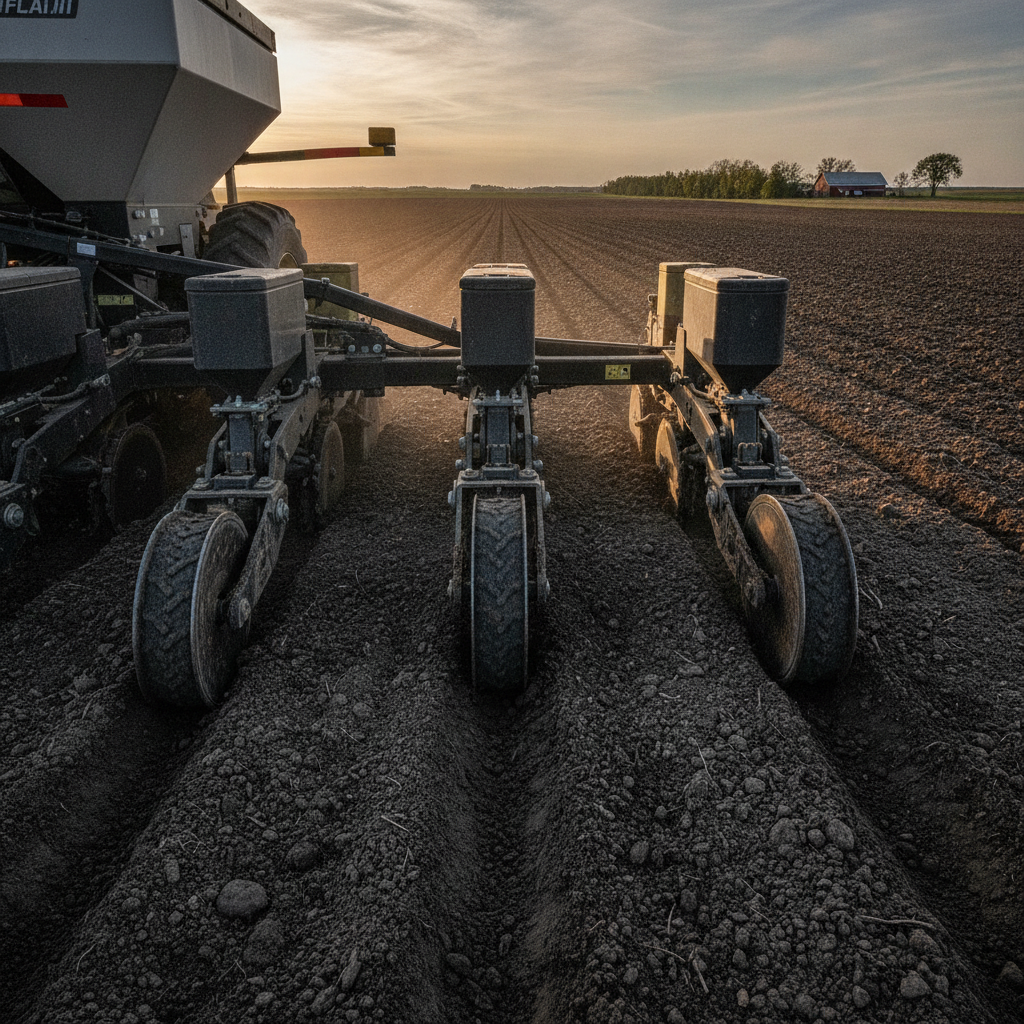
How Do Corn and Soybean Farmers Near Fargo Know Whether Their Planter’s Gauge Wheel Is Actually Maintaining Consistent Seed Furrow Closure — Or Just Riding Over the Top While Seed-to-Soil Contact Suffers?
If you’re farming near Fargo and your planter’s gauge wheels are caked with wet clay by the second pass, they’re not doing what they should. A gauge wheel that’s packed solid isn’t controlling depth — it’s floating. And when it’s floating, the furrow your disc opener just cut can bridge over or collapse unevenly before the seed ever touches firm soil. You can set your planting depth exactly right at the start of the day and still pull stand counts that don’t match your population numbers, all because the gauge wheel stopped doing its job three fields back.
This is a real problem across the Red River Valley and the Northern Plains, and it’s not fixed by adjusting down-pressure alone.
The Gap Between Depth Setting and Actual Seed Placement
Farmers spend real time dialing in planting depth — 1.5 inches for early-season corn, maybe 2 inches in drier soils to chase moisture. But that setting only holds as long as the gauge wheel is rolling clean and making consistent contact with the soil surface beside the furrow.
When a gauge wheel loads up with wet, sticky North Dakota clay — the kind that builds up fast in saturated Red River basin soils or the heavier ground west toward the Drift Prairie — a few things start to happen. The effective diameter of the wheel increases as mud packs into the spokes or around the tire. That pushes the disc opener shallower than your setting. Seed lands above where you want it. Or worse, the furrow stays open longer than it should because the gauge wheel can’t maintain sidewall pressure, and you get air pockets around the seed instead of firm soil contact.
Neither situation is obvious at the time. You find out at emergence — or you don’t find out until yield monitor data tells a story at harvest that you can’t do anything about.
What Gauge Wheel Spoke Design Has to Do With It
This is where spoke geometry actually matters, not just as a spec sheet talking point but as a function that changes what happens inside the furrow.
A solid or close-spoked gauge wheel gives mud somewhere to pack. Once it starts building, it doesn’t shed — it compounds. By the time you notice, the wheel is running like a small drum with an inch of clay bonded to it.
An open-spoke curved design solves this differently. The curved spokes create a self-cleaning action as the wheel rotates — soil that enters the spoke openings gets pushed back out rather than packing in. In wet Fargo-area conditions, that difference between a wheel that cleans itself and one that doesn’t can be the difference between consistent 1.75-inch depth across 400 acres and a depth that wanders from pass to pass without anyone catching it until it’s too late.
Jung Enterprise’s Curved Spoked Gauge Wheels are built specifically around this principle — an open-spoke geometry engineered to shed wet clay and maintain furrow contact through the kind of spring conditions that are common from Fargo south through the Corn Belt. Field-tested across 13,000 planted acres over three years, with only 1/16″ of wear measured over that span. That’s not a marketing number — that’s what actually came off the wheel when someone checked.
Furrow Closure Isn’t Just a Closing Wheel Problem
It’s easy to point at the closing wheel when stand establishment goes wrong, and sometimes that’s the right diagnosis. But furrow closure starts with the gauge wheel. If the sidewall of the furrow is ragged — torn by a wobbling or mud-loaded gauge wheel instead of cleanly cut — the closing wheel is working harder than it should to firm up an already compromised seed trench.
Clean furrow walls start with a gauge wheel that’s running true, holding depth, and pressing the soil sidewall consistently. When that’s working right, the seed drops into a uniform slot, and the closing wheel has a clean job to do. When the gauge wheel is packed out or worn to the point where it’s floating rather than rolling with real contact, every pass downstream gets worse.
In no-till conditions near Fargo — where you’re also dealing with heavy surface residue from corn stalks or soybean stubble — a gauge wheel that isn’t shedding debris cleanly is a double problem. It’s not just mud; it’s mat buildup that affects both depth control and furrow quality.
How to Check Your Own Gauge Wheels Before Planting
You don’t need a lot of tools to know whether your gauge wheels are ready for a Fargo-area spring planting run. Here’s what to actually look at:
- Spin each wheel by hand. It should spin freely with no binding or grinding. Any roughness is a bearing issue — not a maybe, a confirmed problem to fix before the season.
- Look at the spoke openings. If last season’s clay is still packed in there, that tells you something about how the wheel cleans in the field. It may not shed in heavy soil as well as you’d expect.
- Check tire condition around the lip. If the tire lip is deformed, chipped, or the sidewall is visibly worn at the contact edge, depth control is already compromised before you turn a wheel.
- Measure spoke wear. If your wheels have been running for multiple seasons across heavy ground, measure the spoke thickness. Thin spokes flex instead of holding the rigid contact needed for consistent depth.
- Confirm the wheel retainer is seated and secure. A gauge wheel that shifts laterally mid-run because the retainer has worked loose will show up as erratic depth — not obvious until you dig to check.
FAQs: Gauge Wheel Furrow Closure for Fargo-Area Farmers
How do I know if my gauge wheel is causing inconsistent seed depth — not my down-pressure setting?
Dig to check actual seed placement in multiple spots across the field, not just at the start of the run. If your measured depth varies more than a quarter inch from row to row or between early passes and later passes, and your down-pressure hasn’t changed, the gauge wheel is a likely culprit — especially if it’s loading with mud.
Does spoke design really make a difference in heavy North Dakota clay soils?
Yes. Open curved spokes allow soil to exit the wheel as it rotates rather than packing in and building up. In heavy Red River basin clay or the sticky gumbo conditions common across North Dakota and into western Minnesota, this is a functional difference — not cosmetic.
Can a worn gauge wheel affect my final stand count even if depth looks okay at setup?
Absolutely. A worn wheel may set correct depth at the start and drift as soil conditions change mid-field. Worn spokes also reduce the sidewall contact that keeps the furrow cleanly formed. Poor furrow walls lead to uneven seed-to-soil contact, which shows up as irregular emergence and uneven stand spacing.
How long should a quality gauge wheel last in Northern Plains planting conditions?
That depends entirely on design and material. A field-tested steel gauge wheel built for durability — like the ones from Jung Enterprise — has shown only 1/16″ of wear across 13,000 acres over three seasons. A lower-quality wheel in the same conditions may need replacement after a single heavy-use season.
Do Jung Enterprise gauge wheels fit the planter brands commonly running near Fargo?
Jung Enterprise’s Curved Spoked Gauge Wheels are compatible across multiple OEM brands and gauge wheel sizes. Contact Jung Enterprise directly to confirm fitment for your specific planter or air seeder model before ordering.
Get Your Gauge Wheels Ready Before Spring Hits
Farmers near Fargo — and across North Dakota, South Dakota, and into western Minnesota — don’t have room in the planting window for equipment problems that could have been caught in the shop in February. If your gauge wheels are running out of spec, you’ll lose yield before you ever know there was a problem.
Jung Enterprise, based in Ipswich, South Dakota, manufactures patented, American-made gauge wheels, steel rings, and wheel retainers built for the conditions row-crop farmers actually deal with across the Northern Plains. If you want to know whether the right parts are in stock for your planter setup — or you want to talk through what your gauge wheels need before the season starts — reach out to Jung Enterprise directly. We’ll give you a straight answer, not a sales pitch.