
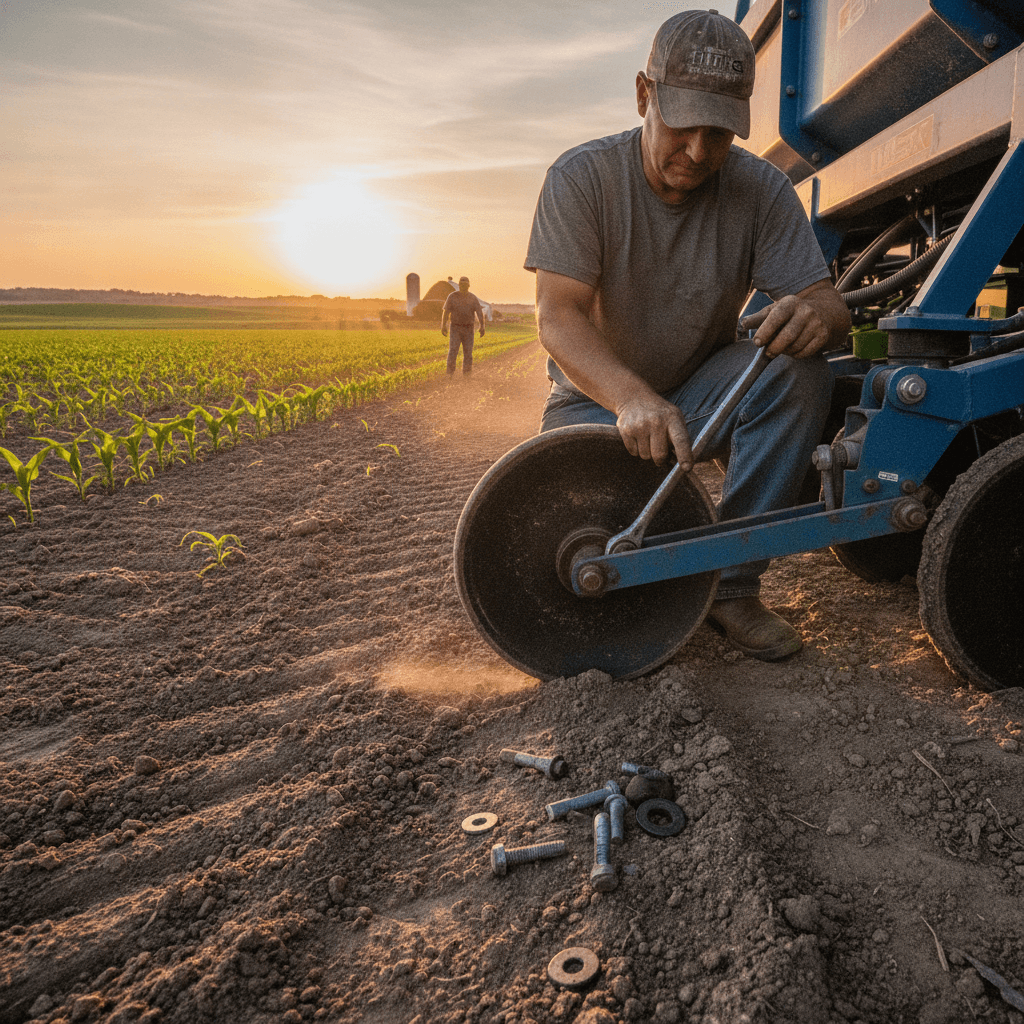
How Do Farmers Near Aberdeen Know If Their Planter’s Gauge Wheel Axle Bolts Are Actually Tight — And Why Loose Hardware Kills Depth Consistency
If you’re farming near Aberdeen and you’ve ever pulled up a row at the end of a field and noticed seeds all over the depth map — some at 1.5 inches, some at 2.5 inches — loose gauge wheel hardware is one of the first things worth checking. It’s not glamorous, it doesn’t sell parts, and you won’t find a lot written about it. But loose axle bolts on gauge wheels are one of the most common and most ignored sources of inconsistent planting depth in corn and soybean planters, and they tend to get worse the harder you run.
Why Gauge Wheel Hardware Gets Overlooked During Pre-Season Prep
Most planter pre-season checklists focus on the obvious stuff — disk blades, seed meters, row cleaners, closing wheels. Hardware torque doesn’t make the list until something actually falls off or starts wobbling. By then, you’ve already planted who knows how many acres with a gauge wheel that was rocking side to side by a quarter inch every time it rolled.
A gauge wheel’s whole job is to ride next to the opener disk and physically control how deep that disk cuts into the soil. If the wheel has any lateral play — any slop in the axle mount — it’s not doing that job consistently. The disk wanders in depth, and your seed placement wanders with it. That’s a yield problem you won’t connect to axle bolt torque when you’re walking beans in July wondering why emergence is uneven in certain rows.
In heavy soils around Aberdeen and across northeastern South Dakota, this gets worse. Wet clay exerts sideways pressure on gauge wheels that loose hardware can’t resist. The wheel deflects, the disk follows, and you’re planting shallower or deeper than your setting. Over a 200-acre corn field, that matters.
What to Actually Check — And When
Before the planter rolls out in the spring, go through every gauge wheel mount with a torque wrench. Don’t just hand-tighten and move on. Most planter manufacturers spec axle bolt torque somewhere in the 35–55 ft-lb range depending on the row unit design, but check your OEM manual for the specific value on your planter model. Bolts that have been run for a few thousand acres stretch slightly and lose clamping force even if they haven’t visibly loosened.
Also check for these things while you have the row units on the stand:
- Lateral play in the gauge wheel: Grab the wheel and push it side to side. You should feel no slop — even a small amount means the axle isn’t clamped tight or the bore has worn.
- Bearing feel: Spin the wheel by hand. It should spin freely without grinding or catching. Rough bearings let the wheel bounce instead of roll, which translates directly to depth variation.
- Gauge wheel seating on the axle: On some designs, the wheel can walk slightly off center on the axle over time. This affects how the wheel rides against the disk and changes your effective depth control.
- Retainer condition: If you’re running a wheel retainer, make sure it’s seated and doing its job. A retainer that’s loose or missing doesn’t just create a safety risk — it allows the gauge wheel to shift under load, which undermines everything you just torqued correctly.
The Retainer Connection — A Gap Most Competitors Don’t Address
Here’s something you don’t see discussed much across the industry: the interaction between gauge wheel axle hardware and wheel retainers. Most of the major planter parts suppliers talk about retainers as a safety part — prevents the wheel from flying off, keeps everything together. That’s true. But a properly installed retainer also adds lateral stability to the gauge wheel assembly during operation.
When the wheel retainer is tight and correctly positioned, it constrains the wheel against the axle in a way that complements the axle bolt torque. When it’s missing, worn, or installed wrong, the wheel has more freedom to shift laterally under load — especially in side-hill conditions or when the planter is making a headland turn under power. Near Watertown and across the glacial till soils of northeastern South Dakota, you run into undulations and drainage swales that put real lateral stress on row unit hardware. A retainer that’s just phoned in doesn’t hold up to that.
Jung Enterprise’s Wheel Retainer is designed specifically to keep the gauge wheel secured against dislodging and lateral shift during operation — not just as a backup in case the axle bolt fails, but as an active part of the depth control system. It’s straightforward to install, and it’s one less variable contributing to depth inconsistency across a long planting day.
How Gauge Wheel Condition Compounds the Hardware Problem
A gauge wheel that’s worn, out of round, or plugged with mud makes tight axle hardware less effective. If the wheel surface is uneven, it doesn’t maintain consistent contact pressure against the disk. You can have perfectly torqued bolts and still get depth variation because the wheel itself is the weak link.
This is where open-spoke gauge wheel designs earn their keep in spring conditions. A solid-face or nearly-solid gauge wheel traps mud in the contact zone between the wheel and the disk opener. Once mud packs in there, that wheel is no longer running true — it’s riding on a variable-thickness layer of soil, and depth goes out the window. Open curved-spoke designs shed that material as the wheel rotates, keeping the contact surface clean and consistent pass after pass.
Jung Enterprise’s Curved Spoked Gauge Wheels are built around this principle. The open-spoke geometry sheds mud instead of packing it, which is exactly what you need when you’re running through the wet, heavy soils that come with a South Dakota spring. Field testing has shown only 1/16″ of wear after 13,000 planted acres over three years — meaning the wheel stays true to its diameter far longer than most farmers expect, which directly supports consistent depth control all season.
A Pre-Season Hardware Checklist Worth Keeping in the Shop
- Torque all gauge wheel axle bolts to OEM spec before first use each year
- Re-check torque after the first 200–300 acres of the season — new hardware seats slightly and can loosen
- Inspect lateral play at every gauge wheel by hand before each planting day in wet conditions
- Check that wheel retainers are present, properly seated, and undamaged
- Inspect gauge wheel face and spoke condition for wear, cracking, or buildup
- Replace any wheel that shows visible out-of-round wear, chunking, or bore elongation
None of this is complicated. It’s just the kind of thing that gets skipped when you’re trying to get the planter out the door before a three-day weather window closes — which is exactly when it bites you.
FAQ: Gauge Wheel Hardware and Depth Consistency Near Aberdeen
How often should I re-torque gauge wheel axle bolts during the season?
At minimum, check after the first 200–300 acres of each season. Hardware seated on new or reconditioned components tends to relax slightly. If you’re running back-to-back planting days in tough conditions, a quick check mid-season is cheap insurance compared to diagnosing uneven emergence after the fact.
Can a worn gauge wheel cause depth problems even if the hardware is tight?
Yes. An out-of-round or worn wheel changes the effective running diameter unevenly. That variation translates directly to seed depth variation. Tight hardware keeps a worn wheel from wobbling laterally, but it can’t correct the diameter inconsistency. If the wheel is visibly worn or out of round, replace it.
Does the type of soil near Aberdeen affect how fast axle hardware loosens?
Heavy clay and gumbo soils create more lateral resistance on gauge wheels, which puts more stress on axle hardware than lighter soils. If you’re running in wet conditions across northeastern South Dakota, plan on checking hardware more frequently than you would in sandier ground further south or west.
Do wheel retainers really affect depth consistency, or are they just a safety feature?
Both. They prevent dislodging, which is the obvious benefit. But a properly installed retainer also reduces lateral movement in the gauge wheel assembly during operation, which directly supports depth consistency. Think of it as a second layer of constraint working alongside your axle bolt torque.
Are Jung Enterprise gauge wheels compatible with my existing planter?
Jung Enterprise’s Curved Spoked Gauge Wheels are designed to fit planters, air seeders, and no-till drills across multiple OEM brands and gauge wheel sizes. Check the product page or contact the shop directly to confirm fitment for your specific row unit setup before ordering.
Ready to Tighten Up Your Planter Before the Season Starts?
Jung Enterprise is a family-owned manufacturer based in Ipswich, South Dakota, building patented gauge wheels, steel rings, and wheel retainers for farmers and dealers across the Northern Plains — South Dakota, North Dakota, Minnesota, and beyond. If you’re near Aberdeen and want to make sure your planter is set up to hold depth from the first pass to the last, we’re worth a conversation.
Browse our full lineup at jungenterprise.net/our-products or reach out directly through our contact page. We’re happy to talk through fitment, installation questions, or what makes sense for your operation before you spend money on parts that don’t solve the actual problem.