
How Do Corn and Soybean Farmers Near Aberdeen Know Whether Their Planter’s Gauge Wheel Bearings Are Actually Failing — Or Just Assuming a Little Wobble Is Normal?
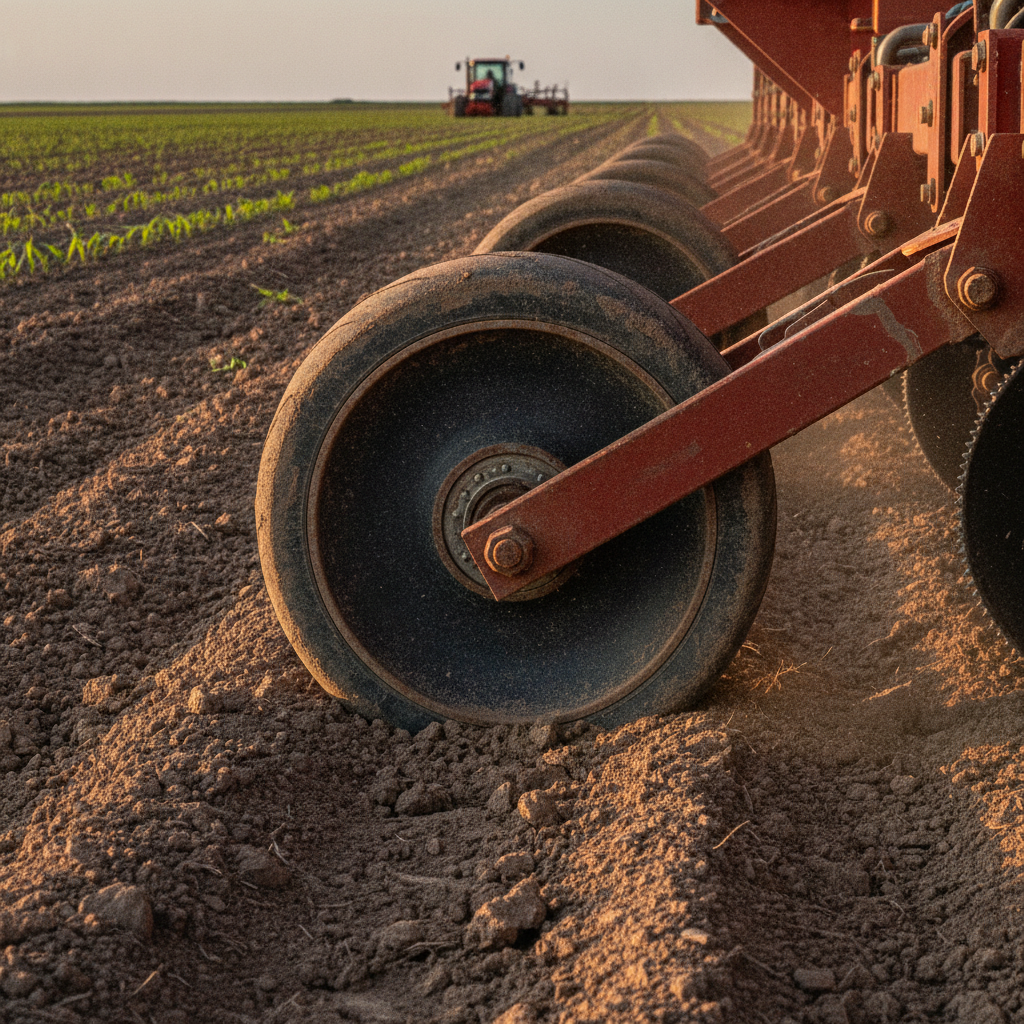
If your gauge wheel has any lateral play when you grab it and shake it side to side, that’s not normal — and it’s not something you should plant through. Farmers near Aberdeen deal with some of the heaviest, wettest spring soils in South Dakota, and a bearing that’s even halfway gone will let your gauge wheel float off its intended running plane, throwing off seed depth across every row it controls. By the time you notice the depth inconsistency in the stand, you’ve already planted hundreds of acres with a part that wasn’t doing its job.
What a Failing Gauge Wheel Bearing Actually Looks and Feels Like
Bearing failure on a gauge wheel doesn’t always announce itself loudly. Most of the time it shows up as one or more of these:
- Lateral wobble: Grab the wheel at the 3 and 9 o’clock positions and push side to side. Any movement — even a little — means the bearing is worn. A healthy bearing should feel locked solid.
- Rough rotation: Spin the wheel by hand with the row unit lifted. It should roll smooth and quiet. Grinding, clicking, or resistance that comes and goes points to a bearing that’s pitted or seized internally.
- Uneven tire wear on the gauge wheel: If one edge of the tire is wearing faster than the other, the wheel is running tilted. That tilt usually traces back to a failed bearing letting the axle shift under load.
- Visible rust or contamination at the hub: Northern Plains springs mean standing water and mud pushed into every gap on your planter. Bearings that weren’t sealed properly — or sealed bearings that have cracked — will rust out fast in those conditions.
The tricky part is that a bearing can feel fine in the shop, then start acting up under field load. You put the row unit down into heavy clay northeast of Aberdeen, the frame flexes, side forces spike, and a bearing that was borderline gives out entirely. If you’re on the fence, replace it before the season starts — not after the third row unit goes down in the same field.
Why This Matters More in Heavy Soils
Aberdeen-area soils — clay-heavy, slow to drain, prone to crusting — put more side load on a gauge wheel than lighter sandy soils do. When the wheel is running through wet clay that wants to push back, every bit of slop in the bearing translates directly into seed depth variation. You might be targeting 2 inches and getting anywhere from 1.5 to 2.75 inches row to row. That’s a germination timing problem, and in corn it’s a yield problem before the crop even emerges.
This is also why the gauge wheel itself matters, not just the bearing. Even a fresh bearing mounted in a worn or geometrically compromised gauge wheel won’t hold consistent depth. If the wheel is cracked, the spokes are packed with dried mud, or the spoke geometry was never right to begin with, you’re fighting a depth control problem that a bearing swap alone won’t fix.
When to Replace the Bearing vs. the Whole Gauge Wheel
This is where most operators make the wrong call. Replacing just the bearing makes sense when the wheel itself is in good shape — straight, no cracks, spokes clean and intact, tire holding pressure. But if the wheel has accumulated wear or the spoke geometry is compromised, you’re putting a new bearing into a part that’s already compromising your planting accuracy. At that point, you’re better off replacing the whole assembly.
Jung Enterprise’s curved spoked gauge wheels are built with an open-spoke design that actively sheds mud rather than packing it in — which matters a lot when you’re running through the wet clay conditions common from Aberdeen south through the James River corridor. The curved spoke geometry isn’t just marketing language; it changes how the wheel interacts with sticky soil so it doesn’t build up a mud ball that throws off running depth.
These wheels have been field-tested to show only 1/16″ of wear after 13,000 planted acres over three years. That’s the kind of service life that makes the math work — fewer mid-season replacements, less downtime, and consistent depth from the first pass to the last.
Pre-Season Bearing Check: What to Do Right Now
If you’re reading this between harvest and next spring’s planting window, now is the right time to pull every row unit and do a quick bearing check. It takes less than a minute per unit if you know what you’re looking for:
- Lift the row unit and grab each gauge wheel — both hands, side to side, then in and out. Any play is a fail.
- Spin the wheel by hand and listen. Smooth and quiet is passing. Anything else is a flag.
- Look at the hub and axle area for rust streaks, cracked seals, or mud intrusion. If you see it, the bearing is compromised even if it spins okay right now.
- Check the tire while you’re there — a tire that’s lost significant air over the off-season may have a slow leak that’s been riding all year, which throws off depth even with a perfect bearing.
Farmers near Ipswich and across the Northern Plains who do this check in October or November can order parts, have them in hand, and do the work at their own pace. The farmers who skip it are the ones making phone calls at 9 PM the night before planting because something fell apart on the first pass.
Frequently Asked Questions
How much lateral wobble in a gauge wheel bearing is too much?
Any measurable lateral movement is too much. A properly functioning bearing should feel completely rigid when you push side to side. Even a small amount of play will get worse under field loads, and it’s already affecting depth control if you can feel it in the shop.
Can I keep planting if only one or two bearings are bad?
Technically you can, but you’re accepting variable seed depth on those rows for the entire planting season. In corn, uneven emergence across rows translates directly to yield loss. The cost of a bearing — or a full gauge wheel assembly — is a fraction of what uneven plant populations cost you at harvest.
Do Jung Enterprise’s curved spoked gauge wheels use a standard bearing that I can replace locally?
Contact Jung Enterprise directly at jungenterprise.net/contact-us or call (605) 281-0497 to get specifics on bearing compatibility and replacement parts for your setup.
Why do gauge wheel bearings fail faster in wet springs?
Water intrusion is the primary culprit. When you’re running through saturated clay — like what you’ll find in a wet April around Aberdeen — mud and water get forced into every gap under field pressure. Bearings that aren’t properly sealed, or sealed bearings that have any crack in the seal from age or impact, will take on water, rust internally, and pit out faster than they would in drier conditions.
Is it worth upgrading the gauge wheel at the same time I replace the bearing?
If your current gauge wheels have more than a couple of seasons on them, or if you’ve been fighting depth inconsistency that you couldn’t pin down, yes. Putting a new bearing in a worn or geometrically compromised wheel doesn’t solve the underlying problem. If you’re pulling the assembly apart anyway, it’s a good time to evaluate whether the wheel itself is part of what’s been holding back your stand uniformity.
Get the Right Parts Before Planting Season
Jung Enterprise is based in Ipswich and builds patented gauge wheels, steel rings, and wheel retainers specifically for the kind of conditions farmers across South Dakota and the Northern Plains deal with every spring. If you’re not sure whether your gauge wheel setup is contributing to depth problems — or you just want to know what your options are before next season — reach out directly.
Contact the team at jungenterprise.net/contact-us or call (605) 281-0497. Don’t wait until April to find out what your planter actually needs.