
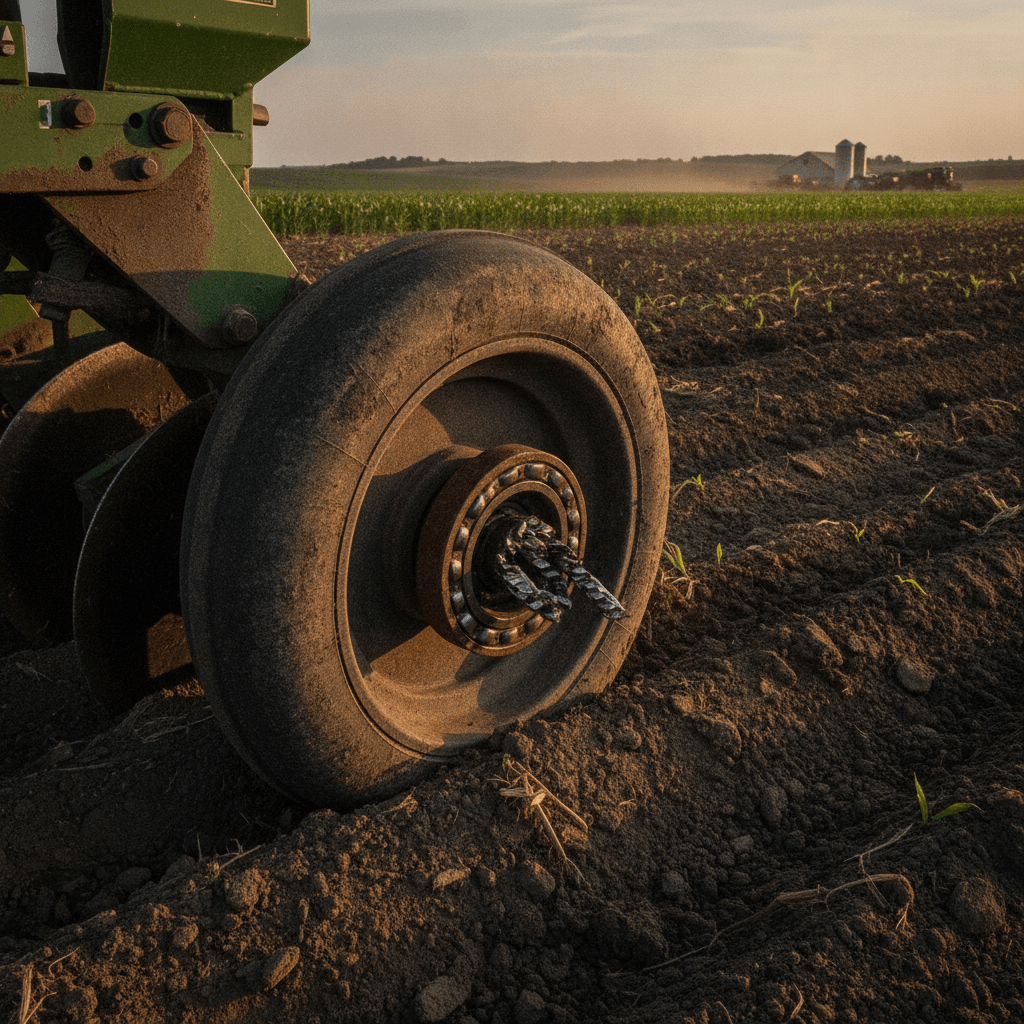
What Happens to Your Planting Depth When Gauge Wheel Bearings Wear Out Near Watertown?
When gauge wheel bearings start to go, your planting depth goes with them — and most of the time you won’t notice until you’re already two hundred acres in. For farmers near Watertown and across eastern South Dakota, this is one of the most common and most quietly expensive planter problems of the spring season. A failing bearing lets the gauge wheel wobble on the shank, and that wobble translates directly into inconsistent seed depth. You might be targeting two inches and getting anything from one and a quarter to two and three quarters — row by row, pass by pass. That kind of variability kills your stand uniformity before the seed even germinates.
Why Bearing Wear Is a Planting Depth Problem, Not Just a Mechanical One
Most conversations about planting depth focus on disc blades, closing wheels, and downforce settings. Bearings don’t get nearly enough attention — and that’s a gap we’ve noticed across a lot of the industry content out there. Here’s the basic mechanics of what happens:
Your gauge wheel runs alongside the disc opener and physically controls how deep that disc cuts into the soil. The wheel rides the surface, the disc cuts beneath it, and the depth is determined by the difference between the two. When the bearing holding the gauge wheel to the arm wears out, the wheel develops lateral play. It can shift inward or outward slightly with every revolution. That movement, even if it’s only a quarter inch of wobble, translates into the disc cutting at inconsistent depths across the row.
In dry conditions this causes uneven emergence. In the wet, heavy soils that eastern South Dakota and the area around Watertown regularly deal with in May, it’s worse — the wheel is already fighting mud and debris, and a loose bearing means even less control over where that seed ends up.
How to Tell If Your Bearings Are the Problem
You don’t need a torque wrench to diagnose a worn gauge wheel bearing. With the planter unhitched and the row unit lifted off the ground, grab the gauge wheel and try to move it side to side. There should be no perceptible play. If you can rock it even a small amount, the bearing is worn. You can also spin it by hand — a worn or contaminated bearing will feel rough, catch, or grind. A good bearing spins smoothly and quietly.
Other signs to watch for in the field:
- Uneven emergence across rows that otherwise have the same downforce and disc settings
- Visible wobble on the gauge wheel when running at field speed
- Noise — a grinding or clicking sound coming from the row unit
- The gauge wheel sitting visibly tilted when the row unit is at rest
If you’re running a planter monitor with individual row sensors, inconsistent depth data from a specific row is another strong indicator. But don’t rely on technology alone — physically checking each gauge wheel before the season starts takes fifteen minutes and can save you a full day of downtime during planting.
The Connection Between Bearing Longevity and Gauge Wheel Design
Not all gauge wheels put the same stress on their bearings. A heavy, solid wheel that’s also prone to packing mud adds rotational weight and drag — both of which accelerate bearing wear. An open-spoke design that actively sheds mud reduces the load the bearing has to carry, especially in the clay-heavy soils common between Watertown and Aberdeen.
That’s one of the practical advantages of a curved-spoked gauge wheel built for these conditions. The open spoke design keeps the wheel from loading up with mud, which means less resistance, less lateral force on the bearing, and a longer service life for the whole assembly. It also keeps depth control more consistent because you’re not fighting the added weight of a caked-up solid wheel pushing the disc deeper than intended.
What Replacement Actually Looks Like — Time and Cost
Replacing a gauge wheel bearing on a row unit is typically a straightforward job if you have the right parts on hand. The problem most farmers run into isn’t the labor — it’s having to stop planting and wait for parts to arrive. If you’re planting corn near Watertown in early May and your window is eight to ten days before the forecast turns wet again, a two-day parts delay is a real yield and revenue hit.
The practical answer is to check your bearings before the season, not during it. Order any questionable ones in February or March when you have lead time and the suppliers aren’t buried in emergency orders. If you’re replacing the bearing anyway, it’s also the right time to look hard at the condition of the gauge wheel itself — a worn or cracked wheel that you put a new bearing into will fail again faster because the seating surface is compromised.
For farmers running multiple planters or operating a custom planting service out of the Watertown or Huron area, this pre-season check is even more critical. You don’t have the luxury of pulling a row unit off the field when you’re on a customer’s schedule.
What the Competitors Miss on This Topic
Most manufacturer and competitor content focuses on gauge wheel selection — which style, what material, what brand. Very little of it connects gauge wheel design decisions back to bearing stress and longevity. That’s a real gap, because the two are directly related. A wheel that packs mud is harder on its bearing. A wheel that wobbles because the bearing is worn produces bad depth data regardless of how good your planting monitor is. These things work together, and they fail together.
At Jung Enterprise in Ipswich, we built our curved-spoked gauge wheels with this in mind. They’ve been field-tested across 13,000 planted acres over three years and showed only 1/16″ of wear — that’s not just a durability number, it also means consistent geometry and consistent bearing loading over the life of the wheel. Consistent geometry is what keeps your depth consistent from the first acre to the last. You can learn more about how these wheels are built on our products page.
Frequently Asked Questions
How often should gauge wheel bearings be replaced on a row crop planter?
There’s no fixed mileage number, but most bearings in high-use conditions — heavy clay soils, wet springs, no-till residue — start showing wear after two to four seasons. Check them physically every year before planting. If there’s any side-to-side play, replace them before you go to the field.
Can a worn bearing cause depth problems even if the gauge wheel looks fine?
Yes. The wheel can look intact but still wobble on its axle if the bearing race is worn or the bearing is contaminated. Always check the bearing independently of the wheel condition.
Does gauge wheel design affect how fast bearings wear out?
It does. Heavier wheels or wheels that pack with mud put more rotational load and lateral stress on the bearing. An open-spoke wheel that sheds mud runs cleaner and puts less load on the bearing over time.
What soils are hardest on gauge wheel bearings near Watertown and eastern South Dakota?
Heavy clay and gumbo soils are the worst. They pack tightly into solid gauge wheels, add significant rotational weight, and create drag that stresses the bearing. Spring conditions in Codington County and the surrounding area regularly produce exactly this scenario.
Is it worth upgrading the gauge wheel when I replace the bearing anyway?
In most cases, yes — especially if the existing wheel is more than three seasons old or shows visible wear. Putting a new bearing into a worn wheel is a short-term fix. Pairing a new bearing with a new wheel gives you a complete, matched assembly that will perform consistently and last longer.
Talk to Jung Enterprise Before Your Next Planting Season
If you’re running corn or soybeans near Watertown, Aberdeen, or anywhere across eastern South Dakota and the Northern Plains, bearing and gauge wheel condition should be on your pre-season checklist every year — not something you figure out at 7 AM on planting day. Jung Enterprise makes gauge wheels and planter components designed and tested in these exact conditions, right out of Ipswich, SD.
Have questions about what fits your planter or what to check before the season? Reach out to us directly — we’ll give you a straight answer, not a sales pitch.