
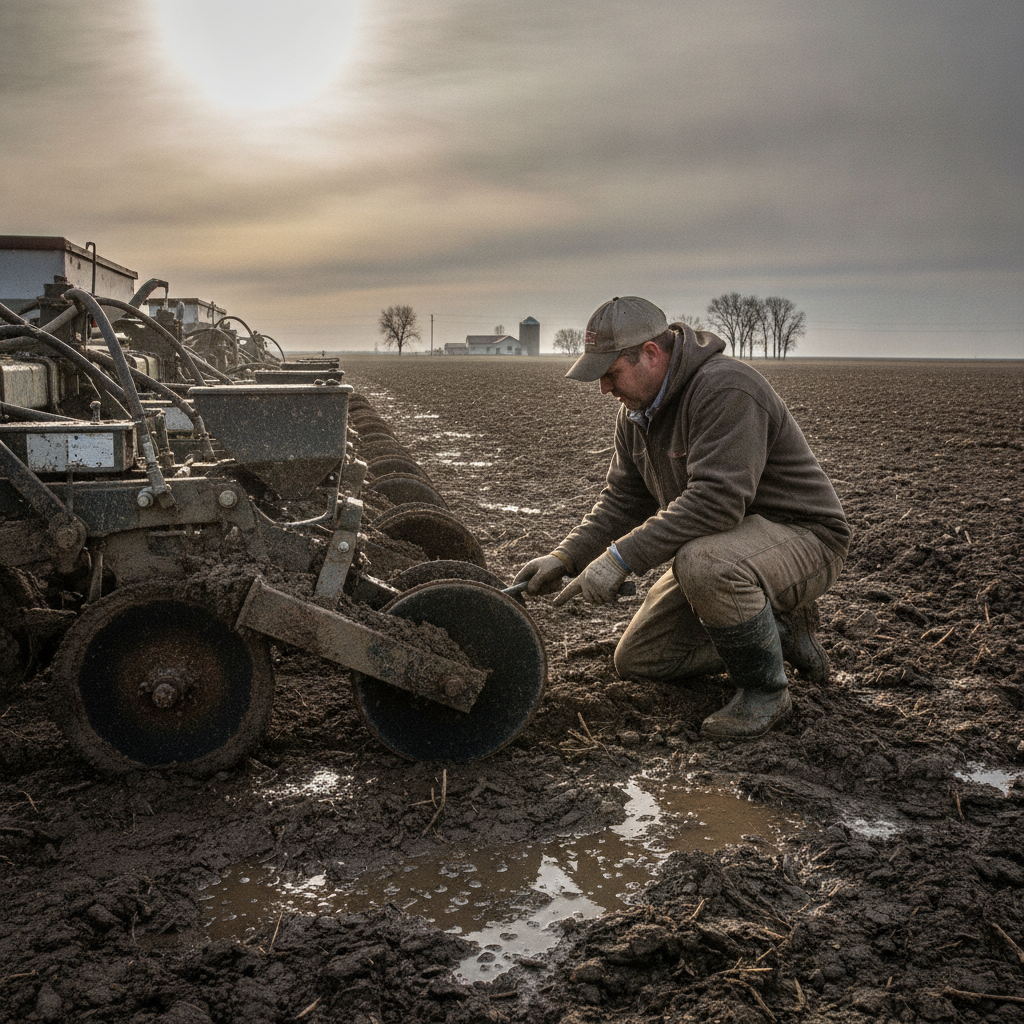
How Do Row-Crop Farmers Near Ipswich Know Whether Their Planter’s Gauge Wheel Is Actually Ready to Handle a Cold, Wet Soil Start — Or Just Assumed to Be Fine After Sitting in the Shed All Winter?
The short answer: most don’t know until something goes wrong. A planter that sat from October through March hasn’t been tested in the conditions it’s about to face — cold, saturated soils, heavy residue, and mud that sticks to every flat surface it can find. If you’re farming near Ipswich or anywhere across the Northern Plains, those first few days of planting are some of the highest-stakes hours of your year. That’s exactly the wrong time to discover your gauge wheel tires are cracking at the lip, your steel ring has a loose mount, or your wheel retainer has worked itself off from vibration on the last road move of fall.
This article covers what a real pre-season gauge wheel inspection looks like — not a quick walk-around, but the checks that actually catch the failures that cold, wet South Dakota springs tend to expose.
Why Cold, Wet Soil Is Harder on Gauge Wheels Than You Might Think
When you’re planting into soil that’s 45 degrees and holding a lot of moisture, your gauge wheels are working harder than they do in mid-May. Cold rubber is stiffer. Saturated gumbo soil near Aberdeen or Huron doesn’t roll off a wheel — it packs and clings. The forces pushing on the tire lip are higher, the mud load on the wheel face is heavier, and any small gap or weak point in the assembly gets stress-tested immediately.
Tire lip cracking is one of the most common early-season failures, and it’s almost always made worse by winter storage. Rubber loses some flexibility sitting in a cold shed for five months. The first time that tire rolls through a wet, clay-heavy field and takes a solid lateral load against the furrow wall, a lip that looked fine in the shed will start splitting. Once the lip is compromised, mud packs into the gap between the tire and the wheel disc, and you lose depth control before you’ve finished the first field.
A steel ring mounted on the gauge wheel tire changes that equation. It physically protects the tire lip from furrow wall abrasion and doubles as a built-in scraper to knock packed mud loose before it has a chance to build up. That’s the kind of protection that matters most in cold, heavy soils — not as a nice-to-have, but as a functional part of keeping the wheel doing its job through the first hundred acres when conditions are worst.
What to Actually Inspect Before First Pass — A Working Checklist
Generic pre-season checklists from equipment manufacturers tell you to check for wear and replace as needed. That’s not wrong, but it doesn’t tell you what to look for or why it matters in the specific conditions you’re about to plant into. Here’s what deserves real attention on every row unit before you leave the yard:
- Tire lip condition: Run your finger around the full circumference of the tire lip on both gauge wheels on every row unit. You’re feeling for cracking, splitting, or areas where the rubber has started to separate from the bead. Any cracking means that tire is going to accelerate its failure in cold, wet soil. If you’re running a steel ring, check that the ring is seated flush and that all six mounting screws are tight. A ring that has backed off even slightly will allow mud to pack underneath it.
- Wheel retainer security: A gauge wheel that dislodges mid-field doesn’t just cause a planting gap — it can damage the row unit itself and costs you time you don’t have during a short planting window. Check that your wheel retainer is properly seated and shows no cracking or deformation. Road transport vibration over the winter and during field-to-field moves is a common cause of retainer fatigue that goes unnoticed until the wheel comes off.
- Spoke and disc condition on open-spoke wheels: If you’re running curved spoked gauge wheels, inspect each spoke for cracks at the hub and at the rim. Cold temperatures make stress fractures easier to miss because the metal contracts. Also check that the open spoke design is actually clear of compacted debris from last fall — packed soil in the spoke openings defeats the whole purpose of the design, which is to shed mud and maintain consistent rolling contact with the furrow wall.
- Bearing play: Grab each gauge wheel and try to rock it laterally. Any slop in the bearing means inconsistent depth control the moment you hit variable soil conditions. Bearings that ran wet last fall may have already started to corrode internally over the winter.
- Row-unit parallelogram and down-pressure: A gauge wheel in perfect condition still won’t hold depth if the row unit itself is worn or the down-pressure isn’t calibrated. Make sure parallel arms move freely without binding and that down-pressure springs or hydraulics are set correctly for the soil weight you’re about to encounter.
The Gap Most Manufacturers Don’t Address: What Happens in the First 50 Acres
Most competitor product pages and blog content focuses on cumulative wear over thousands of acres — which matters, but it skips past the failure mode that actually hurts the most: the first pass of the season into cold, wet, high-residue ground. That first run is when compromised parts fail, when loose mounts work the rest of the way out, and when mud management becomes critical before your equipment has had a chance to warm up and find its rhythm.
Jung Enterprise’s steel ring has been field-tested to only 1/16 inch of wear after 13,000 planted acres over three years. That durability number is meaningful — but what it also tells you is that the design is stable from the first acre, not just the ten-thousandth. A ring that’s properly seated and screwed down with six fasteners doesn’t move, doesn’t let mud pack underneath it, and doesn’t need a separate scraper bolted alongside it. That matters on day one just as much as it does late in the season. You can learn more about how the steel ring is designed and what it protects against before you commit to a pre-season order.
Timing: When to Do This Inspection and When to Order Parts
If you’re farming in South Dakota or southern North Dakota, your realistic planting window for corn runs from late April through mid-May in a normal year — and wet years compress that window significantly. By the time you’re ready to roll, you don’t want to be waiting on parts.
The right time to inspect gauge wheels and order any replacements is late winter — February or early March at the latest. Dealers near Aberdeen and Watertown who stock gauge wheel components move through their supply quickly as April approaches. If you’re a custom planter running multiple farms, you have even less margin for error. A wheel retainer failure or a cracked tire lip on day two of a custom run means someone else’s crop doesn’t get planted on time — and that has real consequences for your business relationships.
Post-harvest inspection in the fall is also worth doing. If you notice lip wear, loose rings, or any retainer deformation when you pull the planter in, handle it in October rather than March. Parts are easier to source, your shop isn’t competing with everyone else’s emergency orders, and you’ll have time to do the job right.
Frequently Asked Questions
Can a steel ring be installed on existing gauge wheel tires, or does it require new wheels?
The steel ring mounts onto your existing gauge wheel tire lip using six screws. You don’t need to replace the whole wheel to add this protection. It’s designed to fit multiple gauge wheel sizes and OEM brands, so check compatibility for your specific setup before ordering.
How do I know if my curved spoked gauge wheels are actually shedding mud or just moving it around?
Watch the wheel face closely during the first few passes in wet conditions. A properly functioning open-spoke gauge wheel should clear itself within one or two rotations. If mud is accumulating on the spoke faces and not releasing, the spokes may be clogged from last season or the wheel angle relative to the furrow wall may need adjustment.
Does cold temperature affect how a wheel retainer functions?
Cold temperatures can make polymer or rubber retainer components stiffer and slightly more brittle, which is one reason winter storage followed by road transport before the first field can expose fatigue cracks that weren’t visible in the fall. Inspect retainers for any deformation or cracking before first use each season.
Is there a difference in how much wear a steel ring sees in no-till versus tilled ground, especially early in the season?
Yes. No-till and strip-till ground — particularly in the heavier soils around Huron and across central South Dakota — tends to put more abrasive load on the tire lip because the gauge wheel is running against undisturbed furrow walls rather than freshly worked soil. That’s exactly where steel ring protection earns its keep fastest.
How many acres should I expect from a gauge wheel tire before the lip wears to the point of needing replacement?
It depends heavily on soil type, tillage practice, and whether the tire lip is protected. Unprotected tires in abrasive conditions can show significant lip wear inside a single season of high-acre custom planting. With a steel ring in place, the tire itself is largely protected from the abrasive contact that causes lip failure — which is why the ring is a cost-effective upgrade rather than an added expense.
Ready to Get Your Equipment Checked Out Before Planting Season?
Jung Enterprise is based in Ipswich and builds gauge wheel components designed for the conditions you actually farm in — wet springs, heavy clay, short planting windows, and high-acre custom runs. If you’re not sure whether your current setup is going to hold up through the first pass, or you want to upgrade to parts that are patented, American-made, and field-proven before you need them, reach out directly. You can also review all available products to see what fits your planter or air seeder setup.
Contact Jung Enterprise to ask about steel rings, curved spoked gauge wheels, or wheel retainers for your operation — or to find out whether a local dealer near you carries them. Don’t wait until you’re already in the field to figure out what you need.