
How Do Farmers Near Ipswich Know Whether Their Planter’s Gauge Wheels Are Actually Causing Compaction — Or Just Getting Blamed for a Soil Problem That Started Somewhere Else?
If you’re digging up roots after harvest and seeing that classic restricted, sideways-growing root system, gauge wheels are probably the first thing your agronomist points at. Sometimes that’s right. But in the gumbo and clay soils across South Dakota’s Northern Plains, the real story is more complicated — and if you fix the wrong thing, you’ll spend money and still see the same problem next season. Here’s how to actually sort out what’s happening in your seed trench before you assume your gauge wheels are the culprit.
Why Gauge Wheels Get Blamed First — and Why That’s Not Always Fair
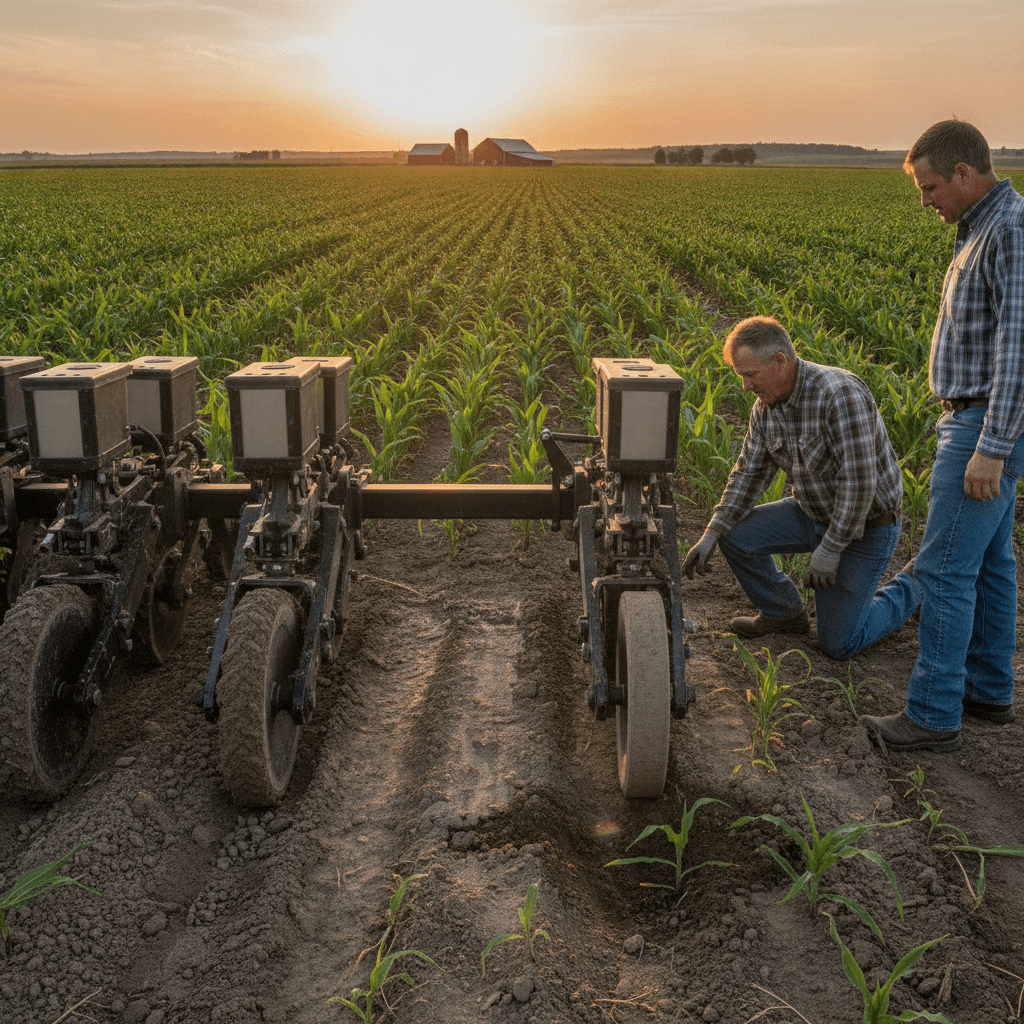
Gauge wheels ride right alongside the seed furrow. They control depth, stabilize the row unit, and in wet conditions, they’re the part most likely to be smearing soil. So when you see compaction near the seed zone, it’s a logical first guess. But gauge wheels compress soil sideways, not deep. True sidewall compaction — that glazed, slick wall of soil pressed tight against the seed — usually shows up when gauge wheels are running in saturated soil with no ability to shed mud off the tire face.
The deeper compaction layers you might be seeing? Those are more likely caused by downforce settings, planting speed, or subsoil conditions that were already there before your planter hit the field. If you’re running too much hydraulic down pressure in marginally fit soil, your closing wheels and disc openers are doing damage that your gauge wheels get blamed for. Gauge wheels don’t apply vertical force — they limit it. That’s an important distinction.
What Actual Gauge-Wheel-Related Sidewall Compaction Looks Like
Here’s what’s actually caused by gauge wheels: when mud packs onto the face of a solid or worn tire and doesn’t shed, you end up with a wheel that’s essentially smearing a layer of wet clay against the side of your seed trench. That glazed wall limits root egress, restricts water movement, and can reduce early-season stand establishment — especially in corn, where the mesocotyl has to push laterally to anchor before going vertical.
In the clay and gumbo soils around Ipswich and out toward Aberdeen, this is a real and repeatable problem in wet April and early May conditions. The fix isn’t always a new gauge wheel — but if your current gauge wheel is holding mud instead of shedding it, you’re making an already marginal soil condition worse with every pass.
This is exactly where open-spoke gauge wheel design matters. Jung Enterprise’s curved spoked gauge wheels are built with an open-spoke design specifically so mud can’t pack and stay. The spokes flex and shed as the wheel turns, rather than building up a clay cap the way a solid-faced tire does. It’s not a marketing claim — it’s basic geometry. A surface that mud can’t adhere to is a surface that doesn’t smear your seed trench wall.
How to Tell Whether Your Down Pressure Is the Real Problem
Before you pull your gauge wheels off and start comparing specs, do a simple trench check in your worst-compaction field. Dig out a seed trench section after planting. Look at the seed trench wall — is it smeared and glazed, or is it relatively clean with a normal soil texture? If the wall is glazed, your gauge wheels may be wet-soil smearing. If the wall looks okay but roots are still restricted below the trench, you’ve got a subsoil problem or a down-pressure problem, not a gauge wheel problem.
Also check your planting speed. Farmers across South Dakota and North Dakota who pushed speed during the tight 2023 and 2024 planting windows saw compaction issues that had nothing to do with gauge wheel design. At higher speeds, row unit bounce increases downforce spikes and smearing regardless of what gauge wheels you’re running.
The One Thing Most Competitor Resources Don’t Tell You About Gauge Wheel Compaction
Most of the content you’ll find from competitors focuses on gauge wheel wear, depth control, or mud shedding in isolation. What they don’t address clearly is how to separate gauge wheel contribution from other row-unit-driven compaction sources — specifically the interaction between gauge wheel mud accumulation, downforce settings, and planting speed.
If your gauge wheels are holding mud, they’re riding higher than their true diameter, which means your disc openers may be cutting deeper than your depth setting. That means more soil disruption, more furrow smear, and a trench that looks like a compaction problem even if your downforce settings are reasonable. It’s a cascading failure — and it starts with mud retention on a gauge wheel that can’t shed.
Running a gauge wheel that sheds mud reliably — combined with a steel ring that protects the tire lip and doubles as a built-in scraper — keeps your effective wheel diameter consistent, which keeps your planting depth honest. Jung Enterprise’s patented steel ring (US Patent 11,707,013 B2) mounts with six screws directly to the gauge wheel face, protecting the tire lip from wear and actively clearing debris so the wheel maintains its true rolling diameter across the entire pass. After 13,000 planted acres over three years, field testing showed only 1/16 inch of wear — meaning the wheel diameter stays consistent and your depth control stays accurate.
What Farmers Near Huron and Watertown Are Running Into With This Problem
Farmers running no-till and strip-till operations near Huron and Watertown deal with a compounding variable: residue. In no-till corn-on-corn or soybean stubble, gauge wheels have to navigate residue mats on top of wet soil. Mud and residue pack together faster than mud alone, and that packed combo on a solid gauge wheel creates an uneven rolling surface that throws off depth consistency row-to-row. If you’re running no-till and seeing variable emergence — not just compaction symptoms — check whether your gauge wheels are carrying a load of mud-and-trash buildup by mid-field before you assume it’s a seed-soil contact issue.
The open-spoke curved design handles this better because the spokes don’t offer a solid face for residue to bridge across. It’s the same reason you’d use an open-tread tire in mud over a slick one — surface geometry matters when the soil is fighting you.
Frequently Asked Questions
Can gauge wheels cause compaction even when soil conditions look fine at planting?
Yes, if they’re carrying mud from an earlier wet stretch in the field. Soil conditions vary across a field, and a gauge wheel that packed up in a low spot stays packed until it sheds — meaning it can smear trench walls in areas that looked drier. Check your wheels mid-field, not just at the edge.
How do I know if compaction is coming from my gauge wheels versus my closing wheels?
Location tells you a lot. Sidewall smearing near seed depth points to gauge wheels. Compaction above the seed, or poor furrow closure that leads to air pockets, points to closing wheels. Dig the trench open and look at where the glazed or compressed layer actually sits relative to seed placement.
Will switching to curved spoked gauge wheels eliminate sidewall compaction?
It will reduce mud-related smearing significantly in wet conditions, but it won’t fix compaction caused by excessive downforce or planting in soils that weren’t fit. Gauge wheel design is one variable. You still have to manage down pressure and planting speed for overall compaction control.
Does the steel ring on the gauge wheel affect how the wheel interacts with the trench wall?
The steel ring protects the tire lip from wear, which keeps the wheel’s rolling diameter consistent. A worn tire lip causes the wheel to run smaller than intended, which throws off depth setting and can cause the disc opener to cut deeper. The ring also scrapes mud off the face actively, so the wheel isn’t carrying buildup into the next revolution.
How do farmers near Bismarck or Fargo handle gauge wheel compaction in heavier soils than what we see in South Dakota?
The Northern Plains from South Dakota up through North Dakota share similar challenges — heavy clay, late-spring moisture, short planting windows that push operators into marginal conditions. The approach is the same: run gauge wheels that shed mud reliably, keep downforce calibrated to actual soil conditions rather than maximum settings, and check trench quality in your worst-draining field sections first.
If You’re Not Sure What’s Causing the Problem, Start With Your Gauge Wheels
Even if gauge wheels aren’t the only cause of your compaction issues, they’re the easiest variable to control — and the one most likely to compound every other problem in wet, heavy soil. If you’re running worn solid-face gauge wheels that hold mud, you’re already fighting uphill. Switching to a wheel that sheds mud and a steel ring that keeps the tire lip intact is a low-cost, high-return change that makes the rest of your row unit work the way it was designed to.
Jung Enterprise builds these parts in South Dakota for the soil conditions and planting windows farmers in this region actually deal with. If you want to talk through what your current setup is doing and whether a gauge wheel or steel ring upgrade makes sense for your planter, reach out to us directly. We’re here in Ipswich, and we know what these fields are like.