
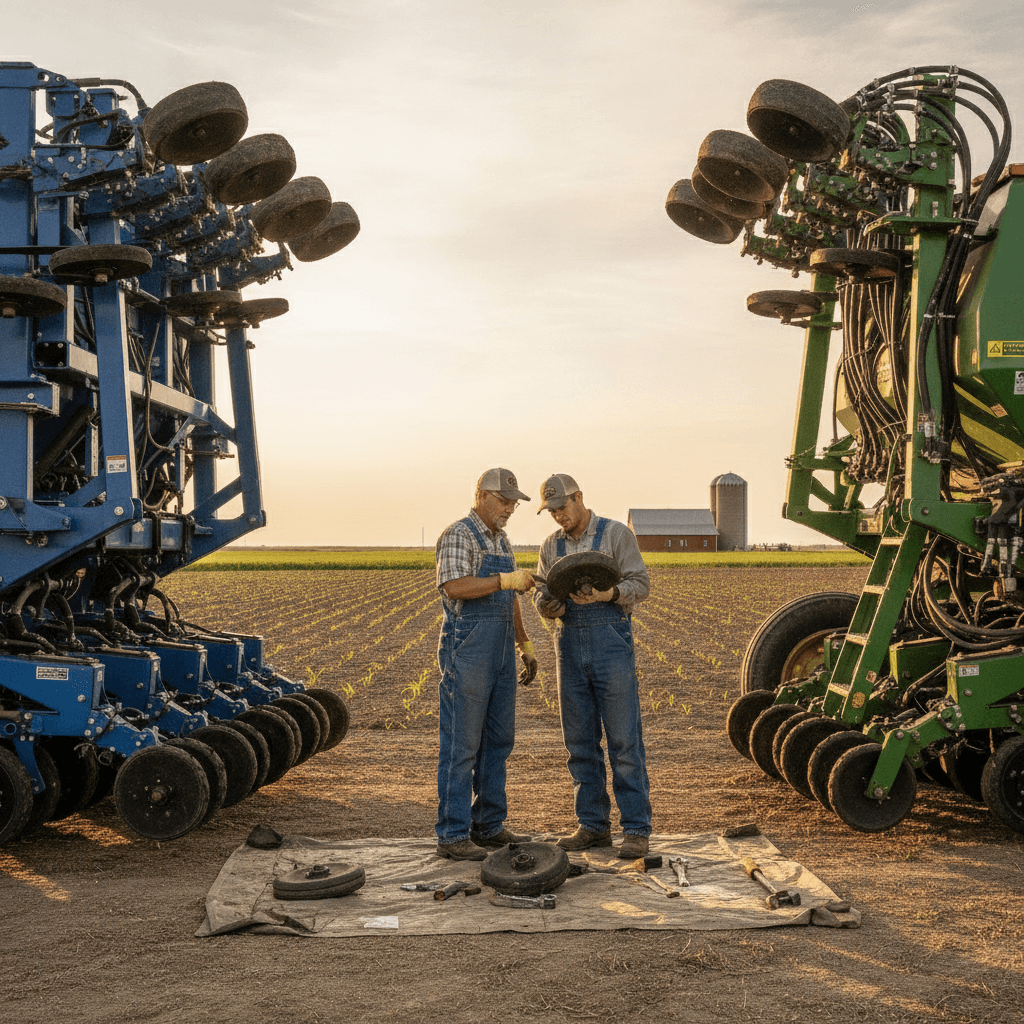
How Do Farmers Near Mitchell Know Whether Their Planter’s Gauge Wheels Are Actually Compatible With an Air Seeder Setup — Or Just Assumed to Cross Over Without Checking?
If you farm near Mitchell and run both a row-crop planter and an air seeder, there’s a good chance you’ve looked at the gauge wheels on both machines and figured the parts are close enough to swap. Sometimes they are. Sometimes they’re not — and you don’t find out until you’re in the field with the wrong wheel seated crooked, a retainer that doesn’t lock right, or a steel ring that’s a hair off on diameter and starts walking at speed. By then, the planting window is burning and you’re back in the shop pulling things apart that should’ve been checked in February.
This isn’t a topic that gets talked about much. Most gauge wheel manufacturers focus on selling you their wheel for your specific machine — not on helping you sort out what actually transfers between the planter and the air seeder sitting in the same shed. That’s a real gap, and it costs farmers time and money every spring across South Dakota, Iowa, and Nebraska when assumptions turn into field problems.
Why Planter and Air Seeder Gauge Wheel Specs Aren’t Always the Same
Row-crop planters and air seeders are built around different planting philosophies. A corn or soybean planter is designed around precise, individual row-unit seed placement — depth control is everything, and the gauge wheel does a lot of that work by riding the furrow wall. An air seeder is moving faster across more acres, often seeding small grains or canola into heavier residue, and the gauge wheel design reflects that.
The result is that gauge wheel diameters, hub configurations, spoke geometry, and axle fitments can vary enough between machine types that a wheel pulled off a planter won’t necessarily seat correctly on an air seeder row unit — even if it looks close. The same goes for the hardware that holds everything in place. A wheel retainer sized and tensioned for a planter row unit isn’t automatically going to hold the same way on a drill or air seeder that’s running through heavier residue at a higher field speed.
What you need to check before you assume parts transfer:
- Gauge wheel outer diameter — even a small difference changes your seeding depth reference
- Hub bore and axle diameter — mismatched fitment causes wobble and premature wear
- Spoke design and mud clearance — an open-spoke wheel that sheds debris well on a planter may not have enough clearance for the residue volumes an air seeder handles
- Steel ring inner diameter — if the ring is sized for a planter tire, it won’t seat flush on a different-profile air seeder tire
- Wheel retainer tab geometry — retainers are sized to specific axle and hub configurations; a retainer that holds fine on a planter may not lock correctly on a drill frame
The Steel Ring Fitment Problem Nobody Warns You About
Steel rings cause more cross-machine fitment confusion than almost any other gauge wheel component. The tire lip the ring is designed to protect varies between planter tires and air seeder tires — not always by much, but enough to matter. A ring that mounts flush and stays locked on a planter gauge wheel tire may sit slightly proud or slightly loose on a different tire profile, and once it starts moving under field load, it stops scraping effectively and starts creating wear rather than preventing it.
Jung Enterprise’s patented Steel Ring (US Patent 11,707,013 B2) mounts with six screws and is designed to stay put — but that holding power depends on the ring being correctly sized for the specific tire it’s protecting. If you’re moving steel rings between machines, verify the tire dimensions match. Don’t just eyeball it. A ring that’s slightly off diameter on an air seeder tire will work loose in heavy gumbo conditions — exactly the kind of wet clay soils you run into on the spring fields around Huron and Mitchell — and when it does, it’s not scraping anymore, it’s just riding along and wearing down.
What Transfers — and What Doesn’t
Here’s the honest breakdown for farmers running multiple machine types out of the same shop:
What often transfers cleanly: Curved spoked gauge wheels built to a standard diameter and hub spec will frequently cross between planter brands and some air seeder configurations — but only when the axle fitment is the same. Jung Enterprise’s Curved Spoked Gauge Wheels are engineered to shed mud through the open-spoke design, which matters whether you’re running corn or small grains. If the hub fits, the mud-shedding geometry works the same way.
What usually doesn’t transfer without checking: Steel rings and wheel retainers are more machine-specific. Retainer tab geometry and spring tension vary enough between planter and drill row unit designs that a retainer should always be verified against the actual axle and hub before assuming it’s the same part.
The durability numbers hold regardless of machine type: The Jung Enterprise Steel Ring has been field-tested to only 1/16″ of wear after 13,000 planted acres over three years. That result was earned on correctly fitted installations. A misfitted ring won’t last anything close to that — and the failure won’t be gradual, it’ll be a ring walking off in the field when you can least afford to stop.
How to Sort This Out Before Planting Season Starts
The best time to work through cross-machine compatibility is right now — post-harvest, before the spring parts rush. Farmers across South Dakota have a short planting window in May where every day of downtime has a direct yield cost. Getting this sorted in the fall or winter means you’re not pulling wheels and measuring tires on a wet April morning.
Start by pulling the specs on both your planter and your air seeder: tire profile, outer diameter, hub bore, and axle diameter. Then compare those against the gauge wheel and hardware specs before you order anything or assume a part crosses over. If you’re not sure, reach out to Jung Enterprise directly — we can walk you through compatibility for your specific machines without sending you the wrong part.
Dealers in the Mitchell area and across central South Dakota who stock gauge wheel components for multiple machine types should also be cross-referencing their inventory against both planter and drill specs. If a dealer can only tell you what planter a wheel fits but can’t tell you whether it crosses to an air seeder, that’s a gap worth filling before your customers find out the hard way in the field.
Frequently Asked Questions
Can I use the same gauge wheel on my corn planter and my air seeder?
Sometimes, but not always. The hub bore and axle diameter need to match. If those specs align between your planter and air seeder row units, a correctly sized curved spoked gauge wheel can transfer. If they don’t, forcing a wheel that’s close — but not right — will cause wobble, uneven depth, and faster wear.
Will a steel ring sized for a planter tire fit an air seeder tire?
Only if the tire profiles and outer diameters are the same. Even a small diameter difference affects how the ring seats and whether it stays locked under field load. Always verify tire dimensions before transferring a steel ring between machine types.
Do wheel retainers cross over between planters and air seeders?
Generally, no — not without checking. Retainer tab geometry and spring tension are designed around specific axle configurations. A retainer that holds correctly on a planter row unit may not lock the same way on a drill or air seeder frame. Verify the fitment before assuming it’s the same part.
How do I know which Jung Enterprise products fit my specific machines?
Contact Jung Enterprise directly at (605) 281-0497 or email help@jungenterprise.net with your machine make, model, and tire specs. We’ll confirm compatibility before you order so you’re not dealing with a mismatch in the field.
Is this a problem that shows up more in no-till or conventional tillage?
It shows up in both, but the consequences hit harder in no-till and heavy residue conditions. If a gauge wheel isn’t seated correctly and mud or residue starts packing against it, the misfitment compounds the problem fast. In the gumbo clay soils common around Mitchell and central South Dakota, a loose or slightly off-spec wheel will plug up far faster than one that’s correctly fitted and shedding debris the way it’s designed to.
Ready to Get This Right Before Spring?
Jung Enterprise builds patented, American-made gauge wheel components out of Ipswich, South Dakota — steel rings, wheel retainers, and curved spoked gauge wheels designed to fit correctly and hold up through a full season of acres. If you’re trying to sort out compatibility between your planter and air seeder before the planting window opens, don’t guess. Contact us directly and we’ll work through the fitment with you. Getting it right now costs you a phone call. Getting it wrong costs you a field day.