
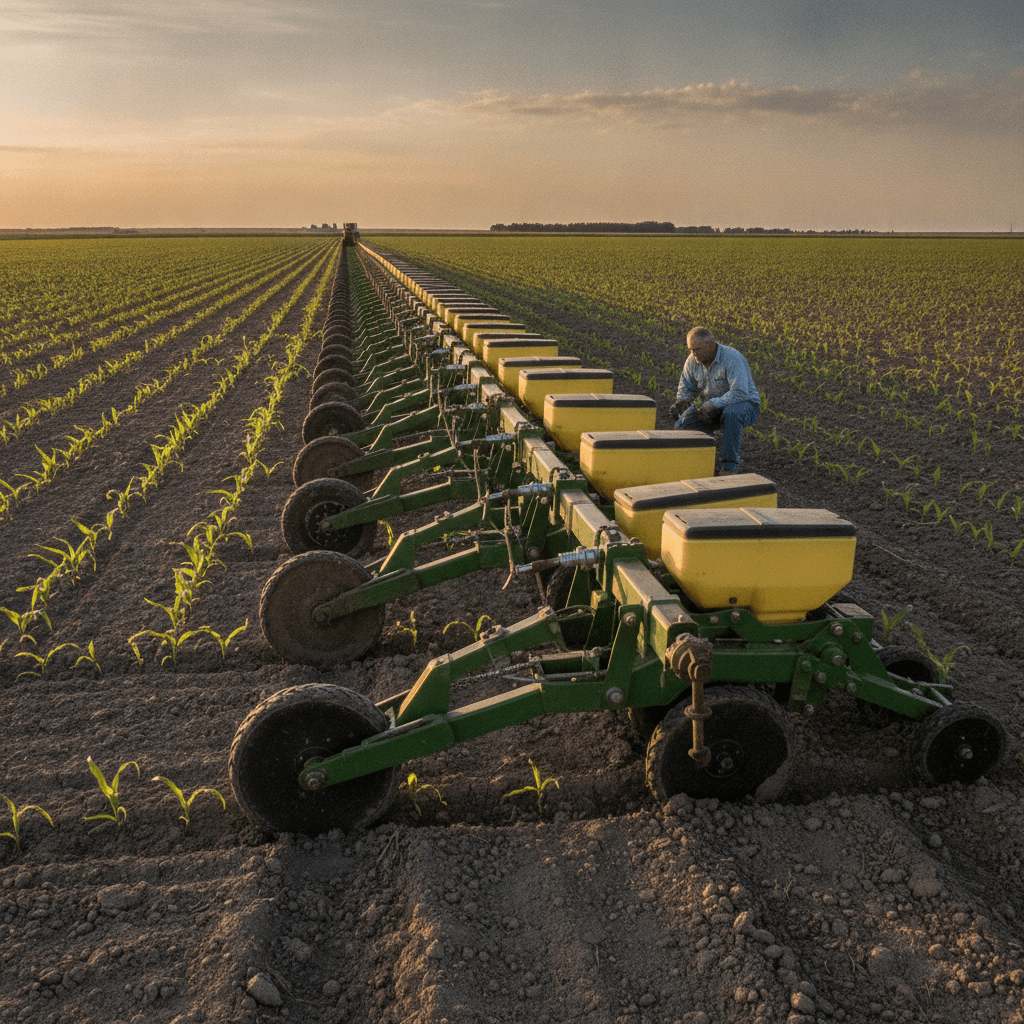
How Do Farmers Near Ipswich Know Whether Their Planter’s Gauge Wheel Is Actually Performing the Same on Row 1 as Row 24 — Or Just Varying Wildly Across the Toolbar?
Here’s the short answer: most of them don’t know — and that’s exactly the problem. If you’re running a 24-row or 36-row planter across the fields around Ipswich and northeastern South Dakota, there’s a very good chance your outside rows and your center rows are not planting at the same depth. Not because your monitor is wrong. Because your gauge wheels aren’t in the same condition from one end of the toolbar to the other, and nobody’s talking about that problem directly.
Competitors in this space spend a lot of time talking about individual row unit performance — one wheel, one trench, one seed. What they largely skip over is the compounding effect of mixed hardware condition across a wide toolbar. That’s the gap we’re addressing here.
Why Toolbar-Wide Consistency Is the Real Yield Problem Nobody Is Naming
When you walk a field after planting, emergence gaps tend to cluster. You’ll notice a stretch of thin, uneven emergence — and it’s rarely random. More often than not, those thin areas map directly to specific rows on the toolbar. Sometimes it’s the end rows riding differently on a slope. Sometimes it’s middle rows loading up with mud in wet clay soils while the outer rows are running cleaner. Sometimes it’s a worn tire on row 14 that’s been losing its lip integrity for two seasons while every other row is still reasonably tight.
The issue is that a single worn or mud-loaded gauge wheel doesn’t just affect that row. It affects your confidence in the whole pass. You can’t tell by watching the monitor which rows are actually holding depth and which ones are floating or digging. By the time you see the emergence pattern, you’ve already planted that field.
For farmers in the Aberdeen and Ipswich area running heavy clay and gumbo soils, this problem hits harder than it does in sandier ground. Clay loads up on gauge wheel tires fast. If your tire lip is worn or unprotected, debris packs against it and starts changing the effective rolling diameter of the wheel — which changes your depth. Do that across 10 or 12 rows simultaneously and you’ve got a planting depth nightmare that looks like a fertility problem or a hybrid problem until you dig down and actually measure.
What Actually Causes Row-to-Row Depth Variation Across a Wide Toolbar
There are a few distinct failure modes that show up differently depending on where a row unit sits on the toolbar:
- Uneven tire lip wear: Gauge wheel tires wear at the lip where they ride the opener disk. Once the lip wears, the tire stops controlling depth precisely and starts letting the row unit drop or float depending on soil resistance. This happens at different rates across the toolbar depending on soil contact, downforce, and how much residue each row is hitting.
- Mud and debris accumulation: In gumbo or wet clay, mud packs onto the gauge wheel face and especially at the lip. Rows that ride lower in a field depression or catch more residue will pack faster than rows on drier ground. That packing changes effective wheel diameter and throws depth off — unevenly.
- Hardware inconsistency from mixed replacement history: It’s common to replace gauge wheels row by row as they fail rather than doing a full toolbar refresh at once. The result is a mix of new, partially worn, and nearly failed wheels all running simultaneously. Each one is controlling depth slightly differently.
- Wheel dislodgement risk at the ends: End rows take more abuse — headland turns, transport stress, impact with field obstacles. If a wheel retainer fails on an end row and the gauge wheel dislodges mid-field, that row goes uncontrolled while the rest of the toolbar keeps planting. You may not know it happened until you’re back at the end.
The Case for Standardizing Hardware Across the Entire Toolbar at Once
One of the most practical things you can do before planting season is treat gauge wheel maintenance as a toolbar-wide decision, not a row-by-row repair call. That means assessing every row unit at the same time — same inspection, same standard — and replacing or upgrading any hardware that doesn’t meet that standard. Not just the ones that look obviously bad.
This is where Jung Enterprise’s Steel Ring becomes a real tool for standardization, not just a wear solution. The steel ring mounts to the gauge wheel tire with six screws and protects the tire lip from the wear that causes depth inconsistency over time. More importantly, its built-in scraper design keeps mud from loading up on the wheel face — which means the wheels that are running in lower, wetter field areas are being protected the same way the drier-condition rows are. You’re leveling the performance across the toolbar instead of letting field conditions create a patchwork of wear rates.
Durability isn’t theoretical here. These rings have been field-tested to only 1/16″ of wear after 13,000 planted acres over three years. That’s the kind of consistent performance you need when you’re trying to hold depth on row 1 and row 36 to the same standard across a full spring run.
Open-Spoke Gauge Wheels and the Mud Problem in Northeastern South Dakota
The other piece of this is the wheel itself. Solid or partially solid gauge wheel designs pack mud in the wet, heavy soils common from the Ipswich area through Huron and south toward the James River lowlands. Once a wheel packs, it stops shedding and starts carrying — and what it carries changes your depth.
Jung Enterprise’s Curved Spoked Gauge Wheels are designed with an open-spoke pattern specifically to let mud and residue clear instead of pack. In gumbo conditions, that’s not a minor detail. It’s the difference between a wheel that’s doing its job at mile 3 and one that’s essentially become a mud disc by the time you hit the far end of a long field.
When you pair open-spoke gauge wheels with steel ring lip protection across every row on the toolbar, you get something closer to uniform performance from end to end — which is the actual goal.
Don’t Overlook the Wheel Retainer When You’re Doing a Full Toolbar Audit
While you’re going through each row unit, check the wheel retainer. A gauge wheel that’s properly protected and shedding mud doesn’t do you much good if it’s at risk of dislodging between fields or on a hard headland stop. The Wheel Retainer from Jung Enterprise keeps the wheel seated and stable, with an easy install that doesn’t require special tooling. It’s a simple addition to a full toolbar standardization, and it takes wheel dislodgement off the table as a mid-planting variable.
Frequently Asked Questions
How do I know if my gauge wheels are causing row-to-row depth variation rather than some other planter issue?
Dig seeds at multiple points across your toolbar within the same field pass and measure actual depth row by row. If you’re seeing a pattern — end rows deeper, center rows shallow, or clusters of variation — that’s more consistent with gauge wheel wear differences than with downforce or seed tube issues, which tend to affect rows more uniformly.
Is it worth replacing all gauge wheels at once, or just the ones that are visibly worn?
If your toolbar has a mix of wheel ages and wear rates, replacing everything at once gives you a consistent baseline and makes future wear easier to track. Patching row by row means you’re always running with mixed hardware, which makes it harder to diagnose depth problems later in the season.
Do Jung Enterprise’s Steel Rings work on all gauge wheel sizes and planter brands?
The Steel Ring is designed to fit across multiple OEM brands and gauge wheel sizes, including common setups on planters, air seeders, and no-till drills. Contact Jung Enterprise directly to confirm fit for your specific setup before ordering.
Can mud loading really change planting depth noticeably in a single field pass?
Yes, in heavy clay or gumbo conditions like those common in northeastern South Dakota, mud can pack onto a gauge wheel face quickly — sometimes within the first half mile of a wet field. Once that happens, the effective rolling diameter of the wheel increases, and the row unit rides shallower than your depth setting. An open-spoke gauge wheel design and steel ring scraper action both help prevent that from happening.
How long does it take to install a Steel Ring on a gauge wheel?
Installation involves six screws and doesn’t require specialized equipment. Most operators can complete a row unit installation quickly during a pre-season inspection, making it practical to do a full toolbar refresh before planting starts rather than waiting for something to fail mid-field.
Ready to Standardize Your Toolbar Before Planting Season?
If you’re farming near Ipswich or anywhere across northeastern South Dakota and you haven’t done a full toolbar gauge wheel audit lately, now is the time — before the spring window closes and every day of downtime costs you acres. Jung Enterprise builds patented, American-made gauge wheel hardware that’s designed to give you consistent performance from row 1 to row 24 and beyond.
Reach out to the team at Jung Enterprise to talk through what your planter needs and which products fit your setup. Contact us here or call (605) 281-0497. We’re based in Ipswich and we understand what your equipment is up against in these soils.