
How Do Farmers Near Ipswich Know Whether Their Planter’s Gauge Wheel Is Actually Seeding at the Right Depth After Switching From Corn to Soybeans — Or Just Running the Same Setup Without Checking?
If you planted corn first and you’re rolling right into soybeans without touching your gauge wheel settings, there’s a real chance you’re not seeding at the right depth — and you won’t know until emergence tells you something went wrong. Farmers near Ipswich deal with a short, high-stakes planting window every spring. Losing four or five days to uneven emergence because the depth was off by half an inch on a crop transition is a problem that compounds fast. The short answer: you need to verify gauge wheel position and depth every time you switch crops. Assuming the setup carries over from corn is how you end up with patchy soybean stands in the first week of May.
Why Corn and Soybean Seeding Depth Aren’t the Same — And Why Your Gauge Wheel Setup Reflects That
Corn generally gets planted at 1.5 to 2 inches, sometimes deeper in dry or sandy soils. Soybeans typically go at 1 to 1.5 inches — shallower, with less tolerance for being buried too deep or sitting too close to the surface. That half-inch difference matters more than most operators give it credit for, especially in the heavier gumbo clay soils common across central South Dakota. In those soils, a gauge wheel that isn’t running clean and true doesn’t just miss depth — it creates inconsistent furrow walls that don’t firm back around the seed correctly.
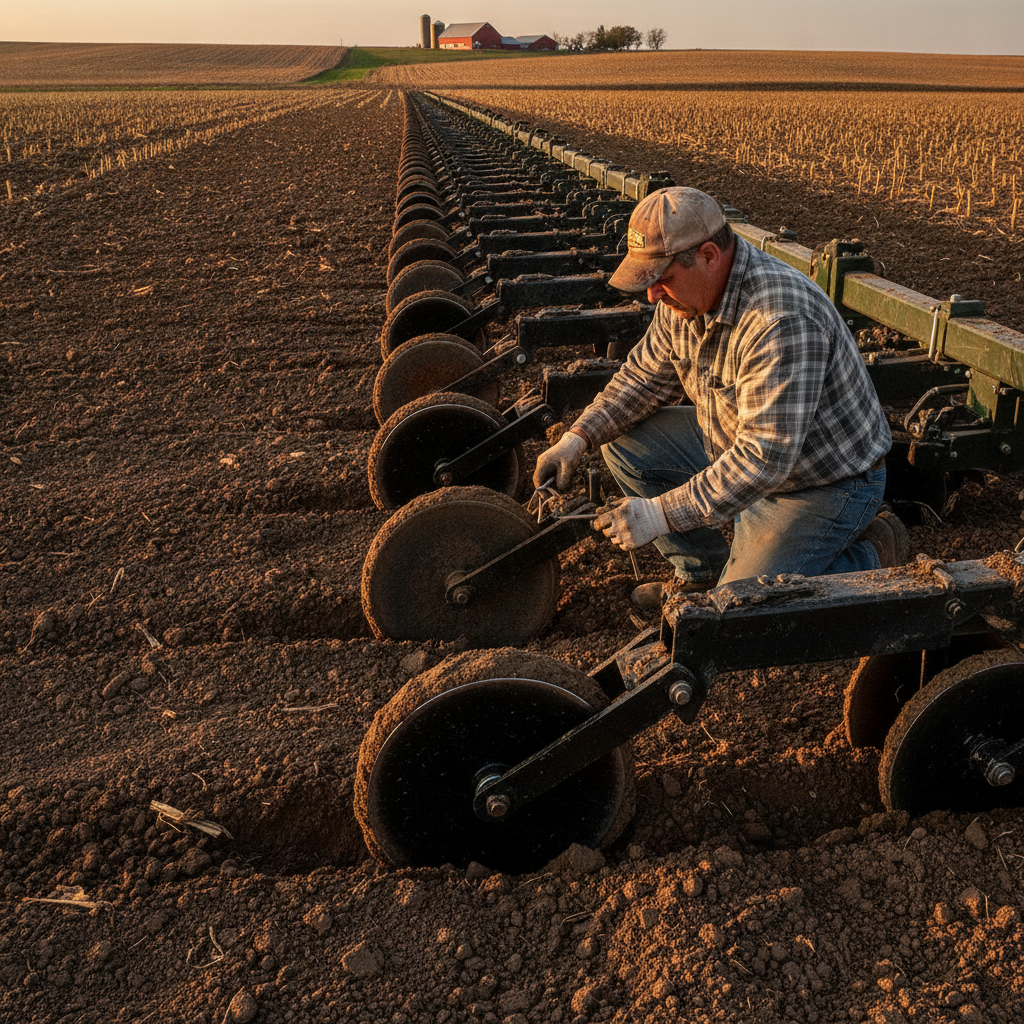
The gauge wheel is the component doing the depth-control work on your row unit. If it’s worn, plugged with mud, or misaligned from a full corn season, it’s not holding the depth you set — it’s approximating it. And when you’re planting soybeans at 1 to 1.5 inches, approximation isn’t good enough.
What to Actually Check Before Your First Soybean Pass
Before you make a single pass on soybeans after finishing corn, run through this:
- Check gauge wheel tire condition. Look at the tire lip specifically — that’s the edge that contacts the soil and sets your furrow depth. If the lip is worn down or damaged from a full corn run, the wheel isn’t riding at the right height and your depth is already compromised.
- Verify the depth adjustment hasn’t drifted. On many row units, depth settings can work loose after a heavy corn planting season, especially in rough or residue-heavy no-till ground. Physically confirm your setting matches the scale on the unit.
- Check for mud pack or debris in the gauge wheel spokes. Packed mud throws off the wheel’s rotation and creates uneven down pressure on one side of the furrow. This is especially common in the wet spring conditions across the Northern Plains.
- Inspect gauge wheel alignment side to side. A wheel that’s canted even slightly causes the disc blade to cut at the wrong angle relative to depth. After a corn season with heavy residue, this happens more than you’d expect.
- Check your wheel retainer. If the gauge wheel is able to shift or wobble on the hub, it doesn’t matter how well you dialed in depth — the wheel will move under load and your depth setting becomes meaningless.
The Mud Plugging Problem Is Worse on the Soybean Side of the Season
Here’s something that doesn’t get talked about enough across the Northern Plains: soybean planting often happens in wetter conditions than corn planting because farmers near Aberdeen, Huron, and Watertown frequently push corn in first when ground conditions are borderline, then circle back to beans when fields are still carrying significant moisture. That means your gauge wheels are hitting wetter, stickier soil on the soybean pass — exactly the conditions that cause mud to pack into open-spoke designs and conventional gauge wheel tires.
A gauge wheel that shed mud fine in moderate corn-planting conditions may start plugging badly by the time you’re back on soybeans in heavier clay ground. When that happens, the wheel stops rotating cleanly, depth control goes out the window, and you’re also dragging soil rather than firming the furrow wall the way you need for good seed-to-soil contact.
This is one of the key reasons the Curved Spoked Gauge Wheels from Jung Enterprise are built the way they are. The open curved-spoke design actively sheds mud as the wheel rotates instead of letting it pack in. In heavy spring soils across South Dakota and into North Dakota and Minnesota, that difference in mud shedding is what keeps depth control consistent from the first round to the last.
The Gap Nobody Talks About: Tire Lip Wear Between Crops
Most gauge wheel content from competitors focuses on mud shedding or bearing life. What they rarely address is what happens to the tire lip over a full corn season in no-till or heavy residue ground — and how that wear directly affects soybean planting depth before you even start.
The tire lip is the contact point where the gauge wheel rides against the soil surface to set furrow depth. In no-till corn ground with heavy stalk residue, that lip takes serious abuse — it’s cutting through residue, rolling over clods, and absorbing lateral forces from the disc blade. By the time you finish corn and transition to beans, a worn tire lip may have lost enough material that your actual seeding depth is a quarter-inch or more shallower than your dial setting shows.
The Steel Ring from Jung Enterprise addresses this directly. It mounts on the outer face of the gauge wheel tire and protects the tire lip from exactly this kind of wear. With field-tested results showing only 1/16 inch of wear over 13,000 planted acres across three seasons, it’s a straightforward way to make sure the tire lip is still holding its geometry when you come back around for soybeans. You can learn more about how it works on the Steel Ring product page.
What Good Looks Like After You Make the Transition
After a proper pre-soybean check, you should be able to pull a seed and measure it at a consistent 1 to 1.5 inches across multiple row units on the first pass. The furrow wall should be firm — not crumbling — and the trench should close cleanly behind the closing wheel. If you’re seeing seed depth vary more than a quarter-inch between row units, or if the trench walls are loose and the soil is falling back in without firming around the seed, something in the gauge wheel setup isn’t right.
That’s the checkpoint. Not the dial setting. Not what the setting was when you parked it after corn. Actual seed placement in the ground, verified by pulling seed on the first round of every new field.
FAQ: Gauge Wheel Depth and Crop Transitions Near Ipswich
Does switching from corn to soybeans require a different gauge wheel, or just a different setting?
Usually just a setting change, but the gauge wheel condition matters as much as the setting. A worn or mud-plugged wheel won’t hold the depth you dial in regardless of what the scale says. Inspect the wheel before you adjust.
How much does tire lip wear actually affect soybean planting depth?
More than most farmers expect. In heavy no-till or high-residue corn ground, tire lip wear over a full season can shift your effective planting depth by a quarter-inch or more. For soybeans targeting 1 to 1.5 inches, that’s a significant portion of your target range. A steel ring protecting the tire lip prevents this from accumulating across seasons.
Why do my soybeans seem to emerge more unevenly than my corn, even when I used the same planter?
Soybeans have less tolerance for depth variation than corn. They’re also often planted into wetter conditions later in the window when gauge wheels are more prone to mud plugging and depth drift. Uneven emergence in soybeans is frequently a gauge wheel issue — worn tire lip, packed mud in the spokes, or a wheel retainer that’s letting the wheel shift under load.
Is it worth doing a full gauge wheel inspection between corn and soybeans if I’m pressed for time?
Yes. The inspection takes less time than replanting a patchy stand. At minimum, check tire lip condition, spoke cleanliness, and your wheel retainer before the first soybean pass.
Do Jung Enterprise gauge wheels fit the planter brands most commonly run in central South Dakota?
Jung Enterprise’s Curved Spoked Gauge Wheels are compatible with multiple OEM planter brands and gauge wheel sizes. Contact the team directly to confirm fitment for your specific row unit before ordering.
If you’re coming off a corn season near Ipswich and getting ready to transition to soybeans, don’t assume your gauge wheel setup is ready to go. A quick inspection now costs you less than an hour. A bad soybean stand costs you the whole season on those acres. Reach out to Jung Enterprise with questions about fitment, steel ring protection, or curved spoked gauge wheel compatibility for your planter — we’re here to help you get it right before you make the first pass.