
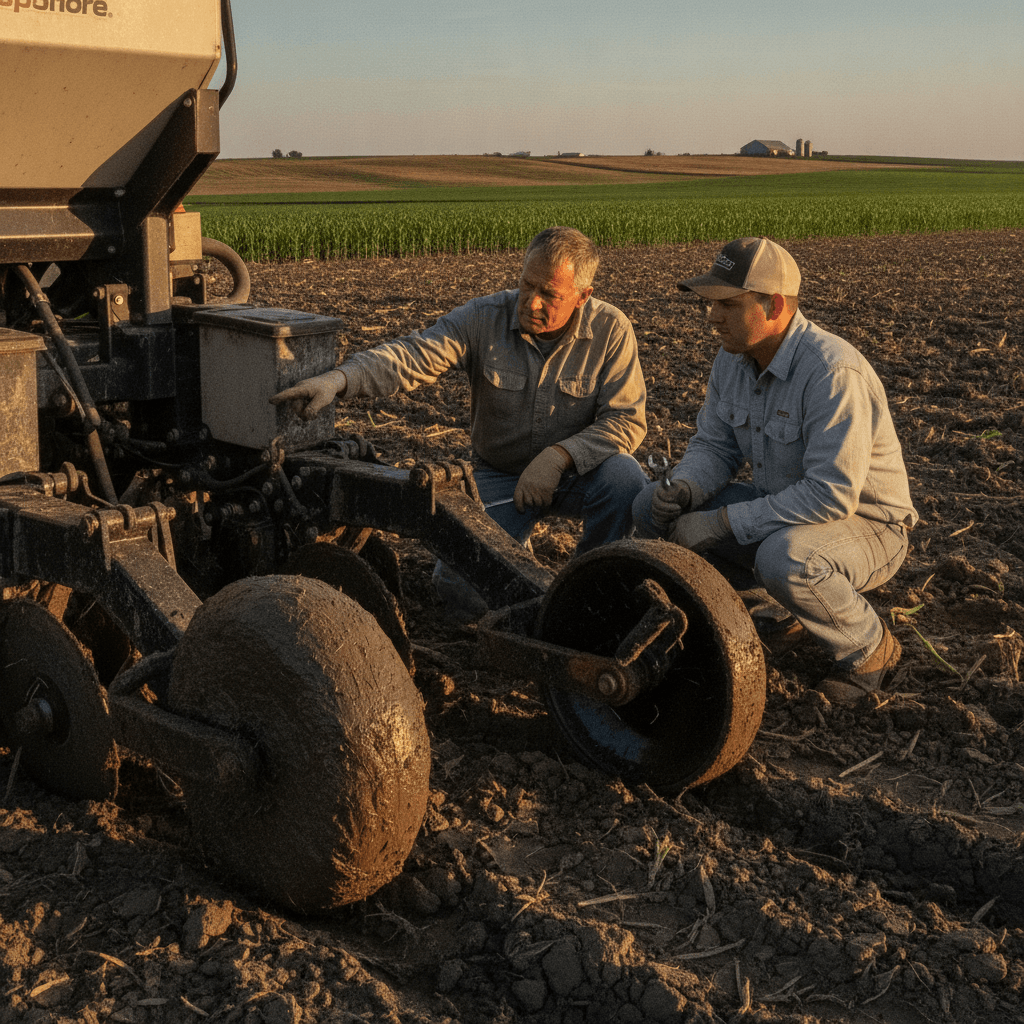
How Do Farmers Near Brookings Spot the Difference Between a Gauge Wheel Mud Problem and a Worn-Out Bearing — Before It Costs Them a Full Day of Planting?
If your gauge wheel isn’t spinning freely or your planting depth is wandering, you’ve got one of two problems: mud packed in and locked the wheel up, or the bearing is gone and the wheel is wobbling on a dead axle. Both symptoms can look almost identical when you’re standing in a muddy field near Brookings mid-morning with a full day of corn acres ahead. The difference matters because the fixes are completely different — and misreading the situation costs you time, money, or both.
Why This Diagnosis Matters More Than Most Farmers Realize
Most of the content out there from competing brands walks you through what their product does. What’s missing is practical, step-by-step guidance on figuring out what’s actually wrong with your row unit before you start pulling parts. That’s the gap we’re going to fill here.
In the eastern South Dakota corridor from Brookings west toward Sioux Falls, spring soils can shift from firm to sticky clay in the span of a couple of hours after a rain. When that happens, gauge wheels that were running clean at 7 a.m. can be fighting through a plugged mess by noon. That’s a mud problem. But if the wheel was already wobbling last fall or has been running rough since you pulled the planter out of the shed, there’s a good chance the bearing is the real issue — and mud is just making it worse.
How to Tell the Difference in the Field
Signs You’re Dealing With a Mud Problem
- The wheel stops spinning entirely but still feels solid when you grab it and try to wiggle it side-to-side — no slop, no play
- You can see packed soil or residue wedged between the spokes or around the tire bead area
- The problem appeared suddenly after soil conditions changed — a wet pass through a low spot, heavier residue, or switching fields
- When you clear the mud and spin the wheel by hand, it turns freely and tracks straight
- Multiple row units on the same planter are showing the same sluggish behavior at the same time
Signs You’re Looking at a Bearing Problem
- The wheel has visible lateral play — grab it at the 3 and 9 o’clock position and push side to side; if it moves, the bearing is worn or gone
- You hear a grinding or clicking sound when you spin the wheel by hand, even after cleaning mud away
- Planting depth on that row has been inconsistent even in clean, dry conditions
- The tire or wheel is sitting visibly off-angle instead of running perpendicular to the row
- The hub area shows rust streaks, discoloration, or the seal is cracked or missing
The quickest field test: wipe the mud off, grab the wheel firmly, and try to rock it. Zero play means mud is your problem. Any play at all points to the bearing.
What Mud Plugging Actually Does to Your Planting Depth
When a gauge wheel locks up from mud, it stops doing its job as a depth reference. Instead of rolling along the soil surface at a consistent height, it drags — and the row unit either rides higher than intended or gets pushed erratically depending on ground speed and down pressure. In a field near Brookings where corn populations are dialed in tight, that inconsistency shows up at stand emergence whether you can see it in the field or not.
An open-spoke gauge wheel design is one of the most practical solutions to the mud-plugging side of this problem. Solid wheels trap material. Curved spoked designs let it shed. If you’re running solid rubber or flat-faced gauge wheels in heavy clay soils, you’re fighting mud every wet planting day. Jung Enterprise’s curved spoked gauge wheels are specifically designed to shed mud through the open spoke pattern rather than pack it in — which means the wheel keeps rolling even when conditions deteriorate.
The Tire Lip Factor — Where Mud and Wear Intersect
There’s a third factor that makes mud plugging worse over time, and most equipment guides don’t address it directly: the tire lip. As the rubber lip at the outer edge of the gauge wheel tire wears down, it creates a channel where mud accumulates and sticks rather than clearing. You end up with a groove that acts like a mud trap, and plugging becomes more frequent and harder to clear as the season goes on.
A steel ring mounted at the tire lip serves two purposes here. It protects that lip from wearing down in the first place, and the ring’s design functions as a built-in scraper that keeps debris from building up in that critical zone. No separate scraper attachment needed, and no extra part to lose or replace mid-season. Jung Enterprise’s steel ring — patented under US 11,707,013 B2 — mounts with six screws and has held up to 13,000 planted acres with only 1/16 inch of measurable wear over three years. That’s real-world data from actual field use, not a spec sheet number.
If you’re dealing with mud plugging that keeps coming back even after you’ve cleaned the wheel and confirmed the bearing is fine, take a close look at whether the tire lip is still intact. A worn lip is often the reason mud stops shedding the way it should. You can find more about protecting that part of the wheel on the steel ring product page.
What to Do Once You’ve Made the Diagnosis
If it’s mud: clear it, assess whether the wheel design is contributing to the problem, and decide before next planting season whether an open-spoke upgrade makes sense. If you’re running no-till or strip-till near Brookings or into Minnesota and Iowa where wet spring conditions are the norm, this is a recurring cost you can engineer around.
If it’s the bearing: replace it before you run another acre. A loose gauge wheel doesn’t just hurt depth — it can put lateral stress on the row unit frame and accelerate wear on other components. And if the bearing has been loose long enough, check whether the gauge wheel itself has been damaged. A wobbling wheel can wear unevenly, which means even a new bearing won’t restore consistent depth if the wheel has deformed.
If you’re unsure which problem you have, or if you’ve got both happening at once, reach out to the team at Jung Enterprise in Ipswich. We can help you figure out what you’re dealing with and whether it’s a wheel replacement, a steel ring, or something else.
Frequently Asked Questions
Can a mud problem cause bearing failure over time?
Yes. When packed mud forces a gauge wheel to drag instead of roll, the bearing takes the stress that would normally be distributed through normal rotation. Over enough acres, that accelerates wear on the bearing race and seal. Keeping the wheel rolling clean extends bearing life.
How often should I check gauge wheel bearings on my planter?
At minimum, check for lateral play before each planting season and again mid-season if you’ve been running in heavy or wet conditions. Five minutes per row unit during a pre-plant inspection catches most bearing issues before they become in-field problems.
Do curved spoked gauge wheels fit my planter brand?
Jung Enterprise’s curved spoked gauge wheels are designed to fit planters, air seeders, and no-till drills across multiple OEM brands and gauge wheel sizes. Contact us with your equipment make, model, and current gauge wheel dimensions and we can confirm fit before you order.
Will a steel ring fix my mud plugging problem on its own?
The steel ring addresses tire lip wear and provides a scraping function at the bead area — it’s one part of the solution. If the wheel design itself is solid or flat-faced and trapping mud through the spoke area, combining the steel ring with an open-spoke wheel gives you the most complete mud defense.
I farm near Brookings on heavy clay ground. Is there a single setup that handles both mud shedding and tire protection?
Running a curved spoked gauge wheel with a steel ring at the tire lip covers both problems. The open spokes shed mud through the wheel, and the steel ring keeps the lip protected and scrapes buildup at the bead. That combination is what we’d recommend for eastern South Dakota clay conditions where plugging and wear both happen in the same season.
If you’re heading into pre-plant prep or trying to work through a diagnosis on a specific row unit, reach out to Jung Enterprise directly. We’re based in Ipswich and work with farmers and ag dealers across South Dakota, Minnesota, Iowa, and beyond. Tell us what you’re seeing and we’ll give you a straight answer on what to look at next.