
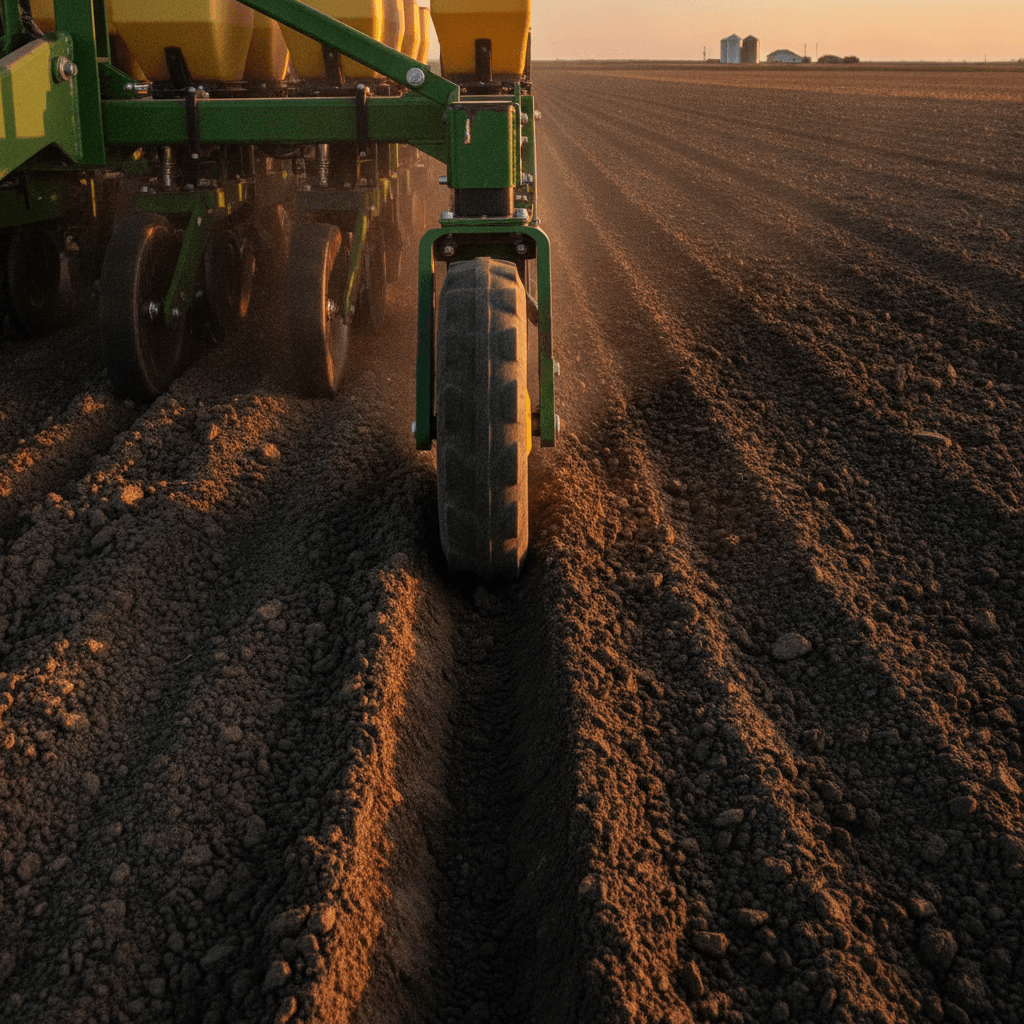
How Do Farmers Near Watertown Know Whether Their Planter’s Gauge Wheel Is Actually Seating the Seed Trench Wall — Or Just Compacting Soil Beside It?
Most farmers think about gauge wheels in terms of depth — are they setting the right depth, are they worn down, do they need replacing. What doesn’t get talked about nearly as much is what the gauge wheel is doing to the trench wall itself. If your gauge wheel isn’t properly pressing against the trench wall as the seed drops, you’re not getting the seed-to-soil contact you think you are. The seed is sitting in a void, the trench wall is either loose or over-compacted in the wrong place, and your germination numbers tell you something went wrong without ever telling you exactly where. For farmers near Watertown working through wet spring soils and no-till corn and soybean ground, this problem shows up more often than most want to admit.
Why Trench Wall Contact Actually Matters
When a disc opener cuts a furrow, the soil on either side of that cut doesn’t just stay put and wait for the seed. The trench walls need to be firmed back toward the seed after it drops. That’s a job the gauge wheel and the closing system share. The gauge wheel — rolling right alongside the disc — is supposed to press the near trench wall inward to keep the furrow walls from sloughing loose and creating an air pocket around the seed.
If the gauge wheel is worn, misaligned, or not the right size for your disc opener setup, it won’t make that lateral contact with the trench wall effectively. It might be setting depth adequately — the row unit is running at the right level — but it’s not doing the wall-firming work. The result is inconsistent germination across the field, especially in wet conditions where the trench wall tends to collapse inward or sidewall smear rather than stay clean.
In Codington County and the surrounding area near Watertown, a lot of that ground is heavy, holds water late into spring, and has significant no-till residue load from corn-on-corn or corn-soybean rotations. In those conditions, a gauge wheel that isn’t maintaining true lateral contact with the trench wall is leaving yield on the table with every pass.
The Signs You’re Not Getting True Trench Wall Contact
Here’s how to know the problem is actually happening in your field, not just in theory:
- Uneven emergence across rows. If some rows consistently emerge two to three days behind others and there’s no obvious fertility or moisture explanation, trench wall contact is a likely culprit. The seeds in the lagging rows are sitting in a loose or collapsed furrow.
- Visible seed spacing variation in the furrow. After planting, open a few furrows by hand before the closing wheel covers them. If seeds are rocking or sitting in loose crumbles rather than pressed against a firm wall, the gauge wheel isn’t doing the job.
- Gauge wheel riding high on residue in no-till. If the wheel is floating on mat residue instead of engaging the soil surface and disc properly, it’s not positioned to press the trench wall at all. This is especially common on the first field after a wet week.
- Cupped or worn tire profile. A gauge wheel tire that’s worn unevenly or cupped inward changes the contact angle with the disc and the trench wall. Even if it looks like it still has rubber, the geometry is off.
What Most Competitor Resources Don’t Tell You
Spend some time on the major gauge wheel supplier sites and you’ll find plenty about gauge wheel material, spoke design, mud-shedding, and downforce. What you won’t find much of is a direct explanation of how gauge wheel geometry — specifically the relationship between the wheel’s lateral face and the disc opener — determines whether you’re getting true trench wall firming or just approximate depth control.
That’s a real gap, because the spoke design and the wheel’s rigidity under load are directly tied to whether it maintains lateral pressure on the trench wall when the disc is cutting through soft or variable-condition soil. A wheel with the right spoke geometry holds its shape and its position against the disc. A cheap or worn wheel deflects under load, floats away from the disc face, and stops firming the wall.
The Curved Spoked Gauge Wheels from Jung Enterprise are built with this in mind. The curved spoke design maintains structural rigidity under downforce load so the wheel doesn’t flex away from the disc face when it hits resistance — wet soil, clod, or compacted no-till ground. That rigidity is what keeps the wheel in contact with both the disc and the trench wall through variable conditions, not just ideal ones. The open spoke design also clears mud instead of packing it, which keeps the wheel running true rather than building up a mud wedge that pushes the wheel out of position.
The Wear Problem That Sneaks Up on You
Gauge wheel wear doesn’t always announce itself. You can have a wheel that looks functional at the start of the season but has lost enough profile that its lateral contact with the disc and trench wall is compromised. The Jung Enterprise steel rings and curved spoked gauge wheels are field-tested to only 1/16″ of wear over 13,000 planted acres across three years. That kind of wear rate matters because it means you’re not gradually losing trench wall contact performance across the season or across years. You’re running with consistent geometry from the first pass to the last.
Compare that to a wheel that’s worn down significantly by mid-season — somewhere around the point where farmers near Huron or Aberdeen are starting to push through heavy, wet late-May ground. At that point, even a few thousandths of profile loss changes how the wheel contacts the disc and the trench wall. Your seed placement data might look fine. Your emergence won’t.
What to Check Before You Assume It’s a Closing Wheel Problem
A lot of farmers who have inconsistent seed-to-soil contact go straight to the closing wheel as the culprit. That’s sometimes right. But it’s worth ruling out the gauge wheel first, because if the trench wall is already compromised before the closing wheel gets there, the closing wheel can’t fully correct it. Check these things in order:
- Gauge wheel profile — is it worn unevenly or cupped?
- Gauge wheel position relative to the disc — is it running tight against the disc face, or has wear or mounting allowed it to drift?
- Spoke condition — are spokes cracked, bent, or packed with debris that’s changing the wheel’s effective diameter or lateral position?
- Wheel retainer — is the gauge wheel actually seated properly on the arm? A wheel that’s slightly dislodged will lose lateral contact with the disc before it loses depth control. Check your wheel retainer to make sure the wheel isn’t backing off the mount under field loads.
Frequently Asked Questions
How do I know if my gauge wheel is causing poor seed-to-soil contact versus my closing system?
Open the furrow after planting, before the closing wheel covers it. If the seed is sitting against a firm, clean trench wall, the gauge wheel is working. If the wall is crumbled or loose around the seed, start with the gauge wheel. Closing wheel problems typically show up as open furrows or sidewall smear visible after the row unit passes.
Does spoke design actually affect trench wall contact, or is it mainly about mud-shedding?
Both. The curved spoke design sheds mud, which keeps the wheel running at its true diameter and position. But the spoke geometry also affects how the wheel flexes under lateral load. A wheel that deflects under pressure loses contact with the disc face, which directly reduces trench wall firming. Rigidity and mud-shedding work together.
Can I use Jung Enterprise curved spoked gauge wheels on my existing planter without other modifications?
The curved spoked gauge wheels are designed to fit multiple OEM gauge wheel sizes and planter brands. Contact Jung Enterprise directly to confirm fitment for your specific row unit setup before ordering.
How often should I be checking gauge wheel lateral contact during planting season?
Check at the start of the season and again after the first 500–1,000 acres, especially if you’re running no-till or heavy residue ground. In wet springs across the Northern Plains, mud buildup and soil abrasion accelerate wear faster than a dry year. A mid-season check on Watertown-area clay ground is a reasonable habit.
Does the steel ring affect trench wall contact performance?
The steel ring protects the tire lip and acts as a built-in scraper to keep mud from packing between the wheel and the disc. By keeping the wheel clear of debris, it helps maintain the wheel’s correct lateral position against the disc — which supports trench wall contact. It’s not a direct contact component, but it supports the system that is.
Talk to Jung Enterprise Before Planting Season Gets Here
If you’re running Watertown-area ground — or heavy clay ground anywhere in South Dakota, North Dakota, or Minnesota — and you’re not confident your gauge wheels are actually firming the trench wall on every pass, it’s worth a conversation before spring. Jung Enterprise is based in Ipswich and builds patented, American-made gauge wheels, steel rings, and wheel retainers that are field-tested for the conditions you’re actually dealing with.
Check out the full product lineup or reach out directly to talk through your row unit setup and what’s going to fit your planter. Contact the team at Jung Enterprise here — the earlier you get this sorted before planting, the less you’re scrambling when the window opens.