
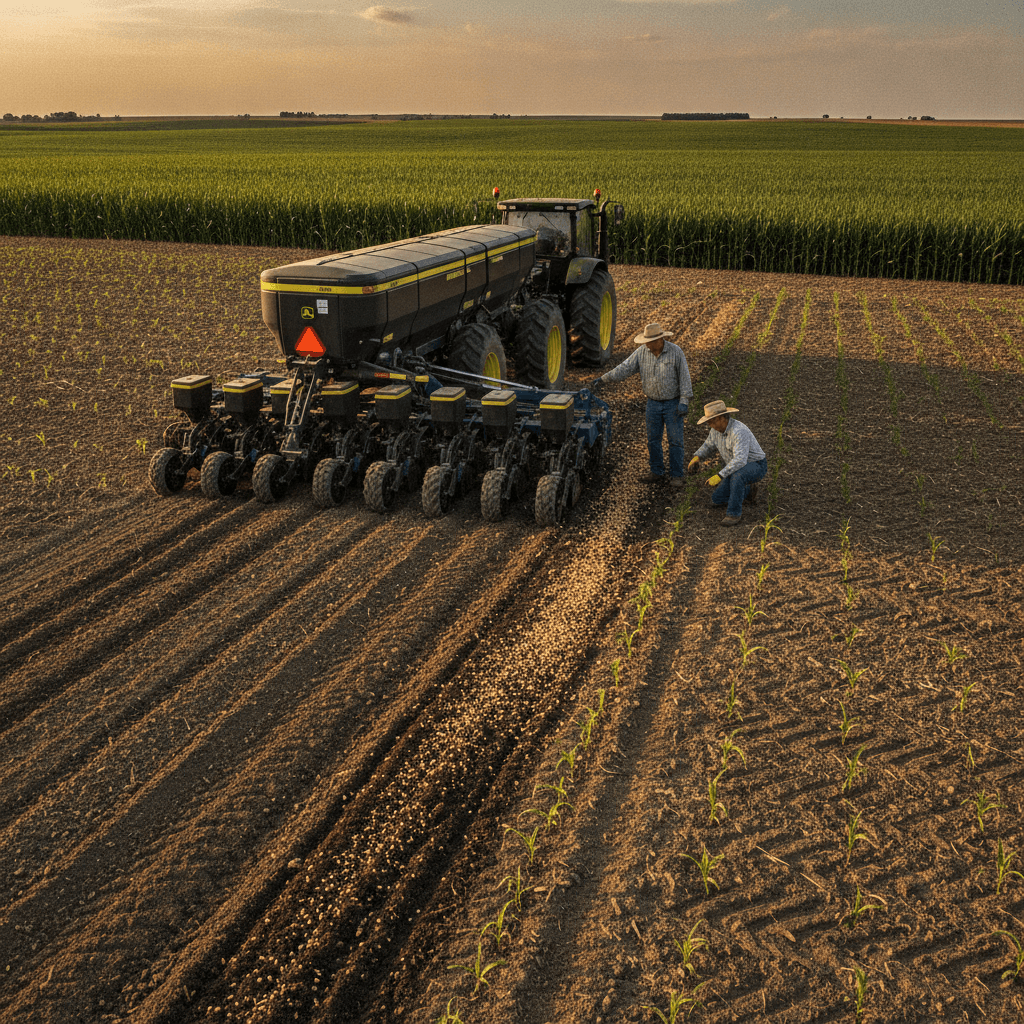
How Do Farmers Near Huron Know Whether Their Planter’s Gauge Wheel Is Actually Controlling Seeding Depth Consistently Across the Field — Or Just Floating With the Terrain?
If you’re farming ground near Huron and your corn emergence looks uneven — some plants up three days early, others lagging a week behind — there’s a good chance your gauge wheels aren’t holding depth the way you think they are. That’s not a seed problem. That’s a mechanical problem, and it starts at the gauge wheel. At Jung Enterprise in Ipswich, we hear this from row-crop farmers every spring: the planter looked fine in the shop, but the field told a different story. Here’s how to know whether your gauge wheel is actually doing its job.
What Gauge Wheels Actually Do — And Where the Depth Problem Starts
Gauge wheels ride alongside the furrow opener and set how deep the seed gets placed. That’s their primary job. They’re supposed to ride on firm soil at a consistent height relative to the disk opener, maintaining your target depth — whether that’s 1.5 inches for soybeans or 2 inches for corn — across the entire field.
The problem is that they don’t always do that. On undulating ground, wet spots, transition zones between soil types, or fields with variable residue loads, gauge wheels can lift, bounce, or lose contact with the soil entirely. When that happens, the disk goes deeper than intended. Or it skips shallow. Either way, seeds end up at different depths in the same pass, and uneven emergence follows directly from that.
Most farmers assume depth variation is a downforce issue — and downforce is part of it. But if the gauge wheel itself is worn, plugged with mud, or riding on a compromised tire, no amount of downforce adjustment is going to fix it. You’re fighting the symptom instead of the cause.
How Mud and Residue Throw Off Depth Control
South Dakota soils around Huron and east toward Aberdeen can turn sticky fast in a wet spring. Clay-heavy and gumbo ground packs onto gauge wheel tires and doesn’t shed on its own. Once that mud builds up enough on the tire sidewall and lip, the effective diameter of the wheel changes. The gauge wheel is now sitting higher than your depth setting accounts for, and the seed is going in shallow — sometimes by a quarter inch or more — without any visible indicator on the planter monitor.
Residue is a separate problem. In no-till and strip-till fields with standing corn stalks, loose chaff accumulates in the spokes of a solid gauge wheel. That accumulation acts like a wedge, pushing the wheel off its intended position or creating intermittent contact with the soil. Open-spoke designs like Jung Enterprise’s Curved Spoked Gauge Wheels shed that material instead of collecting it, which is a design difference that directly affects depth consistency across high-residue fields.
The Tire Lip Problem Nobody Talks About
One angle that most competitors gloss over is what happens to the gauge wheel tire lip over time. The tire lip is the outer edge of the gauge wheel tire — it’s what makes direct soil contact and transfers the downforce into a depth-setting signal. When that lip wears down from season after season of abrasive soil contact, the wheel no longer sits at the same height relative to the opener. You’ve lost calibration on every row unit, and you probably don’t know it.
Jung Enterprise’s patented Steel Ring mounts directly to the gauge wheel and protects that tire lip from wear. It doubles as a built-in scraper — so you’re not buying a separate scraper part and a separate protection part. One component handles both functions. Field testing has shown just 1/16 inch of wear after 13,000 planted acres across three seasons. That’s the kind of durability number that matters when you’re putting on 2,000 acres a year and can’t afford to be guessing whether your depth control is still accurate by mid-May.
What Consistent Depth Actually Looks Like in the Field
If your gauge wheels are working correctly — tire lip intact, mud shedding cleanly, spokes clearing residue — you should see emergence within a 48-to-72-hour window across the majority of the field. Corn that plants at a true 2 inches in 50-degree soil will emerge in roughly 10 to 14 days. If you’re seeing 20 to 25 percent of plants come up 5 to 7 days later than the rest, depth variation is almost always a factor.
Walk a hundred feet of row after planting in variable conditions. Use a pocket knife or a probe to check actual seed depth at 10 random spots. If you’re seeing more than a half-inch of variation between measurements, something mechanical is allowing the row unit to float. That’s where the investigation starts — gauge wheel condition, tire lip wear, and residue clearance, in that order.
Why This Topic Gets Skipped by Most Gauge Wheel Manufacturers
Most competitor content focuses on features — spoke count, material specs, compatibility charts. What it doesn’t address is the specific mechanism by which depth control degrades over time and across variable field conditions. That’s the gap worth filling, because it’s the information you actually need to make a decision about whether to replace or upgrade gauge wheel components before planting season, not after you’ve already lost yield to uneven emergence.
Jung Enterprise builds parts in Ipswich, South Dakota, tested on real Northern Plains ground. The Steel Ring, Curved Spoked Gauge Wheels, and Wheel Retainer are designed to work as a system — protecting the tire, controlling depth, and keeping the wheel seated. If you want to see the full product lineup and how each component fits your planter setup, browse the Jung Enterprise product catalog here.
Frequently Asked Questions
How much seeding depth variation is acceptable for corn near Huron?
Most agronomists put the threshold at plus or minus a quarter inch from target depth. Beyond that, you’ll start to see emergence timing differences that affect canopy closure, pollination timing, and ultimately yield. A half inch of variation or more across multiple row units is a mechanical problem that needs to be corrected before the next planting season.
Can a worn gauge wheel tire lip actually cause measurable yield loss?
Yes. A worn tire lip changes the effective diameter of the wheel, which shifts the depth reference point without any visible warning. If the lip is worn significantly, you can be planting a quarter inch shallower than your setting indicates — consistently, across every acre, without knowing it. In dry early-season conditions, shallow planting means poor germination and uneven stands.
Does the open-spoke gauge wheel design actually make a difference in South Dakota clay soils?
It does, particularly in fields with significant residue. Solid-spoke wheels accumulate material in wet conditions that disrupts consistent soil contact. The curved spoke design sheds residue and mud during rotation, which means the wheel maintains its intended soil contact profile across variable terrain instead of riding on accumulated debris.
How do I know if my gauge wheel retainer is affecting depth control?
A gauge wheel that has shifted laterally — even slightly — because the retainer has failed or loosened will not apply downforce straight down into the soil. It introduces lateral load that can cause the wheel to skip or bounce. If your gauge wheel looks like it’s sitting at an angle on the row unit, the retainer is the first thing to check. See the Wheel Retainer product page for fit and installation details.
When is the right time to replace gauge wheel components near Aberdeen and Huron?
Pre-plant inspection — ideally in February or March — is the right window. By April, lead times get tight and you’re making rushed decisions on parts. Inspect tire lip wear, spoke condition, and retainer seating before the ground thaws. If there’s visible wear or you’re unsure, that’s the time to call, not mid-field during the planting window.
Ready to Stop Guessing About Seeding Depth?
If you’re farming near Huron, Aberdeen, or anywhere across eastern South Dakota and you’re not confident your gauge wheels are delivering consistent depth, Jung Enterprise in Ipswich can help you sort it out. We build American-made, patented gauge wheel components that are field-tested for Northern Plains conditions — not engineered for catalog photos. Reach out before planting season locks in and your options narrow. Contact Jung Enterprise here or call (605) 281-0497 to talk through your setup.