
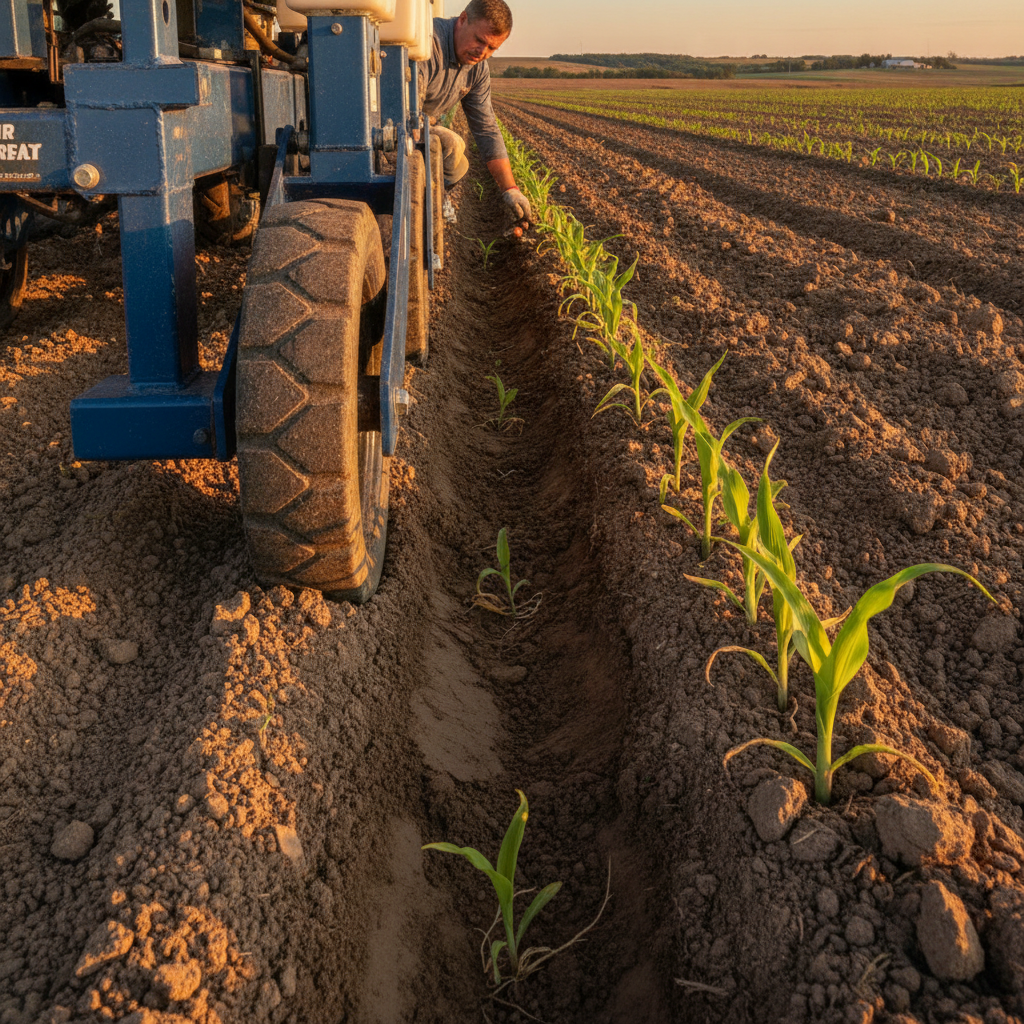
How Do Farmers Near Huron Know Whether Their Planter’s Gauge Wheel Is Actually Causing Sidewall Compaction — Or Just Pressing Seed to Depth the Way It Should?
If you’re farming near Huron and you’ve had a spring where the planter looked like it was running perfectly — good depth, clean furrow, consistent seed spacing — but your stands came in uneven or your roots looked strangled at first pull, sidewall compaction from the gauge wheel is worth putting at the top of your diagnostic list. This isn’t a widely discussed problem, but it’s one of the more frustrating ones because everything looks fine above ground until it isn’t.
Sidewall compaction happens when a gauge wheel — especially one that’s worn, running too much pressure, or carrying mud on its surface — smears and glazes the wall of the seed furrow instead of simply rolling against it to set depth. That glazed wall acts like a barrier. Roots trying to push laterally out of the furrow hit a slick, compacted layer and either stall or redirect downward. The seed germinates. The plant emerges. But it never roots out the way it should, and you see it in yield maps before you ever see it with your eyes.
Why This Problem Gets Misread So Often
Most farmers and agronomists who diagnose stand problems are looking at seeding depth, seed-to-soil contact, and closing wheel performance. Those are all legitimate checkpoints. But sidewall compaction as a standalone failure mode tends to get attributed to other causes — soil type, hybrid, planting date — because the gauge wheel is assumed to be doing its job as long as it’s holding depth.
The trouble is, a gauge wheel can hold depth and still be damaging the furrow wall at the same time. The two functions aren’t mutually exclusive. And in the heavier soils around central South Dakota — the tight gumbo and clay-based ground that stays wet late into April and May — the risk is higher because wet soil smears rather than shearing cleanly when a wheel rolls against it under pressure.
This is a gap that most competitor content doesn’t address directly. You’ll find plenty of discussion about gauge wheel depth control and spoke design for mud shedding, but very little that explains the mechanical difference between a wheel that sets depth cleanly and one that’s actively degrading the furrow wall in the process.
What’s Actually Happening at the Furrow Wall
When a gauge wheel is functioning correctly, it rolls against the side of the open furrow with enough contact to set depth consistently without applying lateral pressure that compresses the soil wall. The wheel surface should be clean and rolling freely. The spoke design matters here — an open-spoke wheel that sheds mud keeps a cleaner rolling surface in contact with the furrow wall compared to a wheel that’s carrying a ring of packed soil on its face.
When things go wrong, it usually comes from one of three places:
- Mud buildup on the wheel face. A gauge wheel carrying packed mud on its tire surface is no longer rolling against the furrow wall — it’s dragging a muddy mass along it. That dragging action smears the wall instead of leaving a clean, open soil structure that roots can penetrate.
- Worn tire lip. A gauge wheel tire that’s worn at the lip changes the contact geometry with the furrow wall. Instead of a consistent, clean profile, you get irregular contact that creates pressure points along the wall — exactly where smearing is most likely.
- Excess downforce combined with wet conditions. Downforce that’s appropriate for dry ground can become too aggressive in wet conditions, pushing the gauge wheel harder into the furrow wall than the soil can handle without compacting.
How to Tell the Difference in the Field
The clearest diagnostic is a furrow wall check in-season, early — ideally within the first week after planting before the soil profile dries and masks what happened. Dig alongside a seed placement point and look at the furrow wall directly. A clean furrow wall will have visible soil structure — small aggregates, some texture. A compacted furrow wall will look smooth and slightly glazed, sometimes with a visible color difference from the surrounding soil. Press your thumbnail into it. If it resists and doesn’t crumble, that’s compaction.
At emergence, look for delayed or uneven rootout when you pull seedlings. Roots that have hit a compacted wall tend to redirect downward earlier than they should, and lateral root development in the first few weeks will be noticeably thinner compared to plants from rows that don’t show the same furrow wall condition.
How Gauge Wheel Design Reduces Sidewall Smearing
This is where the open-spoke design of Jung Enterprise’s Curved Spoked Gauge Wheels addresses the problem directly. The curved spoke geometry actively sheds mud and debris rather than letting it pack on the wheel face. A cleaner wheel face means the contact with the furrow wall stays consistent and rolling — not dragging a muddy surface that smears as it goes.
Beyond spoke design, protecting the tire lip matters too. A worn tire lip changes the wheel’s contact profile with the furrow wall in ways that increase smearing risk, especially in wet conditions. The Steel Ring from Jung Enterprise protects that tire lip from wear — field-tested to just 1/16″ of wear after 13,000 planted acres over three years — so the geometry of the wheel stays consistent across the full season rather than degrading mid-spring when you’re most likely to be planting into wet conditions.
The Steel Ring also doubles as a built-in scraper, which means there’s no separate scraper to install or adjust. It’s one part doing two jobs, which matters when you’re trying to keep the wheel face clean in the kind of heavy, sticky clay ground that surrounds Huron and extends south toward Mitchell and north toward Aberdeen.
What Farmers Near Huron Should Check Before Planting
- Pull the gauge wheels and inspect the tire lip for wear. If the lip profile has changed noticeably from factory, you’re already planting with changed contact geometry.
- Check the spoke condition. If spokes are caked with soil from last season and don’t clean up easily, that’s a sign the wheel face isn’t shedding the way it should be under field conditions.
- Review your downforce settings relative to last year’s soil conditions. What worked in a dry spring won’t be right for a wet one, and that gap is where sidewall compaction risk spikes.
- Do a row-by-row check if you have any rows at the toolbar ends or center that have historically shown lower yields — those rows are sometimes running under different effective downforce and are the first place sidewall compaction shows up in yield data.
For a full look at what Jung Enterprise offers for gauge wheel protection and performance, see the complete product lineup. All parts are American-made, patented, and built for the kind of acres and conditions that farmers across the Northern Plains are actually running.
Frequently Asked Questions
Can sidewall compaction from a gauge wheel actually affect yield, or is it a minor factor?
It’s not minor when conditions are right for it. In wet springs with heavy clay soils — which is a regular situation around Huron and across central South Dakota — sidewall smearing can restrict lateral root development enough to noticeably affect standability and nutrient uptake. Whether it shows up in your yield map depends on how widespread it is across the field and how wet conditions were at planting.
Is sidewall compaction more of a no-till problem or does it happen in tilled ground too?
It happens in both, but no-till ground is at higher risk because the soil structure at the furrow wall is more intact and more susceptible to smearing when wet. In tilled ground, the loosened soil structure gives somewhat before compacting. In no-till, there’s less give, and a wet furrow wall will smear more readily under the same gauge wheel pressure.
Does an open-spoke gauge wheel actually stay cleaner than a solid wheel in heavy mud, or does it still pack up?
An open curved-spoke design sheds mud significantly better than a solid or flat-spoke design — the curved geometry creates a self-cleaning action as the wheel rotates. It’s not immune to packing in extremely heavy gumbo, but it stays cleaner longer than a wheel without that design, which means more passes before the wheel face starts affecting furrow wall quality.
Will a worn gauge wheel tire always cause sidewall compaction, or only in certain conditions?
A worn tire lip increases the risk, particularly in wet conditions and heavier soils. In dry, sandy, or well-structured soils, a worn lip may not cause noticeable compaction issues. But if you’re planting into the kind of tight, wet ground common in central South Dakota or across the Northern Plains in a wet spring, a worn tire lip combined with heavy downforce is the combination most likely to show up as a furrow wall problem.
How do I know if the Steel Ring from Jung Enterprise will fit my planter’s gauge wheel?
Jung Enterprise’s Steel Ring is designed to fit gauge wheels across multiple OEM brands and sizes for planters, air seeders, and no-till drills. Contact us directly with your planter make, model, and gauge wheel size and we’ll confirm compatibility before you order.
If you’re heading into planting season near Huron — or anywhere across South Dakota, North Dakota, Minnesota, or Nebraska — and you want to know whether your gauge wheels are set up to plant clean furrows without compacting the walls, reach out to Jung Enterprise directly. We’re a family-owned manufacturer based in Ipswich, and we’d rather help you get the right part for your setup than sell you something that doesn’t fit your ground. Contact us here or call (605) 281-0497.