
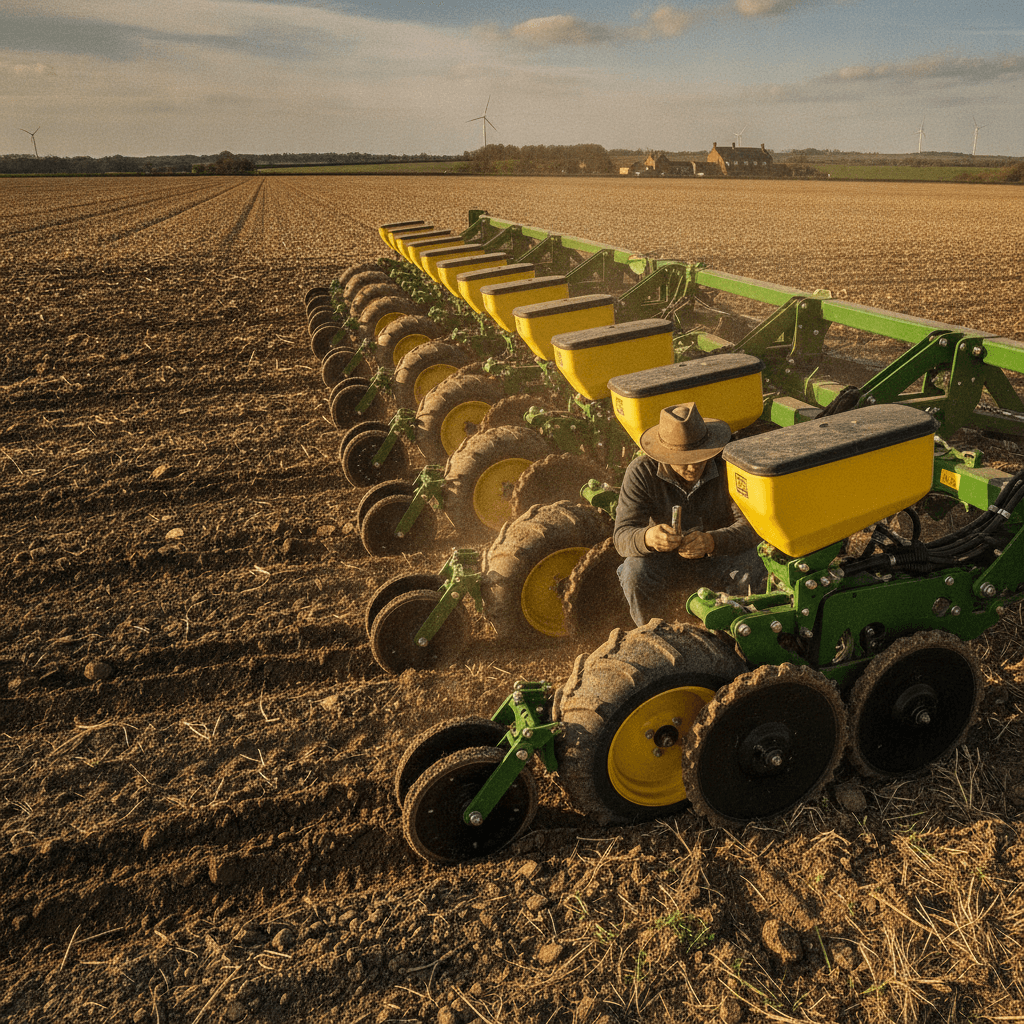
How Do Farmers Near Ipswich Know Whether Their Planter’s Gauge Wheels Are Actually Sized Right for Their Row Spacing — Or Just Running What Came on the Machine?
If you’re farming near Ipswich and your planter is leaving patchy stands or inconsistent emergence rows, the gauge wheels are worth a hard look — not just for wear, but for whether they’re actually the right size for how you’re running the machine. Most farmers bolt on whatever came with the planter or grab the same size they replaced last time without questioning the fit. That works until it doesn’t, and by the time you see the problem in the field, you’ve already lost time you can’t get back during a tight South Dakota planting window.
Why Gauge Wheel Sizing Doesn’t Get Enough Attention
Spend time on the websites of the major gauge wheel manufacturers and you’ll find plenty of coverage on wear rates, scraper designs, and mud-shedding performance. What you won’t find much of is a plain-language explanation of how gauge wheel diameter and width interact with your specific row spacing — and why running the wrong combination causes real problems. This is a gap most operators don’t know to ask about until a dealer or agronomist points it out.
The gauge wheel does two things: it rides alongside the seed furrow to control planting depth, and it applies side pressure to hold the disk open at the right angle. If the wheel diameter is off relative to the disk blades on your row unit, you lose leverage on depth control. If the width is wrong for your row spacing — especially on narrow-row setups or 15-inch rows that some Northern Plains farmers run for soybeans — you risk the wheel interfering with adjacent row units or not sitting flush against the disk blade the way it needs to.
Farmers running 30-inch corn rows have more room to work with. But switch to 20-inch or 15-inch row spacings for soybeans or small grains, and sizing tolerances get a lot tighter. That’s true whether you’re running a planter, an air seeder, or a no-till drill in the heavy clay soils you’ll find across Spink County and down toward Huron.
What the Spec Sheet Doesn’t Tell You About Your Field Conditions
Gauge wheel sizing specs from the OEM are built around average soil conditions. They don’t account for the kind of wet, sticky clay and gumbo soils that are common around Aberdeen and across the James River valley in the spring. In those conditions, a gauge wheel that’s technically the right diameter can still cause problems if the tread design packs and doesn’t shed mud between passes. The wheel ends up running wider than its spec as mud builds up, which changes how it seats against the disk blade and throws off your depth setting.
This is one reason the open-spoke design matters as much as the dimensions. Jung Enterprise’s curved spoked gauge wheels are built specifically to shed that mud load and keep the wheel running true to its actual size through the full planting pass. Field-tested to only 1/16 inch of wear after 13,000 planted acres over three years, they hold their dimensional integrity longer than most alternatives — which means the sizing you verify at the start of the season is still the sizing you’re running at the end of it.
How to Check Whether Your Current Wheels Are Actually the Right Fit
You don’t need a lot of tools to do this check, but you do need to do it before the planter rolls out of the shed. Here’s what to look at:
- Measure the gauge wheel diameter against your disk blade diameter. The wheel should be slightly smaller than the disk to maintain consistent contact along the blade edge. If it’s too close to the same size, or larger, you’re going to get inconsistent depth readings.
- Check the wheel-to-hub offset on narrow-row units. On setups with 15- or 20-inch row spacing, verify there’s clearance between adjacent row unit components. A wheel that’s fine on 30-inch rows can physically conflict on narrower spacings.
- Look at wear patterns on the existing wheel. Uneven or one-sided wear often points to an offset or sizing mismatch, not just normal use.
- Verify the mounting hub fits your axle diameter. Gauge wheels from different manufacturers don’t always share the same hub bore, even when the outer diameter looks identical. Running the wrong bore size creates slop that degrades depth consistency regardless of how good the wheel itself is.
- Check compatibility across all row units on the machine. If you’ve replaced wheels on some rows but not others, you may have mixed sizes running side by side — and that inconsistency shows up in your stand maps if you’re looking for it.
Row Spacing Specifics: What Changes and What Doesn’t
For most farmers near Ipswich running standard 30-inch corn rows, gauge wheel sizing is relatively forgiving — the OEM spec is usually fine if the wheel isn’t worn out. Where sizing becomes more critical:
- Narrow-row soybeans (15–20 inch): Requires closer attention to wheel width and offset to avoid interference between row units. Some OEM wheels aren’t designed with this spacing in mind, even if the machine is marketed as narrow-row compatible.
- Air seeders and no-till drills: These machines typically run narrower openers than row-crop planters, and gauge wheel sizing is often less standardized across brands. If you’ve swapped drill frames, added sections, or changed from one OEM brand to another, don’t assume the wheels transferred correctly.
- Strip-till setups transitioning to no-till: Farmers across North Dakota and Minnesota who have shifted from strip-till to full no-till sometimes find that their existing gauge wheel spec is undersized for the residue and soil resistance they’re now encountering, which changes how much wheel-to-disk contact pressure they actually get.
If you’re running equipment near Fargo or Sioux Falls and dealing with heavy spring residue on top of wet soils, these sizing questions compound quickly.
What to Do When the Sizing Is Off
If you confirm a sizing mismatch, the fix isn’t always buying new gauge wheels. Sometimes it’s a hub spacer, sometimes it’s swapping to a different wheel width while keeping the same diameter. The important thing is matching the replacement to your specific row unit configuration, not just to the planter model number — because the same planter model can be set up with different row spacings, different disk sizes, and different closing wheel configurations that all affect what gauge wheel actually fits correctly.
Jung Enterprise’s product line is built to fit planters, air seeders, and no-till drills across multiple OEM brands and gauge wheel sizes. If you’re not sure what fits your machine, reach out directly — that’s a faster path than trying to cross-reference part numbers across three different manufacturer catalogs before planting season starts.
Frequently Asked Questions
Does gauge wheel diameter matter if the wheel isn’t visibly worn?
Yes. Even a new wheel that’s the wrong diameter for your disk blade size will give you inconsistent depth control. Sizing and wear are separate issues — both need to be right.
Can I run different gauge wheel sizes on different row units of the same planter?
Technically yes, but it will show up as row-to-row depth variation. If you’ve mixed sizes across a multi-row planter, you’re likely seeing it in your stand uniformity without knowing why. Standardize across all row units before planting season.
How do I know if my gauge wheel is sized right for narrow-row soybeans near Ipswich?
The main checks are clearance between adjacent row units and whether the wheel sits flush against the disk blade without being forced inward by the tight spacing. If you’re changing row spacing on an existing planter, verify fit before the field — not during.
Do Jung Enterprise curved spoked gauge wheels fit multiple row spacings?
Yes. They’re designed to fit planters, air seeders, and no-till drills across multiple OEM configurations and gauge wheel sizes. Contact Jung Enterprise to confirm the right fit for your specific setup before ordering.
Does the steel ring on the gauge wheel tire affect sizing?
The steel ring protects the tire lip and acts as a built-in scraper — it doesn’t change the functional diameter of the wheel in a way that affects depth control. That said, if you’re adding a steel ring to a wheel that’s already at the upper edge of its size tolerance, it’s worth confirming clearance with your disk blade. Jung Enterprise can help you check that.
Talk to Jung Enterprise Before Planting Season Locks In Your Setup
Getting gauge wheel sizing right is one of those things that takes maybe 30 minutes before the season and saves you a full day of troubleshooting during it. If you’re farming near Ipswich, Aberdeen, Huron, or anywhere across South Dakota and the Northern Plains and you’re not certain your current wheels are actually sized right for your row spacing and soil conditions, it’s worth a conversation now rather than after emergence tells you something went wrong.
Contact Jung Enterprise to talk through your row unit configuration and find out whether your current gauge wheel setup is actually dialed in — or just close enough to cost you at planting time.