
How Do Corn and Soybean Farmers Near Ipswich Know Whether Their Planter’s Gauge Wheel Is Actually Running the Right Spoke Geometry for Their Soil Type — Or Just Using Whatever Came Stock From the Factory?
If you’re farming corn or soybeans near Ipswich and you haven’t thought hard about gauge wheel spoke geometry, you’re probably not alone — but you might be leaving yield on the table. The gauge wheel that shipped on your planter was designed to cover a wide range of conditions across a lot of different geographies. That doesn’t mean it’s the right design for the heavy clay and gumbo ground that shows up every wet spring across central South Dakota. When spoke geometry doesn’t match your soil type, the result isn’t catastrophic — it’s subtle. Depth drifts. Mud packs. Seed placement gets inconsistent. And by the time you notice, you’ve already planted a few hundred acres with the problem baked in.
What Spoke Geometry Actually Does (And Why It’s Not Just About Mud)
Most conversations about gauge wheel spokes start and end with mud shedding — and that’s fair, because plugged wheels are a real problem in the Northern Plains. But spoke geometry does more than just shed mud. The shape, angle, and curvature of the spokes affect how the wheel contacts the soil, how it rolls through residue, and how consistently it maintains the furrow depth the disc opener is trying to hold.
A flat-spoke or straight-spoke design rolls through soil with relatively uniform contact. That works fine in light, loamy ground. In heavier soils — the kind of sticky, high-clay material you find in fields near Huron or stretching north toward Aberdeen — straight spokes give mud a flat surface to pack against. Once that happens, you don’t have an open-spoke gauge wheel anymore. You have a partial disc that’s carrying weight unevenly and running inconsistent depth row to row.
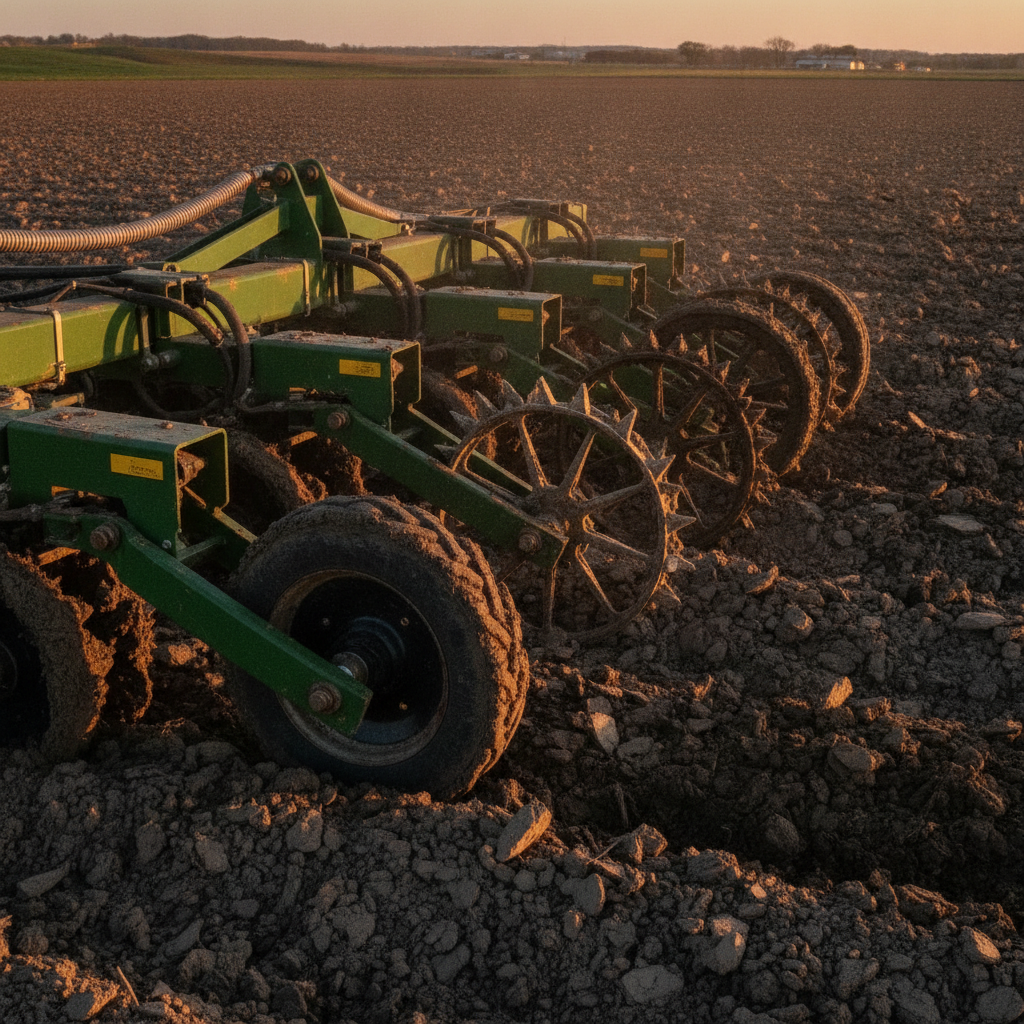
Curved spoke geometry changes that dynamic. The curve on each spoke deflects soil outward rather than letting it build a bridge across adjacent spokes. It also distributes the rolling load more evenly across the contact patch, which helps maintain consistent furrow depth in variable soil conditions — especially when you’re moving across a field that transitions from worked ground to no-till zones or through areas with heavy residue from last year’s corn crop.
The Gap Most Manufacturers Don’t Address: Matching Design to Regional Soil Conditions
Here’s something worth noting. If you spend time on the websites of the major gauge wheel suppliers, you’ll find plenty of information about materials, compatibility charts, and general mud-shedding claims. What you won’t find much of is a direct conversation about how spoke geometry should be matched to specific soil conditions — the kind of regional specificity that actually matters if you’re farming in the high-clay soils of central or northeastern South Dakota, or the heavy black dirt that shows up across southern Minnesota and Iowa.
That’s a gap. And it’s the kind of gap that pushes farmers toward default decisions — running whatever came on the planter, or replacing with the same thing because it’s what they know. For a lot of operations in this part of the country, that default is quietly costing yield every spring.
Jung Enterprise’s curved spoked gauge wheels were designed with that regional reality in mind. The open-spoke, curved design sheds mud and residue continuously through each rotation instead of letting buildup accumulate between passes. That’s not a marketing claim — it’s a geometry problem with a geometry solution, and it’s been field-tested across the kind of variable spring conditions that show up every year in South Dakota and North Dakota.
What Happens When You Plant Heavy Clay With the Wrong Spoke Design
Let’s be specific about the failure mode, because it’s easy to miss in the field until it shows up in your yield map.
When a gauge wheel packs with mud, the effective diameter of the wheel changes — slightly, but enough. As the packed mud builds up between spokes, the wheel starts riding higher on the debris rather than on the soil surface itself. The disc opener loses its depth reference. Seed drops at inconsistent depths. In corn, that translates directly to uneven emergence and variable ear size at harvest. In soybeans, inconsistent depth hits pod fill and uniform maturity. Neither one is recoverable after the seed is in the ground.
Farmers near Mitchell and in the heavier soils east of Ipswich know this problem well — especially in wet springs when the ground is saturated through most of April and you’re trying to hit a narrow planting window before conditions change. That’s exactly when spoke geometry matters most, because that’s when the clay is stickiest and most likely to bridge across a straight-spoke wheel.
Durability: What You Should Expect From a Curved Spoked Gauge Wheel
Switching gauge wheel designs is a real investment, and it’s fair to ask how long a curved spoked wheel actually holds up under field conditions. The answer matters especially for custom planters who are putting serious acres on their equipment every spring, or for farmers running 24- or 36-row planters where replacing a full set of wheels adds up fast.
Jung Enterprise’s curved spoked gauge wheels have been field-tested across 13,000 planted acres over three seasons, showing only 1/16 inch of measurable wear. That’s not a lab result — it’s real field use under the kind of abrasive, variable conditions that come standard in South Dakota and the broader Northern Plains. For comparison, OEM gauge wheels and some import alternatives show significantly more wear at that mileage, which means more frequent replacement and more mid-season downtime.
Pairing curved spoked gauge wheels with a steel ring for tire lip protection extends the life of the whole assembly further. The steel ring mounts with six screws, protects the tire bead from abrasion, and functions as a built-in scraper — so you’re not adding a separate part or extra complexity to get the scraper function. That matters when you’re trying to keep maintenance simple during planting season.
Frequently Asked Questions
Does spoke geometry really matter if I’m farming relatively dry ground?
It matters less in consistently dry, sandy loam conditions — but most farms near Ipswich don’t get consistently dry springs. Even in drier years, early-season soil near Ipswich and Aberdeen tends to hold moisture longer than it looks on the surface. Curved spoke geometry provides insurance without a performance penalty in dry conditions, so it’s not a tradeoff.
Are curved spoked gauge wheels compatible with my existing planter brand?
Jung Enterprise’s curved spoked gauge wheels are designed to fit across multiple OEM brands and gauge wheel sizes. Contact Jung Enterprise directly with your planter make and row unit model to confirm fitment before ordering.
How do I know if my current gauge wheel is packing with mud rather than shedding it?
Stop the planter mid-pass and inspect the gauge wheels on several row units. If you can see soil bridged between spokes — even partially — that wheel is not shedding cleanly. Full packing is obvious; partial packing is easy to miss until you pull the wheel off and look at it closely.
Can I mix curved spoked gauge wheels with my existing steel rings, or do I need a full replacement?
You can run curved spoked gauge wheels alongside existing steel rings as long as the components are compatible with your gauge wheel diameter and planter row unit. Jung Enterprise can help confirm compatibility if you’re unsure what you’re currently running.
Is spoke geometry relevant for air seeders and no-till drills, or just row-crop planters?
It’s relevant for all three. Air seeders and no-till drills in heavy residue and clay soils — common across North Dakota and southern Minnesota — face the same bridging and packing problems as row-crop planters. The same curved spoke advantage applies to depth consistency and mud shedding on those machines.
Get the Right Gauge Wheel for Your Ground
If you’re farming near Ipswich or anywhere across central and northeastern South Dakota and you’re still running factory-stock gauge wheels, it’s worth taking a hard look at what spoke geometry you’re actually running and whether it’s matched to the clay content and moisture conditions in your fields. The difference between a straight-spoke and a curved-spoke design may not be dramatic in a dry year on light ground, but in a wet spring on heavy soil — the kind of spring that shows up here every few years and costs real money if your planter isn’t set up right — it’s the difference between consistent seed placement and a yield map full of variability.
Contact Jung Enterprise in Ipswich to talk through your gauge wheel setup, confirm compatibility with your planter or air seeder, and find out what a curved spoked gauge wheel upgrade actually looks like for your operation. We’re a family-owned, American-made manufacturer with real field-tested results — not a catalog house pushing generic parts. If the design isn’t right for your ground, we’ll tell you that too.