
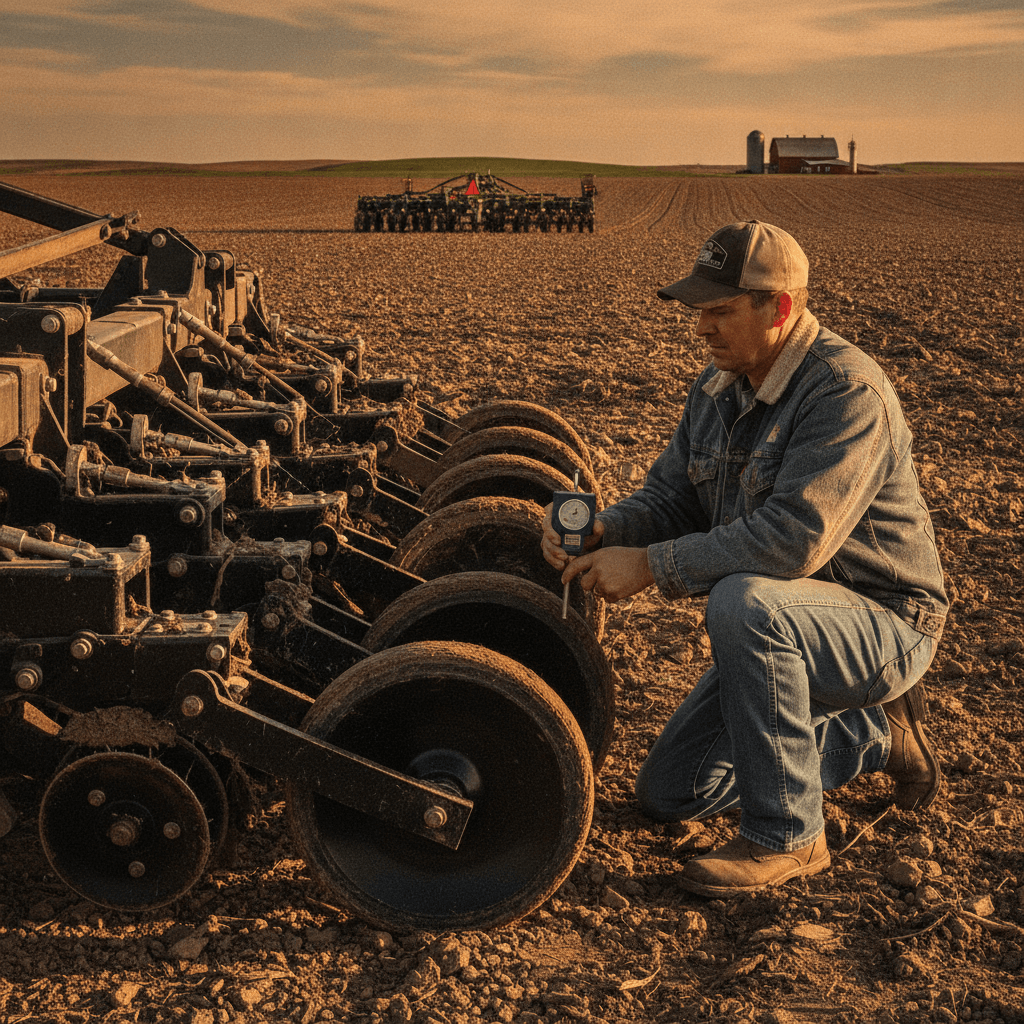
How Do Farmers Near Bismarck Know Whether Their Planter’s Gauge Wheel Tires Are Actually the Right Durometer — Or Just Soft Enough to Deform Under Load?
Farmers near Bismarck who are running high down-pressure settings — either air bag systems or springs cranked down tight — need to understand one thing that rarely shows up in any competitor’s product literature: gauge wheel tire durometer matters. Tire hardness, measured on the Shore A scale, determines how much a rubber tire deforms when it’s carrying load between the row unit and the soil. Too soft, and the tire squashes down under pressure, changes its effective contact geometry, and quietly shifts your seeding depth off target. You won’t see it happening. You’ll just see uneven emergence or a stand that never quite matches what the meter said you were putting down.
This is one of those issues that doesn’t get much attention from the major gauge wheel suppliers — most of them list diameter, width, and compatibility. Durometer? It’s either not published or buried in a spec sheet most dealers never see. That’s a gap worth closing, because in the variable soils across North Dakota and into western Minnesota, it matters more than most operators realize.
- Why Tire Hardness Actually Affects Planting Depth
- What the Competitors Aren't Telling You About Gauge Wheel Rubber
- The Open-Spoke Design Advantage When Soil Conditions Are Variable
- Tire Lip Wear Makes the Durometer Problem Worse
- What to Check on Your Own Gauge Wheels Before Planting
- FAQ: Gauge Wheel Tire Durometer and Depth Consistency
Why Tire Hardness Actually Affects Planting Depth
Gauge wheels ride on either side of the seed furrow and set the depth the opener disc cuts into the soil. The tire contacts the soil surface, and the distance between the tire’s contact point and the disc blade edge determines how deep the seed drops. That relationship is fixed — until the tire deforms.
When a gauge wheel tire is too soft, especially under heavy down pressure, the sidewall and contact patch distort. The tire’s effective rolling diameter changes. In practical terms, that means your row unit is running slightly deeper than your depth setting on the hard pass, slightly shallower on the soft pass, and varying somewhere in between across changing soil conditions. The planter looks right. The depth stop is where you set it. But the actual seed placement is drifting, row to row and pass to pass.
In wet spring conditions — which anyone farming near Bismarck or across North Dakota knows are the norm, not the exception — soft tires also compound the mud-packing problem. A deformed contact patch carries more soil per revolution, loads up faster, and requires the scraper system to work harder just to keep the wheel turning cleanly.
What the Competitors Aren’t Telling You About Gauge Wheel Rubber
Go check the product pages for gauge wheels on most of the major supplier sites. You’ll find diameter options, axle compatibility, width specs, and claims about open-spoke mud-shedding. What you almost never see is the actual durometer rating of the tire compound, or any explanation of what happens to that compound after two or three seasons of UV exposure and ozone aging — both of which soften rubber over time.
This matters for a specific practical reason: a gauge wheel that performs correctly at the start of its first season may be running noticeably softer by year three, especially if it’s stored outside or in a shed with poor UV protection. The tire looks fine. It’s not cracked or chunked. But it’s lost enough hardness that it’s no longer holding the same contact geometry it had when it was new.
The honest answer is that most rubber gauge wheel tires are in the Shore A 60–75 range when new, and they soften from there. If you’re running maximum down pressure — common on no-till setups in the heavy soils west of Bismarck — you want tires toward the harder end of that range, with a compound that holds its rating across seasons and temperature cycles.
The Open-Spoke Design Advantage When Soil Conditions Are Variable
One reason Jung Enterprise built the Curved Spoked Gauge Wheels with an open-spoke design isn’t just about mud clearance — it’s about reducing the surface area that traps soil and adds rotational mass. When a gauge wheel is loaded with packed clay between solid ribs, you’ve added weight and altered the rolling resistance of the wheel. That changes how the row unit floats and responds to terrain variation, which compounds any depth inconsistency already introduced by tire deformation.
The curved spoke geometry sheds soil as the wheel rotates, which keeps the wheel’s effective mass and rolling behavior consistent across a field with varying soil moisture. In fields north of Bismarck where you can hit dry ridge crests and wet low spots in the same quarter section, that consistency is the difference between a clean stand and a patchy one.
Tire Lip Wear Makes the Durometer Problem Worse
Here’s something that almost no one discusses in the gauge wheel space: as the tire lip wears down from disc contact, the effective wall thickness of the tire at the critical contact zone decreases. A thinner sidewall deforms more easily under the same load. So a tire that was borderline acceptable at the start of the season is effectively running at a lower functional durometer by midseason as the lip wears into the rubber.
That’s exactly the problem Jung Enterprise’s Steel Ring was designed to address. The steel ring mounts to the gauge wheel with six screws and protects the tire lip from disc-contact wear — which means the tire maintains its original wall geometry and hardness characteristics longer. It also functions as a built-in scraper, so you don’t need to add a separate scraper part to keep the wheel surface clean in North Dakota’s spring clay soils. Field testing showed only 1/16 inch of wear after 13,000 planted acres over three seasons. That’s not a marketing claim — that’s what the part actually does in working conditions.
What to Check on Your Own Gauge Wheels Before Planting
- Squeeze test across the tire sidewall: If it deflects easily with hand pressure, it’s likely softer than ideal — especially for high down-pressure applications. Compare a new tire versus one that’s been running three seasons and you’ll feel the difference immediately.
- Check the tire lip: Look for wear against the disc blade. Any significant rounding or groove cut into the tire lip is reducing wall thickness and increasing deformation risk.
- Run the planter through a test pass and pull cores: Check seed depth at multiple points across the row and compare to your depth setting. More than 1/4 inch of variation warrants a closer look at the tire condition.
- Inspect for UV cracking or surface hardening: Both indicate age-related compound degradation, which can cause unpredictable hardness variation across the tire face.
- Check your down pressure setting relative to soil conditions: If you’re running high pressure in soft soils, you’re asking a softer tire to carry more load than it was designed for — and it will deform accordingly.
Jung Enterprise is based in Ipswich, South Dakota, and works with row-crop farmers and ag dealers across the Northern Plains — including operators in North Dakota who are dealing with exactly these soil and equipment conditions. If you have questions about whether your current gauge wheels are holding up the way they should, or whether the steel ring is the right solution for protecting your tire investment, reach out directly.
FAQ: Gauge Wheel Tire Durometer and Depth Consistency
What durometer should a gauge wheel tire be for high down-pressure planting?
Generally, you want a gauge wheel tire in the Shore A 65–75 range for high down-pressure applications. Softer compounds deform under load and shift your effective seeding depth. If your supplier can’t tell you the tire’s durometer rating, that’s worth asking about before you buy.
Can a gauge wheel tire look fine but still be too soft to hold depth?
Yes. Rubber softens with age due to UV exposure, ozone, and temperature cycling — even without visible cracking or wear. A three-year-old tire can look perfectly serviceable but test significantly softer than it was new. The squeeze test is a quick field check, but it’s not a substitute for pulling depth cores.
Does the steel ring actually help with depth consistency, or is it just about wear protection?
Both. The steel ring prevents tire lip wear, which preserves the tire’s sidewall thickness and original geometry. A tire that maintains its shape holds depth more consistently than one with a worn, thinned lip. The scraper function also keeps the wheel rolling cleanly, which affects how the row unit tracks the soil surface. See the full product overview for how the steel ring, wheel retainer, and curved spoked gauge wheels work together.
Is gauge wheel tire deformation a bigger problem in clay soils near Bismarck than in lighter soils?
Clay soils resist penetration more, which means your planter generates higher reaction forces at the gauge wheel to maintain depth. That increases tire deformation risk compared to sandy or loam soils. Farmers in the heavier gumbo soils of North Dakota and western South Dakota are running conditions where tire hardness matters more, not less.
How do I know if my gauge wheels are compatible with a Jung Enterprise steel ring?
The steel ring is designed to fit multiple gauge wheel sizes and OEM brands. Contact Jung Enterprise directly with your planter make, model, and current gauge wheel size and they’ll confirm compatibility before you order.
If you’re farming near Bismarck or anywhere across North Dakota and you want to get this sorted out before planting, reach out to Jung Enterprise. We’re a family-owned manufacturer in Ipswich, South Dakota, and we build parts that are made to hold up — not just to look good on a spec sheet.