
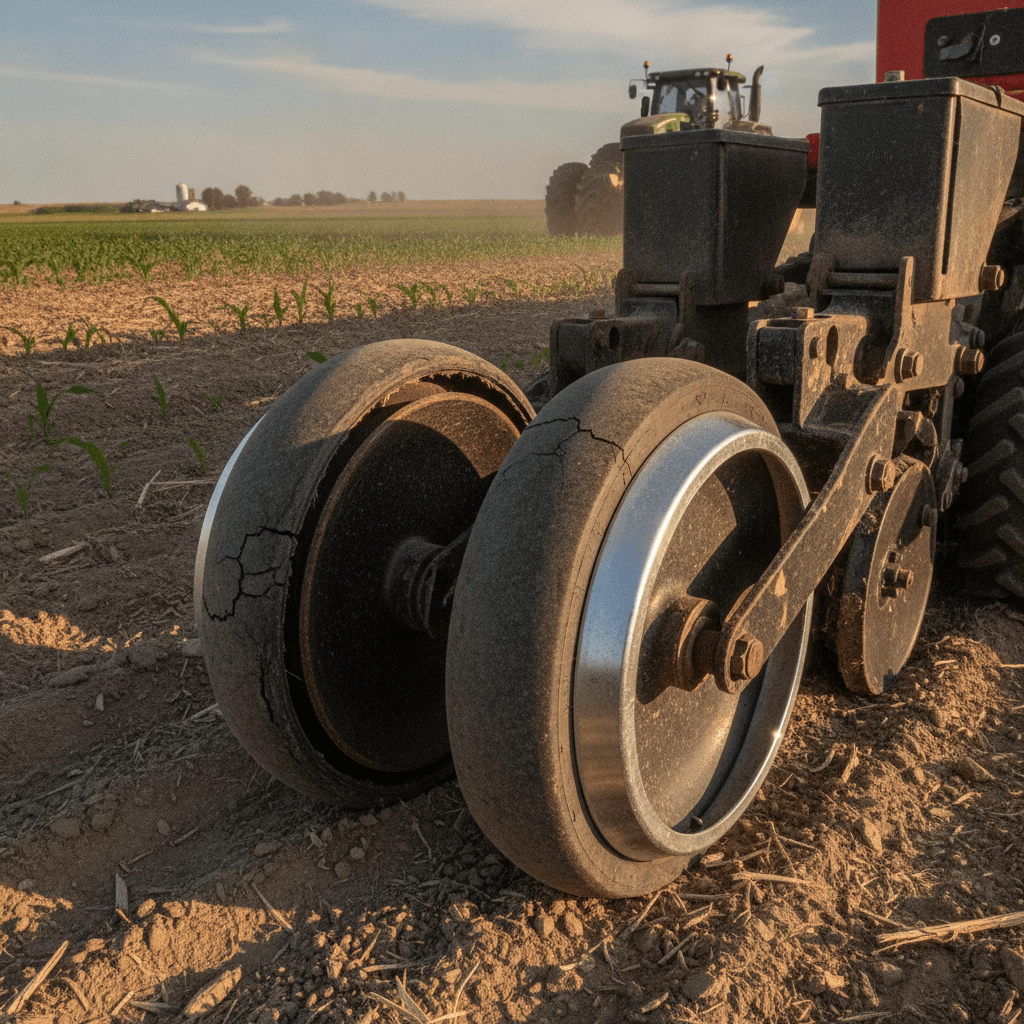
How Do Farmers Near Watertown Know Whether Their Planter’s Gauge Wheel Tire Lip Is Actually Protected — Or Slowly Grinding Away on Every Pass?
If you’re farming near Watertown and you haven’t pulled a gauge wheel off your planter and looked closely at the tire bead lately, there’s a decent chance it’s showing wear you’re not accounting for. The tire lip — that thin rubber edge where the tire seats against the rim — takes a beating every single acre. Mud packs against it, grit works under it, and on heavier soils the abrasion never really stops. Most operators don’t notice until the tire starts slipping on the rim or the bead cracks and you’re losing planting depth mid-field. By then, you’ve already lost the window.
- What's Actually Happening to the Tire Lip You Can't See From the Cab
- Why Most Competitors Don't Talk About Tire Lip Wear Specifically
- How Much Wear Is Too Much — And How Do You Know Before It's a Problem?
- What This Costs You in Downtime If You Wait
- Installation and Compatibility: What Farmers in the Field Actually Ask
- Frequently Asked Questions
- Talk to Jung Enterprise Before Your Next Planting Season Starts
What’s Actually Happening to the Tire Lip You Can’t See From the Cab
The gauge wheel tire lip isn’t designed to be a wear surface — but it ends up being one. As the tire rolls through soil, debris catches between the tire bead and the rim flange. In the clay and gumbo soils common across eastern South Dakota and into western Minnesota, that debris is abrasive, heavy, and it doesn’t let go. Every rotation grinds a little more rubber off that lip.
On a new tire, the bead seats firmly and holds consistent contact with the rim. As the lip wears, that contact gets uneven. The tire starts to move slightly on the rim under load. That movement throws off planting depth — not dramatically, not all at once, but enough to cost you stand consistency over the course of a planting season. If you’re running corn at 34,000 seeds per acre and your depth is floating by a quarter-inch on a worn tire lip, you’re not planting the field you think you’re planting.
The other problem is mud packing. When debris gets between the tire and rim, it doesn’t just cause wear — it holds moisture against the rim surface. That accelerates corrosion on the rim flange, and eventually you’ve got a rim that’s pitting out under a tire that looks fine from ten feet away.
Why Most Competitors Don’t Talk About Tire Lip Wear Specifically
Browse through most gauge wheel product pages from the usual names in this space and you’ll find a lot of discussion about tread design, spoke openings, and mud-shedding. What you won’t find is a straightforward explanation of what protects the tire lip itself — the bead-to-rim interface. That’s a gap worth paying attention to, because it’s one of the first things that fails on a high-acre planter and one of the last things operators think to inspect.
Jung Enterprise’s Steel Ring addresses this directly. It’s a patented steel ring (US 11,707,013 B2 and related patents) that mounts to the gauge wheel with six screws and wraps the tire lip, physically protecting that bead area from abrasion and debris intrusion. It also functions as a built-in scraper — so you’re not buying a separate scraper attachment and hoping it stays aligned. One part does both jobs.
How Much Wear Is Too Much — And How Do You Know Before It’s a Problem?
Here’s a practical way to check: after a full planting season, pull the gauge wheel, deflate the tire, and look at the bead where it seats on the rim flange. If you can see a visible groove worn into the rubber — even shallow — the lip is compromised. If the tire shifts at all when you try to rotate it on a deflated rim, it’s already moving under load in the field.
On unprotected gauge wheels running in heavier soils around Watertown and Aberdeen, lip wear shows up noticeably within a season or two. It accelerates fast in no-till and strip-till operations where the row unit is pushing through residue and the gauge wheel is doing real work against harder soil profiles.
The Steel Ring from Jung Enterprise has been field-tested to just 1/16″ of wear after 13,000 planted acres over three seasons. That’s not marketing language — that’s what came off an actual working planter with documented acreage. The tire lip underneath that ring stays protected because the steel takes the wear instead of the rubber.
What This Costs You in Downtime If You Wait
Replacing gauge wheel tires mid-season near Watertown — or anywhere across the Northern Plains during a tight planting window — isn’t just a parts cost. It’s a day of planting you don’t get back. In a region where the window between fit conditions and the next rain event can close in 48 hours, sitting in the shop swapping tires is a real yield hit. A set of gauge wheel tires, labor to dismount and remount, and the downtime to source parts locally can easily run into several hundred dollars per row unit when you factor in everything.
Protecting the tire lip from the start — before you’ve burned through a tire that didn’t need to go that fast — is the cheaper path. It’s also the more predictable one. When you know what’s wearing and at what rate, you can plan maintenance instead of reacting to it.
See all Jung Enterprise planter components built to reduce that kind of unplanned downtime.
Installation and Compatibility: What Farmers in the Field Actually Ask
The Steel Ring mounts with six screws and fits multiple gauge wheel sizes across common OEM planter brands. It works on planters, air seeders, and no-till drills — so if you’re running a mixed equipment lineup across your operation or running custom planting across multiple farms in the Watertown area, you’re not dealing with a part that only fits one machine. Installation doesn’t require a shop visit or specialty tools.
If you’re a dealer or distributor in eastern South Dakota or western Minnesota stocking gauge wheel parts for your customer base, this is also a straightforward add-on conversation. Farmers replacing a worn tire are already thinking about what caused the wear — the Steel Ring is the direct answer to that question.
Frequently Asked Questions
Does the Steel Ring replace the gauge wheel tire, or does it work alongside it?
It works alongside your existing gauge wheel tire. The ring mounts to the gauge wheel and wraps the tire lip to protect it from abrasion and debris. You keep running your tire — it just doesn’t wear out from the lip inward the way it would unprotected.
Will the Steel Ring work on my planter if I’m running no-till near Watertown in heavy clay soils?
Yes. The Steel Ring is specifically built for conditions where debris and abrasive soil are a constant problem. No-till operations in heavier soils are exactly where unprotected tire lips wear fastest, and where the built-in scraper function of the ring makes the most practical difference.
How does the built-in scraper on the Steel Ring work — and why does that matter?
The ring’s design includes a scraper profile that clears mud and debris from the tire surface as the wheel rotates. That means you don’t need a separate scraper attachment to prevent mud from packing around the tire bead. Fewer parts, fewer things to adjust, fewer things to lose in the field.
How long does the Steel Ring actually last compared to a standard unprotected gauge wheel setup?
Field testing showed only 1/16″ of wear on the Steel Ring after 13,000 acres planted over three seasons. The tire lip underneath remained protected throughout. An unprotected gauge wheel tire in similar conditions can show significant bead wear well within a single season in heavier soils.
Can ag dealers near Watertown or Aberdeen stock these for their customers?
Yes — dealer and distributor relationships are a big part of how Jung Enterprise operates. If you’re an equipment dealer in eastern South Dakota or into North Dakota or Minnesota, reach out directly to discuss stocking and support options.
Talk to Jung Enterprise Before Your Next Planting Season Starts
Jung Enterprise is based in Ipswich and builds patented, American-made gauge wheel components for farmers and dealers across South Dakota and the surrounding region. If your gauge wheel tire lips are showing wear, or if you’ve been replacing tires more often than you think you should be, it’s worth a conversation.
Contact us directly at jungenterprise.net/contact-us or call (605) 281-0497. We’ll tell you straight whether the Steel Ring fits your setup and what to expect.