
How Do Row-Crop Farmers Near Ipswich Know Whether Their Planter’s Gauge Wheel Tire Lip Is Actually Wearing Down Between Fields — Or Just Looks Fine Until the Tire Blows Out Mid-Season?
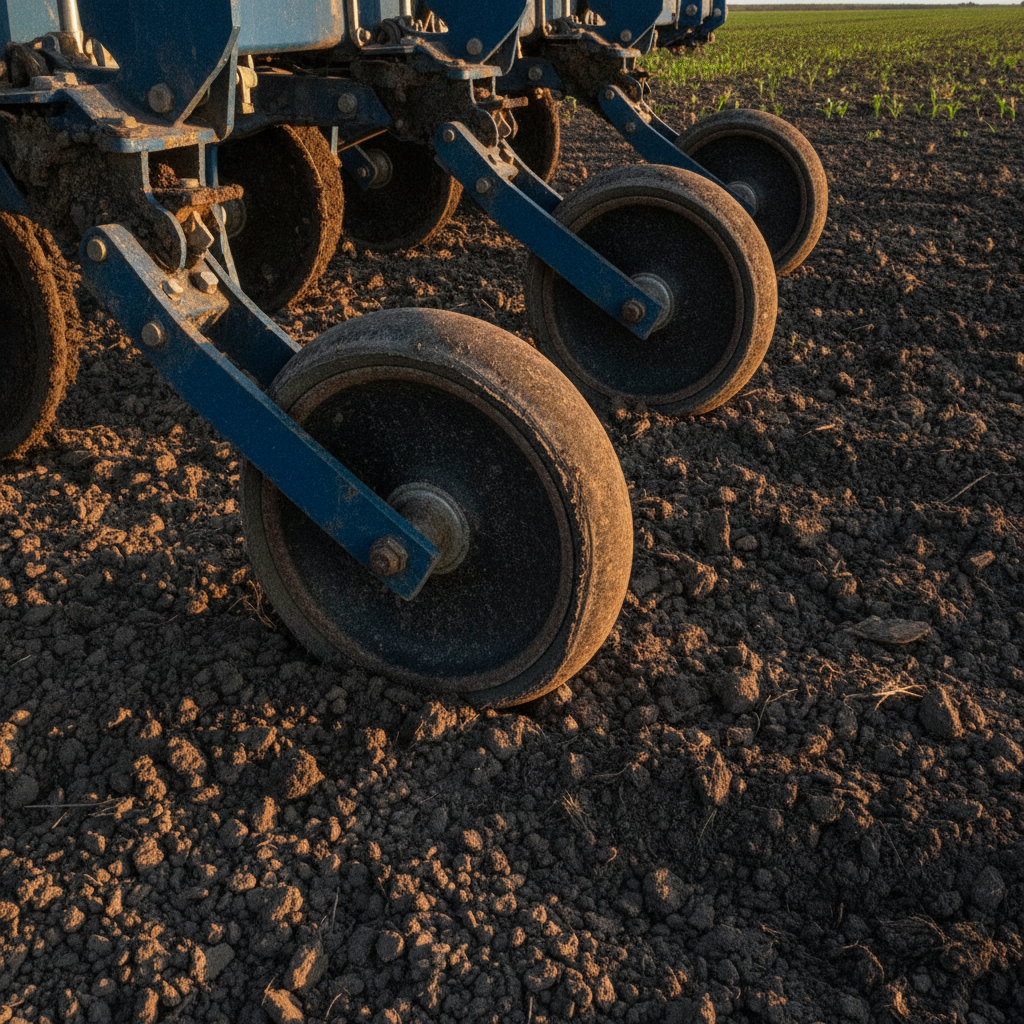
The short answer: most don’t catch it until something goes wrong. Gauge wheel tire lip wear doesn’t announce itself the way a flat tire does. The lip — that raised outer edge of the gauge wheel tire that rides against the furrow wall and helps the wheel track planting depth — wears down gradually. From the seat of a cab or a quick walk-by during a headland turn, the tire still looks inflated, still looks round, still looks like it’s doing its job. But if that lip has been ground down by abrasive clay, corn stalks, or repeated contact with hard soil, the wheel has already lost a critical piece of its depth-holding geometry. By the time you notice the problem, you’ve likely planted hundreds of acres with inconsistent seed depth — or you’re changing out a tire that blew from the inside because the lip wore through.
For farmers near Ipswich, Aberdeen, or Watertown running corn and soybeans through tight spring windows, that’s not a small problem. It’s a yield problem.
Why the Tire Lip Matters More Than Most Farmers Realize
The gauge wheel tire isn’t just there to roll. It’s doing two specific mechanical jobs: holding the row unit at the correct seeding depth and maintaining contact with the furrow wall to keep the disk opener cutting straight. The tire lip — the outer bead edge — is the part that presses against the soil and takes the brunt of that lateral load.
In normal conditions, that wear is slow enough to manage. But in the gumbo clay and heavy black soils common across the Northern Plains — from the fields east of Ipswich down toward Huron and across into parts of Minnesota — that lip is under constant abrasive pressure. The soil doesn’t give. It grinds. Add in no-till residue, wet spring conditions where the wheel is fighting mud pack-out at every revolution, and you’ve got an environment that accelerates tire lip wear significantly faster than what most tire manufacturers design around.
Once the lip is gone or significantly reduced, the wheel can rock laterally in the furrow. That lateral instability translates directly into variable seeding depth, and variable seeding depth in corn translates directly into uneven emergence and yield drag. Most agronomists will tell you that a half-inch of depth variation is enough to show up in your stand counts. A full inch is enough to show up in your yield monitor.
What Actually Causes It to Wear as Fast as It Does
This is the piece that most farmers haven’t thought through in detail — and it’s a topic the major equipment suppliers largely skip over in their product content. Tire lip wear isn’t just about mileage or acres. It’s about soil type, planting conditions, and whether the wheel has any built-in protection at that contact point.
The primary wear mechanisms are:
- Abrasive soil contact at the bead edge — Clay soils and heavy loam act like sandpaper against the rubber lip on every revolution. Sandy loam is actually easier on tires than the gumbo clay you find around the Ipswich and Aberdeen areas.
- Debris wedging under the lip — In no-till and heavy residue situations, small pieces of stalk, chaff, and hardened soil can get wedged between the tire lip and the hub flange. That material creates a localized grinding point that cuts into the rubber faster than open soil contact would.
- Mud pack-out and the scraping effect — When mud builds up on the inside face of the gauge wheel, the tire lip starts acting as a scraper against packed material. Without a proper scraper in place, that material stays packed and the lip does all the work of clearing it — wearing itself down in the process.
- Tire mounting stress over time — Repeated removal and remounting for inspection or replacement gradually degrades the lip bead integrity, especially if the wheel isn’t being remounted clean and dry.
How to Actually Inspect for Tire Lip Wear Before It Costs You
This is a five-minute inspection that most farmers skip because it requires getting hands-on with the wheel rather than just looking at it from standing height.
Pull the row unit up and get your hand on the outer face of the tire. Run your thumb along the raised lip edge around the full circumference. You’re feeling for:
- Uneven lip height — spots where the lip feels noticeably lower than adjacent sections
- Flat spots or squared-off edges where the lip should be rounded
- Cracking or checking in the rubber at the base of the lip, which indicates the lip is under stress and wearing from below
- Any section where the lip has worn flush with the sidewall face
If you’re seeing more than 1/8″ of lip height difference around the circumference, or if any section has worn flush, that wheel is compromised. In a wet spring like the ones Watertown and surrounding areas see regularly, a compromised lip means the wheel will track loose through saturated soil rather than holding firm against the furrow wall.
Do this inspection after the first 200–300 acres of the season, not just before you put the planter away in the fall. The first wet, heavy-residue fields of spring are the hardest on tire lip integrity.
What Stops Tire Lip Wear — And Why a Built-In Scraper Matters
The most direct fix is protecting the tire lip before wear starts. That’s exactly what the Jung Enterprise Steel Ring is designed to do. It mounts to the outer face of the gauge wheel with six screws, covering the vulnerable tire lip with a hardened steel barrier that takes the abrasive contact instead of the rubber.
The patented design (US 11,707,013 B2) also functions as a built-in scraper. As the wheel rotates, the steel ring clears mud and debris off the tire face — the same debris that would otherwise get packed against the lip and grind it down. You’re not adding a separate scraper part or trying to rig up a DIY solution. The scraping action is built into the ring itself.
Field results back this up. Over 13,000 planted acres across three seasons, the steel ring showed only 1/16″ of wear. The tire lip underneath remained intact and functional. That’s the kind of durability number that matters in a short planting window where you can’t afford to pull a row unit for tire replacement mid-field.
The ring is American-made, compatible with multiple gauge wheel sizes, and fits planters, air seeders, and no-till drills across the major OEM brands. If you’re running a no-till or strip-till operation — which is increasingly common across South Dakota and North Dakota — the steel ring is especially relevant because residue contact is constant and tire lip wear accelerates in those conditions.
Browse the full product line on the Jung Enterprise products page to see what’s available for your specific setup.
FAQ: Gauge Wheel Tire Lip Wear Near Ipswich and the Northern Plains
How often should I inspect gauge wheel tire lip wear during planting season?
At minimum, inspect before the season starts and after the first 200–300 acres. In wet springs or heavy residue conditions — which are common across South Dakota and into Minnesota — inspect every 500 acres or whenever you notice any variation in furrow quality or depth consistency between rows.
Can I keep planting on a worn tire lip if I’m almost done with the field?
You can, but you’re planting at depth you can’t control accurately. In corn especially, finishing the field with a worn lip can mean the last passes are seeded shallower or less consistently than the first passes. That shows up in your stand and in your yield monitor. It’s rarely worth the risk when you’re already close to the end of a field.
Does the steel ring fit older John Deere and Case planters, not just new equipment?
Jung Enterprise’s steel ring is designed to fit multiple gauge wheel sizes across different OEM brands, including older equipment. Contact Jung Enterprise directly with your row unit make, model, and gauge wheel diameter to confirm fitment before ordering.
Is tire lip wear worse in gumbo clay soils near Huron and Aberdeen compared to lighter soils?
Yes, meaningfully so. The dense, sticky clay common in those areas creates more abrasive lateral pressure on the tire lip than sandy loam or lighter soils. Farmers in those areas should expect faster lip wear and should inspect more frequently — especially in wet springs when the clay is working hardest against the wheel.
If I add a steel ring, do I still need a separate gauge wheel scraper?
No. The Jung Enterprise steel ring includes built-in scraper geometry as part of its patented design. You don’t need to source or mount a separate scraper. That’s one of the advantages over piecemeal aftermarket solutions — it’s one part, one install, and it handles both tire lip protection and mud clearing in a single component.
Talk to Jung Enterprise Before Your Next Planting Season
If you’re running corn or soybeans near Ipswich and you haven’t physically inspected your gauge wheel tire lips this season, that’s the first thing to do when you pull the planter out of the shed. It takes five minutes and it can save you a tire blowout, a mid-field stop, or a yield loss you won’t be able to trace back to the right cause.
Jung Enterprise is based in Ipswich and builds equipment for exactly these conditions — Northern Plains soils, short windows, and the kind of wear that shows up fast when spring is wet and the ground is working against you. The steel ring, wheel retainer, and curved spoked gauge wheels are all American-made, patented, and field-tested to the numbers we stand behind.
If you want to know whether the steel ring is the right fit for your planter or air seeder setup, reach out to Jung Enterprise directly. We’ll give you a straight answer without the sales pitch.