
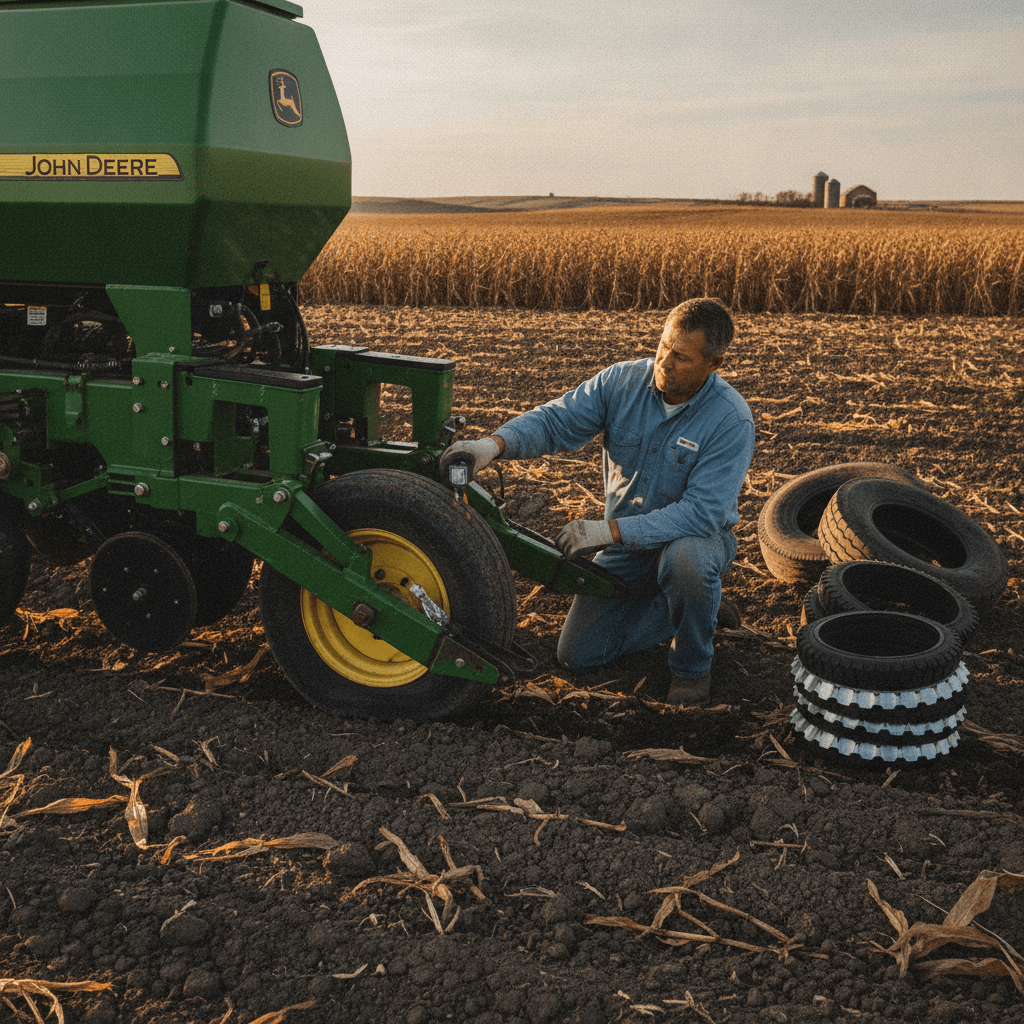
If you’re farming near Ipswich and your planter’s gauge wheels aren’t holding consistent tire pressure from one field to the next, you’ve got a depth problem you probably haven’t traced back to the right cause yet. A gauge wheel that starts the morning at the right pressure and ends it soft by a few PSI isn’t going to stay at your target depth. It’s going to ride lower as the day goes on, push more soil, and give you inconsistent seed placement you won’t see until emergence — or worse, until harvest.
This is a topic most planter parts suppliers don’t talk about directly, and it’s worth covering plainly. Here’s how to know whether pressure loss is actually happening on your planter, what causes it, and what you can do about it before it costs you a stand.
- Why Gauge Wheel Tire Pressure Actually Matters for Planting Depth
- How to Know If You Have a Pressure Problem — and Where to Look First
- What's Actually Causing the Tire Lip to Wear Down
- The Gap Most Planter Parts Suppliers Don't Cover
- Practical Steps Before the Next Planting Season
- FAQs: Gauge Wheel Tire Pressure Near Ipswich
- Get in Touch With Jung Enterprise Before the Next Planting Season
Why Gauge Wheel Tire Pressure Actually Matters for Planting Depth
Gauge wheels don’t just roll alongside the row unit. They set the depth. The tire is what rides on the soil surface and determines how far down the opener goes relative to the ground. When tire pressure drops — even a little — the effective diameter of the tire changes. A softer tire compresses more under load, which means the opener rides slightly deeper than intended.
In a field with variable soil conditions, like the clay-heavy ground common across much of South Dakota and into Minnesota, a row unit running through a wet low spot is already under more load than one crossing a dry ridge. Add inconsistent tire pressure on top of that, and you’ve got depth swings that no amount of down-pressure adjustment is going to fix. You’re chasing a moving target.
The standard gauge wheel spec on most planters is 20–22 PSI. At that pressure, small changes matter more than people expect. A drop of 3–4 PSI can shift effective planting depth by an eighth of an inch or more under load. For corn, that’s the difference between a clean, consistent stand and a ragged emergence pattern that sets the crop back from day one.
How to Know If You Have a Pressure Problem — and Where to Look First
The most honest way to find out is to check tire pressure at the beginning and end of a planting day, and again after the machine has sat overnight. Use a good gauge, not the one that’s been rolling around in the toolbox for six years. If you’re seeing a drop of more than 2 PSI between checks, something is leaking.
The most common source of slow leaks on gauge wheel tires isn’t the valve stem. It’s the tire bead — specifically where the tire seats against the wheel rim. This is where worn or damaged tire lips cause problems. When the lip of a gauge wheel tire gets ground down from contact with debris, stubble, or the rim itself, it stops seating cleanly. You get a micro-gap the bead can’t fully seal across. The tire holds air fine on a flat surface, but under field load — especially in wet, gummy soil conditions like what farmers around Aberdeen and Huron deal with in a typical wet May — the bead flexes enough to let air escape slowly.
The second place to check is the rim itself. If debris has packed into the area between the tire and rim, or if the rim has taken a hit that warped it even slightly, you’ll get the same result. The tire won’t seat correctly and will bleed air under load.
What’s Actually Causing the Tire Lip to Wear Down
In no-till and strip-till ground — which is most of what farmers between Ipswich and Watertown are running — the gauge wheels are spending a lot of time pushing through surface residue, rolled-over stalks, and whatever the spring conditions threw at the seedbed. The outer lip of the tire takes continuous abrasion from that contact, and from the rim edge if the tire shifts at all under lateral load.
Over time, that lip wears thin. Once it’s gone, you’re not just looking at a leaky tire — you’re looking at a tire that’s structurally compromised at the bead, which is the worst place for a failure to start. And replacing gauge wheel tires every season because the lips wear out is not a solution. It’s just expensive.
This is exactly the problem Jung Enterprise’s Steel Ring is built to solve. The steel ring mounts directly to the gauge wheel with six screws and wraps the outer tire lip with a hardened steel lip protector. It prevents the tire bead area from contacting debris, residue, and rim edges directly. The ring also functions as a built-in scraper, which is something competitors sell as a separate add-on. You get both functions in one part. After field testing covering 13,000 planted acres over three seasons, wear on the steel ring itself measured only 1/16 of an inch. The tire lip underneath was protected throughout.
The Gap Most Planter Parts Suppliers Don’t Cover
You can read through the product pages and support content from most of the major gauge wheel and planter parts suppliers — Yetter, Schaffert, Copperhead Ag, Exapta — and find plenty of detail on scraper design, spoke geometry, and closing wheel options. What you won’t find is a direct conversation about what protects the tire lip from wear, and how tire lip degradation leads directly to pressure loss and depth inconsistency. That connection gets skipped. It matters.
A farmer running an air seeder in North Dakota or a 16-row planter outside Huron with worn tire lips is dealing with a compounding problem: the depth control is compromised, the tires are leaking slowly, and the root cause is a part of the wheel that was never protected to begin with. Addressing the tire lip isn’t a niche concern — it’s foundational to consistent planting depth.
You can find more detail on how the steel ring fits into a complete gauge wheel setup at the products overview page.
Practical Steps Before the Next Planting Season
- Check tire pressure at the start, middle, and end of a planting day. If you’re seeing a consistent drop, find the source before you assume it’s the valve stem.
- Inspect the tire bead area visually. Run your finger around the lip of each gauge wheel tire and feel for wear, cracking, or irregular surface texture. If it’s thin or uneven, that tire is already compromised.
- Look at the rim edge where it contacts the tire. Any burring, rust buildup, or deformation is a seating problem waiting to cause a slow leak.
- Consider whether your current setup includes any tire lip protection. If you’re running bare gauge wheel tires against the rim with no protective ring, you’re losing lip material every acre.
- Don’t replace the tire before protecting what’s underneath it. A new gauge wheel tire on an unprotected rim will wear the same way the last one did.
FAQs: Gauge Wheel Tire Pressure Near Ipswich
What’s the correct tire pressure for most planter gauge wheels?
Most gauge wheel tires are spec’d at 20–22 PSI. Check your planter’s OEM documentation, but in general you want consistent pressure across every row unit — not just average pressure across the planter. Row-to-row variation in pressure creates row-to-row variation in depth.
Can a slow tire pressure leak actually affect planting population?
Yes. If a soft tire rides deeper than intended, you’re placing seed in firmer, wetter soil than the opener was tuned for. Seed-to-soil contact and germination timing both suffer. In a short planting window — which is most springs across the Northern Plains — that kind of inconsistency can affect final stand counts in ways that don’t show up until it’s too late to replant.
Does the Jung Enterprise Steel Ring work with my gauge wheel size?
The Steel Ring is designed to fit across a range of gauge wheel sizes and is compatible with planters, air seeders, and no-till drills from multiple OEM brands. Contact Jung Enterprise with your gauge wheel dimensions to confirm fit before ordering.
How often should I check gauge wheel tire pressure during planting season?
At minimum, check at the beginning and end of each planting day. If you’re moving between fields with significantly different soil conditions — especially going from dry ground to wet clay — check mid-day as well. Wet ground puts more lateral load on the tire bead, which is where most slow leaks originate.
Is tire lip wear covered under OEM warranty on gauge wheels?
In most cases, no. OEM gauge wheel tires are considered wear items, and lip wear is considered normal wear. The practical answer is to protect the lip before it wears — not wait for warranty coverage that generally won’t apply.
Get in Touch With Jung Enterprise Before the Next Planting Season
If you’re farming near Ipswich, Aberdeen, Watertown, or anywhere else in the Northern Plains and you’re not sure whether your gauge wheel tires are holding pressure the way they should — or whether the setup you’re running is actually protecting the tire lip — reach out to Jung Enterprise directly. We’re a family-owned American manufacturer based in Ipswich, and we build parts that are field-tested for the conditions you’re actually dealing with.
Contact Jung Enterprise here to ask about the Steel Ring, curved spoked gauge wheels, or wheel retainers for your specific planter or air seeder setup. No sales pitch — just straight answers about what fits your equipment and what it’ll do in your fields.