
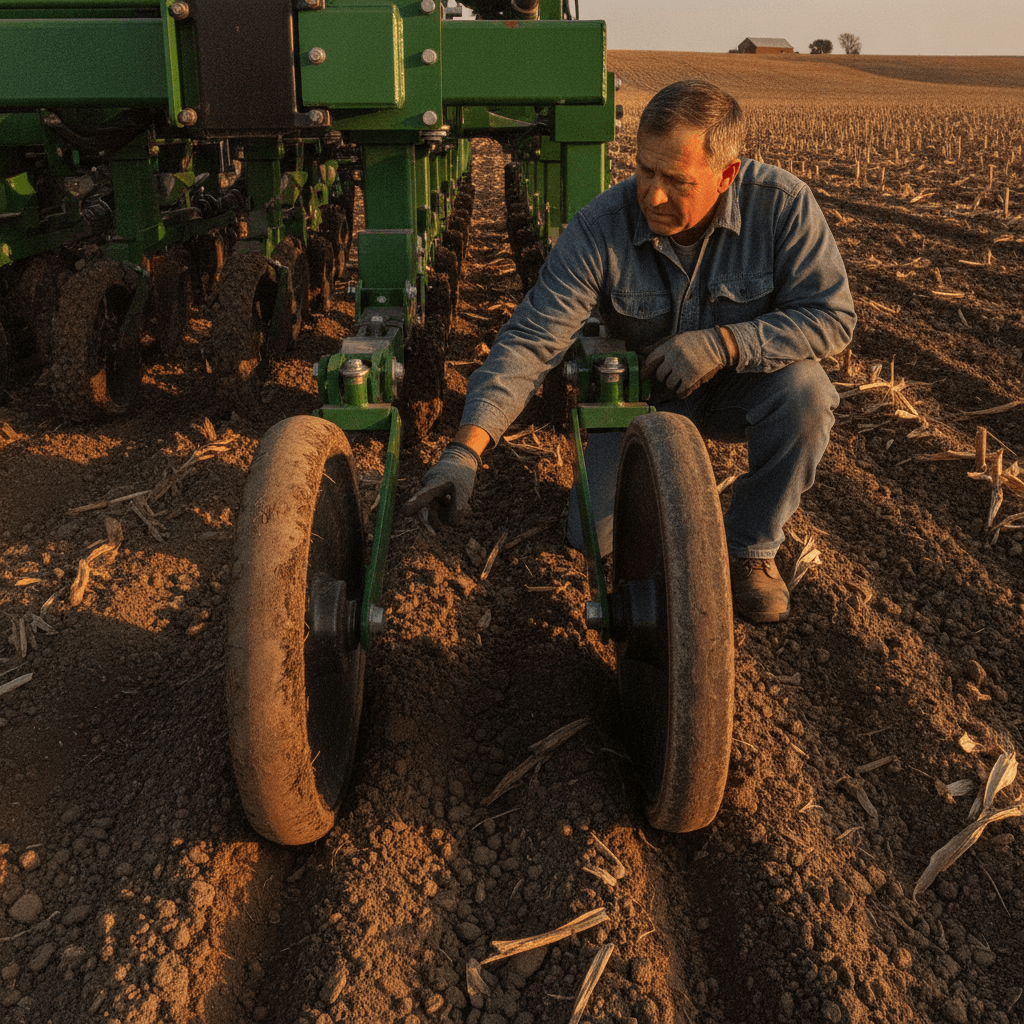
How Do Farmers Near Ipswich Know Whether Their Planter’s Gauge Wheels Are Actually Wearing Evenly — Or Cupping and Drifting Depth on One Side of the Row Unit?
If your gauge wheels are cupping on the inner edge and you haven’t caught it yet, you’re probably planting a fraction of an inch shallower on one side of the row unit than the other — and doing it on every single pass. For farmers near Ipswich dealing with short planting windows and variable spring soils, that kind of quiet, invisible problem can run hundreds of acres before anyone connects it to a yield drag at harvest. The short answer: pull a wheel, flip it over, and look at the tire lip. If the wear profile isn’t symmetric, you’ve got a problem worth fixing before the planter rolls.
- Why Gauge Wheels Wear Unevenly in the First Place
- What Cupping Actually Does to Planting Depth
- How to Actually Inspect for Uneven Wear
- How Jung Enterprise's Steel Ring Addresses Tire Lip Wear Before Cupping Starts
- When to Replace Versus When to Keep Running
- Frequently Asked Questions
- Talk to Jung Enterprise Before the Next Season
Why Gauge Wheels Wear Unevenly in the First Place
Gauge wheels don’t wear out like a pickup tire that logs highway miles. They’re pressed into the soil, loaded against a furrow wall, and dragged through residue, rocks, and mud at planting speed — often in one direction, at one side angle, under constant downforce. That one-sided loading is what causes cupping.
On a properly functioning row unit, the gauge wheel rolls flat with even contact across the tire profile. But a few things push that contact off-center fast:
- Worn or loose parallel arms that let the row unit cant slightly sideways, loading one gauge wheel edge harder than the other
- Uneven downforce application — especially on older spring systems — that shifts side-to-side pressure
- Debris and soil buildup packing into the spoke area and forcing the tire to run cocked
- Low tire pressure that lets the sidewall collapse unevenly under load
- Tire lip damage from abrasive gumbo soils or contact with rocks, which changes how the tire rolls against the disc opener
In the heavier clay soils common across central and northeastern South Dakota — from the fields east of Ipswich down toward Aberdeen and Huron — gauge wheels work harder per acre than in sandier ground. The soil sticks, it loads the wheel, and wear accelerates on the side that’s fighting the furrow wall. Farmers running no-till or strip-till in that region see it faster because the disc and furrow geometry puts more consistent lateral force on the tire edge.
What Cupping Actually Does to Planting Depth
Here’s the part that doesn’t get talked about enough: a cupped gauge wheel changes your effective planting depth, but not in a way that shows up cleanly in your monitor. The tire is no longer rolling on its designed contact patch. The cupped edge rides up on the ridge of the worn-out profile, which raises the row unit slightly relative to where it’s supposed to be running. You might be targeting 2 inches and actually planting at 1¾ on that row — consistently, all day, across every field.
In corn, that half-inch difference in seed depth during a dry stretch can mean the difference between consistent germination and a patchy stand. In soybeans, it shows up as variable emergence timing that your population count won’t catch until you’re walking fields. Neither problem is easy to connect back to gauge wheel wear once you’re past planting.
This is the gap that most competitor content skips. Companies selling gauge wheel scrapers and mud-shedding products focus almost entirely on the plugging and mud problem. Cupping and asymmetric wear — the slower, subtler wear mode — rarely gets its own section anywhere in their technical content. But for farmers who rotate fields with both heavy and lighter soils, or who run mixed planting systems, it’s the failure mode that sneaks up on you.
How to Actually Inspect for Uneven Wear
You don’t need a caliper for a first-pass inspection. Pull the gauge wheel off the row unit — takes about five minutes with the right socket — and set it on a flat surface. Look at the tire in profile from the side. A worn wheel that’s still wearing evenly will show a consistent, symmetrical tread profile across the full width of the tire face. A cupped wheel will show a concave scoop on one side — usually the inboard edge that runs closest to the disc opener.
Run your thumb across the tread. If you feel a ridge on one edge and a valley toward the center or opposite edge, that’s cupping. Also check the tire lip — the rolled bead at the outer edge where the tire meets the hub. If it’s chipped, cracked, or visibly thinner on one side, the lip is taking asymmetric impact loading, which means the wheel is running cocked.
Do this inspection on every row unit, not just the ones you suspect. Wear patterns across a planter are rarely uniform — field conditions, row position relative to traffic lanes, and individual row unit condition all affect how fast any given wheel wears.
How Jung Enterprise’s Steel Ring Addresses Tire Lip Wear Before Cupping Starts
One of the root causes of early cupping is tire lip damage. Once the lip is compromised — either by abrasion, impact, or the repeated grinding that happens in gumbo soils — the tire starts running off its designed contact geometry, and uneven wear follows. Jung Enterprise’s Steel Ring mounts directly to the outer rim with six screws and covers the tire lip with a hardened steel band, protecting it from exactly that kind of damage.
The patented design (US 11,707,013 B2 and related patents) includes a built-in scraper that clears mud and debris from the tire as it rotates. That matters because packed debris is one of the things that forces a gauge wheel to run at an angle — which is what starts the cupping cycle. By keeping the wheel clean and protecting the lip, the Steel Ring preserves the contact geometry that keeps wear even across the tire face.
In field testing, the Steel Ring logged 13,000 planted acres over three years and showed only 1/16 inch of wear. That’s the kind of durability number that makes a difference when you’re comparing it against an OEM tire that shows visible cupping after two or three seasons in hard clay ground.
When to Replace Versus When to Keep Running
If you’re seeing cupping but the wear is shallow — less than about 3/16 inch of depth across the cupped section — and the tire lip is intact, you’re probably okay to finish the season if you’re already mid-planting. But if the lip is damaged, the cupping is pronounced, or you’re seeing the row unit riding high on any pass through heavy soil, replacement before the next planting season is the right call. Running a cupped wheel another full season usually means you’ll be replacing it anyway, and you’ll have lost the yield from inconsistent depth across however many acres you planted.
For farmers planning pre-season maintenance near Ipswich, the February through April window is when you want to be catching this — not the week before you want to roll. Jung Enterprise’s full product lineup includes the Steel Ring, Curved Spoked Gauge Wheels, and Wheel Retainers, all designed to work together on planters, air seeders, and no-till drills across multiple OEM configurations.
Frequently Asked Questions
Can I rotate gauge wheels side to side to even out wear the way you’d rotate tires on a truck?
Sometimes, but not always. If the cupping is driven by a mechanical issue — like a canted parallel arm — rotating the wheel just moves the problem. Fix the mechanical root cause first, then replace or rotate the wheel. If the wear is purely soil-driven and the row unit checks out mechanically, swapping left and right on the same row unit can extend tire life a bit.
Does tire pressure affect how fast a gauge wheel cups?
Yes. An underinflated gauge wheel is more prone to uneven sidewall loading, which accelerates cupping on the inner edge. Check pressure at the start of the season and after any significant temperature swing. In northern South Dakota and North Dakota, a cold snap between field days can drop pressure enough to matter.
Will Jung Enterprise’s Curved Spoked Gauge Wheels hold up better against cupping in heavy clay soils?
The open-spoke design sheds mud more effectively, which reduces the asymmetric loading that contributes to cupping. When debris can’t pack into the wheel, it’s harder for the wheel to run cocked. Combined with the Steel Ring protecting the tire lip, you get a system that maintains consistent contact geometry longer than a standard solid-spoke wheel in tough soil conditions like the gumbo ground common in central and northeastern South Dakota.
How do I know if the cupping is from the gauge wheel or from a disc opener problem?
Put a straightedge across the gauge wheel tire faces — both wheels on the same row unit — and look at whether the row unit itself is level. If the unit is canted, the disc is likely worn asymmetrically too. If the unit is level but you still see cupping, the wear is in the gauge wheel itself, not a systemic row unit geometry problem.
Do dealers near Aberdeen or Huron stock Jung Enterprise parts?
Contact Jung Enterprise directly at (605) 281-0497 or at the contact page to find out about dealer availability in your area. Direct ordering is also available. Lead times are tightest heading into planting season, so ordering in winter is the right move if you know you’ve got worn wheels going into spring.
Talk to Jung Enterprise Before the Next Season
If you pulled a gauge wheel this fall and didn’t like what you saw — or if you’re heading into pre-season maintenance and want to get ahead of a cupping problem before it costs you yield — reach out to Jung Enterprise in Ipswich. We build steel rings, wheel retainers, and curved spoked gauge wheels specifically for the conditions farmers across South Dakota, North Dakota, Minnesota, and Iowa are actually dealing with. American-made, patented, and field-tested where it counts. Contact us here or call (605) 281-0497 to talk through what your planter needs before spring.