
How Do Farmers Near Ipswich Know Whether Their Planter’s Gauge Wheels Are Actually Compatible With Strip-Till Setups — Or Set Up to Fight the Berm Every Pass?
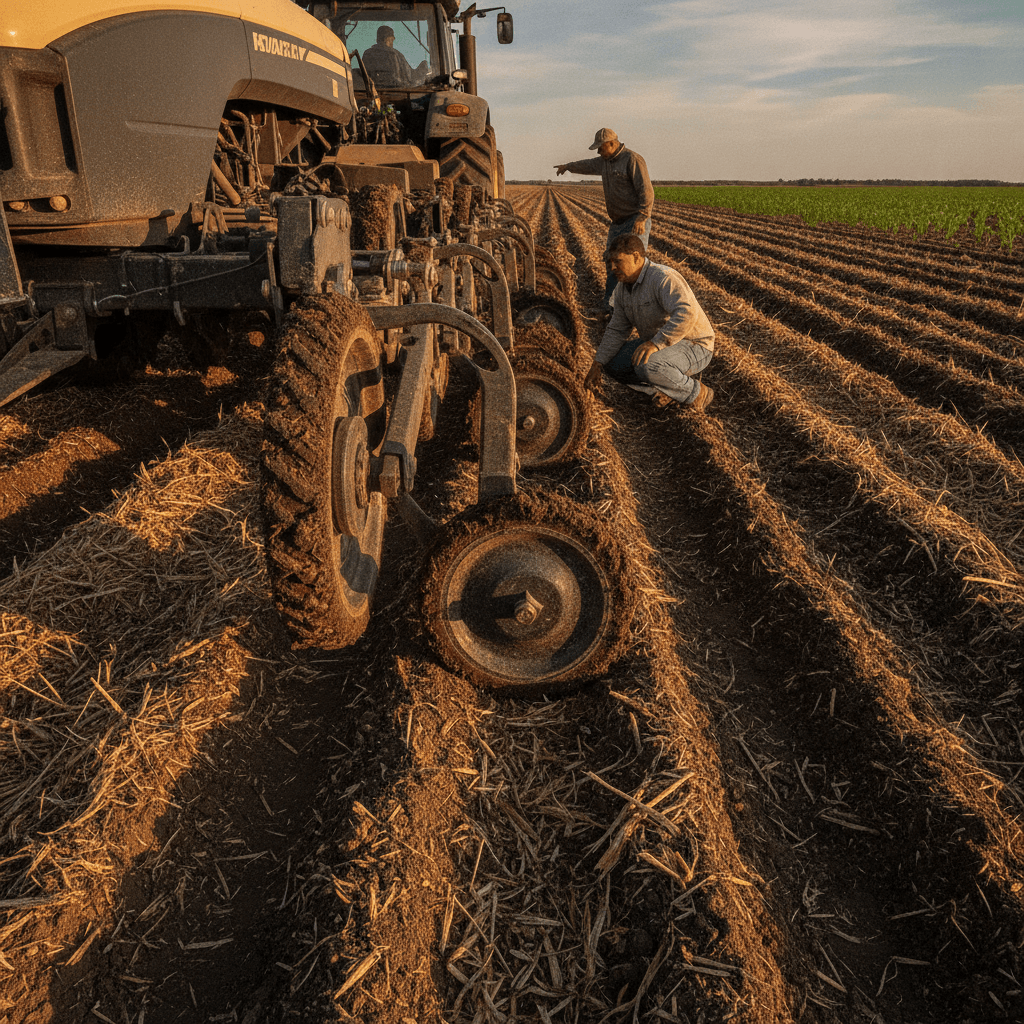
If you’re running a strip-till system near Ipswich and your planting depth has been inconsistent from pass to pass, the gauge wheels are a logical first place to look — but most of the content out there on gauge wheel selection completely ignores strip-till. The berm changes everything: you’re not planting into flat, freshly worked ground, and you’re not planting into completely undisturbed soil either. You’re planting into a raised, partially dried strip that can be harder on the crown and softer on the shoulders, and a gauge wheel that was spec’d for conventional or straight no-till planting may not handle that transition cleanly.
- What Strip-Till Actually Does to Your Gauge Wheels
- Solid-Face Wheels vs. Open-Spoke Design in Strip-Till Conditions
- The Scraper Problem in Strip-Till — And Why a Built-In Solution Is Better
- Berm Height Variation and What Your Gauge Wheel Setup Needs to Handle It
- What to Check Before Planting Season If You're Running Strip-Till
- Frequently Asked Questions: Strip-Till Gauge Wheels Near Ipswich
- The Bottom Line for Strip-Till Operators
What Strip-Till Actually Does to Your Gauge Wheels
Strip-till berms introduce a terrain problem that flat-ground planting doesn’t have. When the row unit rides up onto the berm, the gauge wheels have to find a consistent reference surface — fast. If the berm crown is inconsistent in height or width (which it often is after a wet fall or a frost-heave winter across South Dakota and southern North Dakota), the gauge wheel is constantly hunting for depth. That shows up as variable emergence, which is exactly what strip-till is supposed to prevent.
There’s also a mud issue that gets worse in strip-till than people expect. The stripped zone can hold moisture differently than the surrounding undisturbed soil. When you hit that transition — especially in the clay and gumbo soils common around Huron and Aberdeen — mud packs into a conventional solid-face gauge wheel and doesn’t release. The wheel loses its reference to the soil surface and starts riding on packed debris instead of soil. At that point, you’re not controlling depth at all.
Solid-Face Wheels vs. Open-Spoke Design in Strip-Till Conditions
This is the gap that most competitor content doesn’t touch directly. The standard solid or semi-solid gauge wheel that ships with most planters was designed for relatively consistent, tilled soil. It doesn’t actively shed mud. In a strip-till environment — where you’ve got moist, disturbed soil in the strip and firm, wet soil at the edges — a solid wheel will pack up quickly in any spring where conditions are less than ideal.
An open-spoke gauge wheel design handles this differently. The curved spokes create flex and airflow through the wheel face, which means mud doesn’t pack and stay. It clears on its own as the wheel rotates. For strip-till planting in the Northern Plains, where you might encounter three different soil moisture conditions in the same field depending on drainage patterns, that self-cleaning matters more than it does in a controlled tilled environment.
Jung Enterprise’s curved spoked gauge wheels are built around exactly this principle — open-spoke design that sheds mud without a separate scraper attachment, and field-tested to just 1/16″ of wear after 13,000 planted acres over three years. That wear rate matters in strip-till because the berm crown creates a slightly different load profile on the wheel face than flat planting — you want a wheel that’s going to hold its geometry across a full season, not one that wears unevenly and starts creating its own depth variation by mid-May.
The Scraper Problem in Strip-Till — And Why a Built-In Solution Is Better
Some farmers add aftermarket scrapers to their existing solid gauge wheels to address the mud issue in strip-till. It works, to a point. The problem is that a scraper is a separate wear item — it has its own mounting hardware, its own wear rate, and its own failure mode. When you’re running back-to-back 18-hour days during a tight planting window, the last thing you want is to be chasing a scraper that’s come loose or worn through on one row unit while the rest of the planter is fine.
The steel ring on a Jung gauge wheel acts as a built-in scraper — it’s integrated into the tire lip protection design, not bolted on as an afterthought. It protects the tire lip from wear while simultaneously keeping the wheel face clear of packed debris. One part doing two jobs means one fewer failure point in the field. That’s not a small thing when your planting window in South Dakota might be eight to twelve days wide if the spring is cooperative, and shorter if it isn’t.
Berm Height Variation and What Your Gauge Wheel Setup Needs to Handle It
Strip-till done in the fall and planted in the spring isn’t always the same berm you built. Freeze-thaw cycles can settle berms unevenly. A wet fall followed by a dry spring can leave the top of the berm harder than you expect, with the shoulder still soft. In those conditions, the gauge wheel needs to respond to real soil resistance quickly — and it needs consistent contact with the berm surface to do that.
Wheel retainers matter here more than most farmers think. If your gauge wheel is at all loose on the axle — even a small amount of lateral play — it will walk slightly on the uneven berm surface and give you inconsistent depth readings. A properly fitted wheel retainer keeps the gauge wheel locked in its correct operating position so that the depth you set in the shop is the depth you get in the field, even when the berm isn’t perfectly uniform.
What to Check Before Planting Season If You’re Running Strip-Till
- Wheel face condition: Look for flat spots or uneven wear on the gauge wheel face. Strip-till can accelerate edge wear if the berm shoulder is harder than the crown. A wheel that’s worn unevenly across its face is going to read depth inconsistently.
- Mud clearance: Spin the wheel by hand and watch for drag. If debris is already packed in from last season, that’s a sign your current wheel isn’t shedding cleanly in strip-till conditions.
- Tire lip integrity: The tire lip takes extra stress on the berm entry. Check for cracking or deformation. If the lip is already compromised, a steel ring can stabilize it and extend its service life through the season.
- Lateral play on the axle: Grab the wheel and check for side-to-side movement. Any detectable play means the wheel retainer needs attention before it causes depth problems in the field.
- Scraper wear (if applicable): If you’re running a separate bolt-on scraper, inspect the mounting hardware. These tend to loosen under the vibration of berm planting and can fail at the worst time.
Frequently Asked Questions: Strip-Till Gauge Wheels Near Ipswich
Do I need a different gauge wheel for strip-till versus conventional planting?
Not necessarily a different size, but the design matters. An open-spoke, self-cleaning gauge wheel handles the variable moisture and soil conditions in a strip-till environment better than a solid-face wheel. If you’re planting in South Dakota conditions — clay soils, variable spring moisture — the mud-shedding design is worth the upgrade.
Can the same gauge wheel work on both my strip-till fields and my flat-ground fields?
Yes. A quality curved-spoke gauge wheel with consistent geometry and good mud-shedding characteristics will perform well across both. The open-spoke design doesn’t hurt you in dry or firm conditions — it just isn’t as necessary there.
Why does my planting depth vary more in strip-till than in conventional planting?
Berm height inconsistency, soil moisture variation across the strip shoulder, and gauge wheels that pack with mud are the three most common culprits. Check lateral play on the axle and inspect the wheel face for packed debris before you blame the planter’s depth settings.
How do I know if my steel ring is set up correctly for strip-till?
The steel ring should sit snugly against the tire lip with no lateral movement and no gaps that allow debris to pack between the ring and the tire. It should rotate cleanly with the wheel without binding. If you’re seeing mud accumulation behind the ring, the scraper function isn’t working the way it should — check that the ring is properly seated and that the mounting screws are torqued to spec.
Does Jung Enterprise’s equipment fit the planters commonly used in the Ipswich and Aberdeen area?
Jung Enterprise builds gauge wheels and steel rings to fit multiple OEM gauge wheel sizes across common planter and air seeder brands running in the Northern Plains. If you’re not sure whether your current setup is compatible, reach out directly — it’s a quick conversation and worth having before planting season starts.
The Bottom Line for Strip-Till Operators
Strip-till is a smart system for preserving soil structure and improving moisture retention across the Northern Plains — but it puts a specific set of demands on your planting equipment that conventional planter setups weren’t designed for. The gauge wheel is the part that has to reconcile berm height variation, variable soil moisture, and mud clearance all at once, every row, every pass. A solid-face wheel that was fine in your old corn-on-corn conventional system may not be what you need now.
If you’re running strip-till near Ipswich, Huron, or Aberdeen and your emergence maps still look variable after you’ve checked everything else, it’s worth taking a hard look at what your gauge wheels are actually doing on the berm. Contact Jung Enterprise to talk through your setup — we’re here to help you figure out whether a gauge wheel upgrade makes sense before you’re already in the field.