
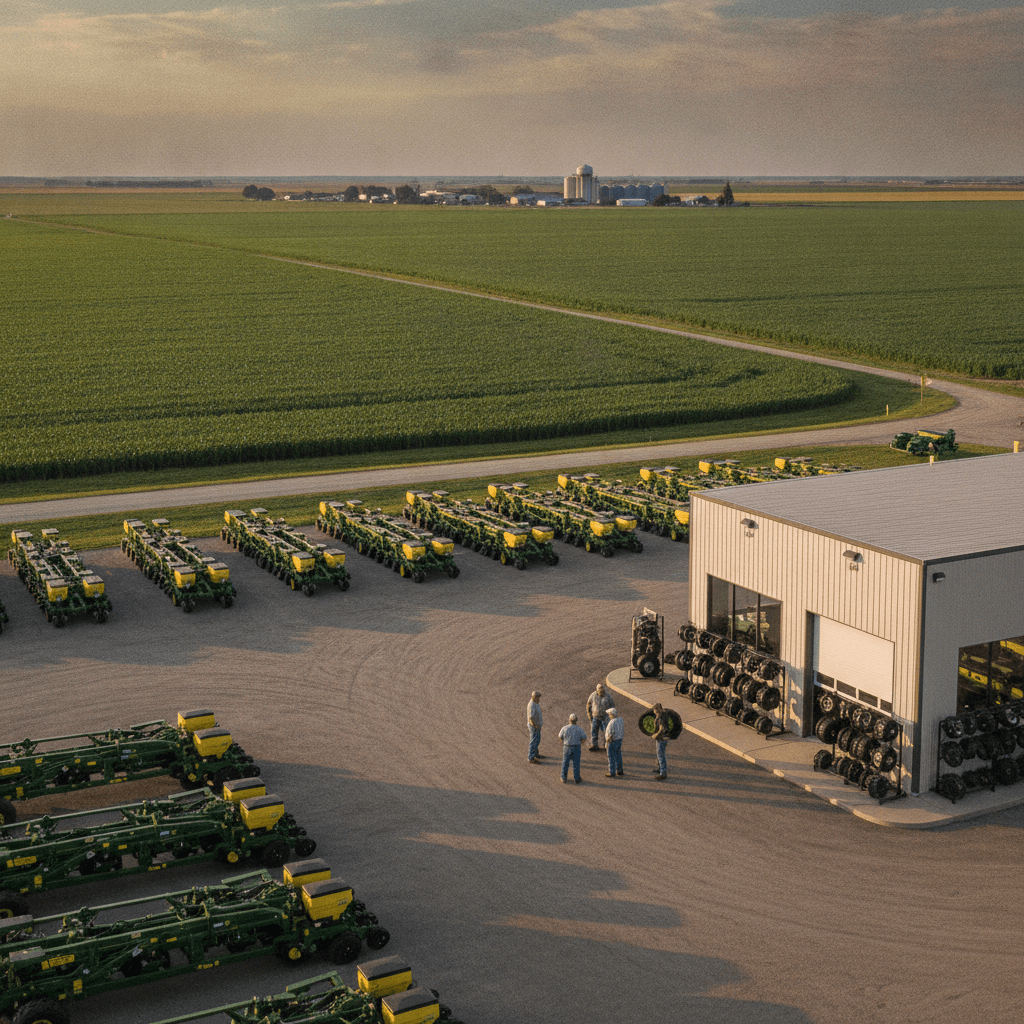
How Do Ag Dealers Near Ipswich Decide Which Gauge Wheel Brands to Stock — And What It Means for Farmers Buying Parts Locally
If you’ve ever walked into a dealer in or around Ipswich looking for a replacement gauge wheel and walked out with whatever happened to be on the shelf, you already know the problem. Dealers don’t carry everything. What they stock is the result of a few deliberate decisions — some good, some driven purely by distributor agreements — and those decisions trickle directly down to you when you’re trying to get a planter running at 6 a.m. during a short planting window.
This article explains how dealers in South Dakota and across the Northern Plains actually evaluate gauge wheel and planter parts brands before they commit shelf space, and what you as a farmer or custom planter should understand about that process before you assume your local dealer has the best option available.
- What Dealers Are Actually Looking At When They Pick a Brand
- The Gap Nobody Talks About: What Dealer Stocking Decisions Miss
- What Makes a Gauge Wheel or Steel Ring Worth Carrying — From a Dealer's Perspective
- What This Means If You're a Farmer Buying Locally
- For Dealers and Distributors Considering Adding a New Line
- Frequently Asked Questions
What Dealers Are Actually Looking At When They Pick a Brand
A good independent ag dealer — the kind you still find in smaller towns across South Dakota, Minnesota, and Iowa — is thinking about a handful of things when they decide what to stock:
- Return rate and warranty claims. If a brand generates a lot of warranty headaches, dealers drop it fast. Their service counter time is expensive.
- Customer demand and ask-for rate. If five farmers in the same county are asking for a specific part, the dealer pays attention.
- Compatibility breadth. A part that fits across multiple OEM planter brands is easier to justify as a stock item than a hyper-specific SKU for one row unit configuration.
- Distributor relationship and margin. This one matters more than most farmers realize. Dealers often stock brands tied to their primary distributor’s catalog — not necessarily the best option for the farmer.
- Proven field durability. Dealers who service their customers long-term care whether a part holds up. A gauge wheel that wears out in one season and sends a farmer back to the counter is a short-term win and a long-term reputation problem.
The issue is that criteria four — distributor relationship — sometimes crowds out criteria five. That’s where farmers need to do a little homework on their own.
The Gap Nobody Talks About: What Dealer Stocking Decisions Miss
Most competitor manufacturers in this space publish product specs and feature lists. What they rarely address is the distribution and stocking side of the equation — how a product actually gets in front of the farmer through the dealer network, and what happens when it doesn’t.
Farmers near Aberdeen, Watertown, and Huron know this well: there are stretches during planting season where the part you need isn’t at the nearest dealer, the next-nearest dealer is two hours away, and the online order won’t arrive before the weather window closes. That’s a real yield cost, not a hypothetical one.
This is exactly the argument for working with manufacturers who are close to your region and who invest in dealer relationships with distributors that can actually get product onto shelves before planting ramps up in April and May. A manufacturer based in Ipswich, South Dakota — right in the middle of the Northern Plains row-crop belt — thinks about logistics differently than one shipping from a warehouse on the East Coast or a factory overseas.
What Makes a Gauge Wheel or Steel Ring Worth Carrying — From a Dealer’s Perspective
Here’s what a sharp dealer is looking for, and frankly what you should be looking for when you’re evaluating a product yourself:
Documented field durability, not marketing claims. There’s a meaningful difference between “heavy-duty construction” language on a website and a product that has logged 13,000 planted acres with only 1/16 inch of measurable wear over three seasons. The latter gives a dealer something concrete to tell a skeptical farmer. It also means fewer comebacks.
Patented design that solves a real problem. A steel ring that protects the tire lip from wear AND doubles as a built-in scraper — eliminating the need for a separate scraper part — is a product dealers can explain in one sentence. Simple value propositions move off shelves. Products that require a paragraph of explanation tend to sit.
Broad compatibility. Planters, air seeders, and no-till drills aren’t all running the same hardware. A gauge wheel or steel ring that fits across multiple configurations reduces the number of SKUs a dealer has to carry to cover most of their customer base. That’s a real stocking advantage.
American-made with a clear warranty story. Farmers from Bismarck down to Iowa have learned to be skeptical of imported parts that look right but wear fast. Dealers have learned the same lesson. Parts manufactured domestically with verifiable quality control are easier to stand behind.
What This Means If You’re a Farmer Buying Locally
You have more influence over what your local dealer stocks than you probably think. If you walk in and ask for a specific product by name — especially if two or three other farmers in the area do the same — a dealer notices. That’s how new brands get onto shelves.
It also means you shouldn’t assume that what’s on the shelf is the best option. Ask your dealer whether they’ve looked at alternatives. Ask them about return rates on what they’re currently selling. Ask whether they can order a product you’ve researched if they don’t stock it. Most good dealers will work with you on that.
And if you’re a custom planter or running a larger operation across multiple counties, the calculus is even more direct: downtime cost per hour during planting window is easy to calculate. A part that lasts three seasons versus one that needs replacing every season isn’t a marginal difference — it’s a real operating cost you can put a number on.
Jung Enterprise’s full product line — including curved spoked gauge wheels, wheel retainers, and patented steel rings — is designed specifically for the conditions farmers across the Northern Plains deal with: heavy clay, gumbo soils, wet springs, and tight planting windows where equipment has to work every day without babysitting.
For Dealers and Distributors Considering Adding a New Line
If you’re an ag dealer in South Dakota, North Dakota, Minnesota, or Iowa and you’re evaluating what to put on your shelf for the next planting season, the conversation with Jung Enterprise is worth having. The dealer relationship matters here as much as the product — regional support, straightforward ordering, and parts that don’t generate warranty headaches are the baseline expectation, not the exception.
Frequently Asked Questions
Can I ask my local dealer near Ipswich or Aberdeen to order Jung Enterprise products if they don’t stock them?
Yes. Most dealers can place a special order if you ask. If multiple farmers in an area request the same product, dealers will often consider adding it to their regular stock. Contact Jung Enterprise directly to find out about current distribution and dealer availability near you.
Do Jung Enterprise gauge wheels and steel rings fit the planters and air seeders most common in South Dakota?
Yes. The product line is designed for compatibility across multiple OEM brands and configurations — planters, air seeders, and no-till drills. If you have a specific row unit or gauge wheel size question, reach out directly and they’ll confirm fit before you order.
What’s the advantage of a steel ring with a built-in scraper over buying a gauge wheel scraper separately?
Fewer parts to manage, fewer failure points, and one less thing to install. The patented steel ring design (US 11,707,013 B2) protects the tire lip from wear and scrapes mud and debris off the wheel in one unit. In heavy clay or gumbo conditions common from Huron to Fargo, that matters during a long planting day.
How do dealers in the Northern Plains evaluate durability claims from gauge wheel manufacturers?
The honest answer is that many rely on manufacturer-provided data and early customer feedback. That’s why concrete field-test numbers — like 1/16 inch of wear after 13,000 acres over three seasons — carry more weight than general durability language. Ask your dealer if a product has documented field data, not just spec sheet claims.
Is Jung Enterprise set up to work with distributors, or only direct-to-farmer sales?
Both. Jung Enterprise works with dealers and distributors as well as selling direct to farmers and custom planters. If you’re a dealer in Iowa, Minnesota, or the Dakotas looking to add a line, get in touch to discuss terms and stocking.
If you’re a farmer trying to figure out the right parts for your planter setup, or a dealer looking to add a product line that your customers will actually come back and ask for again — reach out to Jung Enterprise in Ipswich. The conversation starts with your specific equipment and your specific field conditions, not a catalog pitch.