
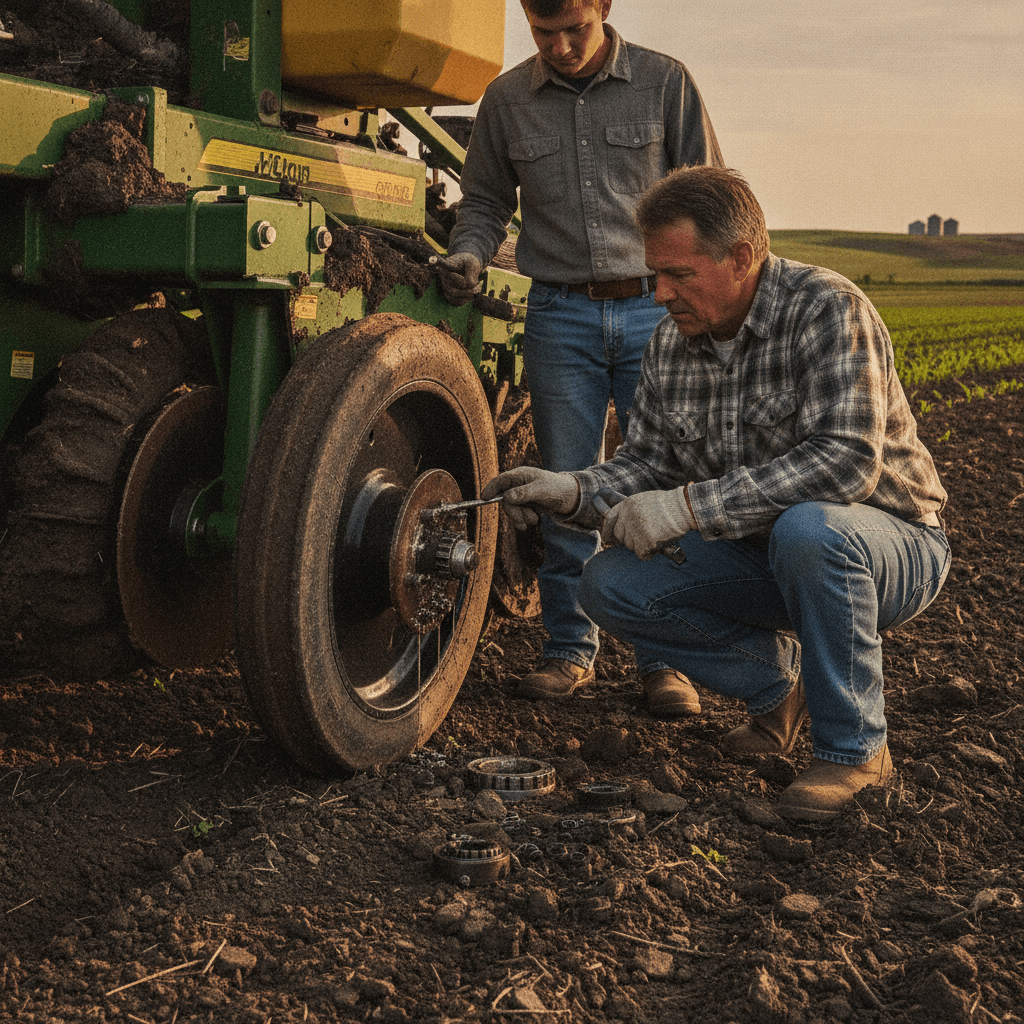
How Do Farmers Near Sioux Falls Know Whether Their Planter’s Gauge Wheel Hubs Are Actually Greased Often Enough — Or Running Dry Until the Bearing Seizes?
If you’re farming near Sioux Falls and your gauge wheel hubs haven’t been touched since last fall, there’s a real chance you’re going into planting season with dry bearings. Most bearing failures don’t give you much warning — the hub gets stiff, starts running hot, and by the time you notice wobble or hear noise, you’ve already got a seized bearing and a row unit sitting at the wrong depth. The short answer is this: if you can’t remember the last time you hit those zerks, you’re probably overdue.
- Why Gauge Wheel Hub Lubrication Gets Overlooked
- What a Proper Pre-Season Hub Check Actually Looks Like
- How Often Should You Actually Be Greasing During the Season?
- What Competitors' Content Misses on This Topic
- How Wheel Design Affects Hub Longevity
- Frequently Asked Questions: Gauge Wheel Hub Maintenance Near Sioux Falls
- Talk to Jung Enterprise Before Planting Season Gets Here
Why Gauge Wheel Hub Lubrication Gets Overlooked
Pre-season planting prep has a long list. Disc openers, closing wheels, seed meters, down pressure springs — there’s a lot competing for your attention. Gauge wheel hubs are small, they don’t make noise when they start drying out, and most operators assume if the wheel spins freely by hand it’s fine. That’s not always true.
The bearings inside a gauge wheel hub are running in a hostile environment. They’re low to the ground, they pick up grit and moisture, and they take side load every time the row unit flexes over uneven terrain. In heavy clay soils — the kind that run across a lot of eastern South Dakota and into Minnesota and Iowa — mud packs around the hub and accelerates contamination. That moisture pulls grease out of the bearing races faster than most people expect.
The other thing that kills gauge wheel bearings quietly is sitting. If a planter sat all winter with water in the hub cavity, the grease may have separated or washed out. Spinning the wheel by hand in February doesn’t replicate what happens under field load at 5 mph across 1,200 acres of corn ground.
What a Proper Pre-Season Hub Check Actually Looks Like
You don’t need special tools. You need time and a grease gun. Here’s what to actually look for:
- Spin and feel: With the planter raised and off the ground, spin each gauge wheel by hand. It should feel smooth and consistent. Rough, grinding, or notchy rotation means the bearing is already compromised.
- Check for lateral play: Grab the wheel at the 9 and 3 o’clock positions and try to wiggle it side to side. Any perceptible slop beyond a small amount indicates bearing wear or a loose hub nut — both need to be addressed before you plant a single acre.
- Hit every zerk fitting: Some gauge wheel assemblies have one zerk, some have two. Pump grease until you see fresh grease purging out around the seal. Old, dark grease purging first is normal — keep going until you see clean grease.
- Look at the seals: If the rubber lip seal on the hub is cracked, torn, or missing, grease won’t stay in and contaminants won’t stay out. A $4 seal replacement now costs you a lot less than a mid-planting bearing swap.
This check should be part of every pre-season walkdown, ideally in March before the ground is ready. Farmers around Watertown and Aberdeen who plant corn and soybeans on tight windows know what it costs to lose a day of planting to a seized hub — it’s not a small number when you’re pushing to hit your planting date.
How Often Should You Actually Be Greasing During the Season?
This is where most operators fall short. The answer depends on your conditions, but a reasonable baseline for most South Dakota and Northern Plains operations is every 8–10 hours of planting time in normal conditions, and every 4–6 hours if you’re running in heavy, wet soils. Gumbo clay is especially rough on hub seals because the mud pressure forces its way past the seal face when the wheel is spinning under side load.
Custom planters covering ground across multiple farms and soil types should be hitting hubs more aggressively — probably every other fill-up. You’re covering more acres faster, your equipment doesn’t sit long enough to cool down, and you’re moving into fields with different soil profiles that may be harder on bearings than what you last ran through.
One practical rule: if your greasing interval is determined by convenience rather than hours or conditions, you’re probably not greasing often enough.
What Competitors’ Content Misses on This Topic
Most competing manufacturers focus their content on gauge wheel design — spoke shape, tire durometer, mud shedding, compatibility lists. That’s useful, but almost nothing out there speaks plainly to the maintenance side of gauge wheel reliability. The bearing and hub are treated as an afterthought, even though a failed hub will sideline a row unit just as fast as a cracked wheel or a bad tire. If you search for guidance on gauge wheel greasing intervals or hub seal inspection, you’ll mostly find generic grease schedules buried in operator manuals — not practical field-level guidance written for the conditions you’re actually running in.
At Jung Enterprise, built out of Ipswich and built for the conditions farmers across this region deal with, the conversation around gauge wheel reliability doesn’t stop at the wheel itself. The whole assembly has to hold up — and that includes what’s inside the hub.
How Wheel Design Affects Hub Longevity
This is worth understanding before you just re-grease and move on. A gauge wheel that’s constantly plugging with mud is putting more stress on the hub bearings than one that sheds cleanly. When the wheel packs up, it creates an imbalanced load that the bearing has to absorb every rotation. That’s not what those bearings are designed for.
Open-spoke gauge wheel designs — like the Curved Spoked Gauge Wheels from Jung Enterprise — shed mud more effectively than solid or semi-open designs. Less mud packing means less uneven load on the hub, which extends bearing life between services. It’s not a magic fix, but it’s a real factor that changes how hard you have to work to keep hubs healthy through a wet spring planting season.
Similarly, the Steel Ring that Jung Enterprise manufactures (patented under US 11,707,013 B2) acts as a built-in scraper that keeps mud from building up against the tire lip and forcing debris toward the hub area. It’s a small detail that adds up across 1,000 acres. The Steel Ring has logged 13,000 planted acres with only 1/16″ of wear over three years — that’s the kind of durability that reduces the total maintenance burden on the whole row unit, not just the tire.
Frequently Asked Questions: Gauge Wheel Hub Maintenance Near Sioux Falls
How do I know if my gauge wheel bearing is actually seized versus just stiff from sitting?
A stiff bearing will usually free up after a few rotations by hand and some fresh grease. A seized bearing won’t rotate at all, or will feel grinding and rough throughout the full spin. If there’s heat coming off the hub after a short amount of field time, the bearing is failing.
Can I run through planting season with a gauge wheel hub that has slight lateral play?
Not without accepting depth inconsistency on that row. Even minor play in the hub translates to the gauge wheel walking side to side slightly, which means your depth reference is moving. Over a full field, that costs you stand uniformity — especially in corn where depth consistency matters most.
How many grease fittings does a typical gauge wheel hub have?
It varies by brand and wheel assembly, but most have one or two zerk fittings per hub. Check your operator manual for the specific locations — some are on the axle bolt, some are on the hub face itself. If a fitting won’t take grease, it’s likely plugged and needs to be replaced before it can do any good.
Does hub maintenance differ between planters and air seeders?
The basic grease-and-inspect routine is the same, but air seeders often cover more acres per season and at higher speeds than row planters, so the interval should be tightened accordingly. If you’re running an air seeder across northern South Dakota or into Minnesota, assume you’re logging hub hours faster than a conventional 16-row row crop planter.
What’s the most common mistake farmers make with gauge wheel hubs heading into planting season?
Not inspecting the seals. Grease is useless if the seal is compromised — it won’t stay in and contaminants will get in. A seal check adds five minutes per row unit and can prevent a mid-season failure that costs you half a day of planting time and a parts run to Aberdeen or Watertown in the middle of your window.
Talk to Jung Enterprise Before Planting Season Gets Here
If you’re prepping your planter near Sioux Falls or anywhere across the Northern Plains and you want to know whether your gauge wheels — the hubs, the tires, the scrapers, all of it — are actually set up to hold up this season, reach out to us directly. Jung Enterprise is a family-owned manufacturer based in Ipswich, and we build parts that are field-tested in the same conditions you’re farming in. Contact us here to ask about fitment, get product details, or talk through what your row units actually need before the ground opens up.