
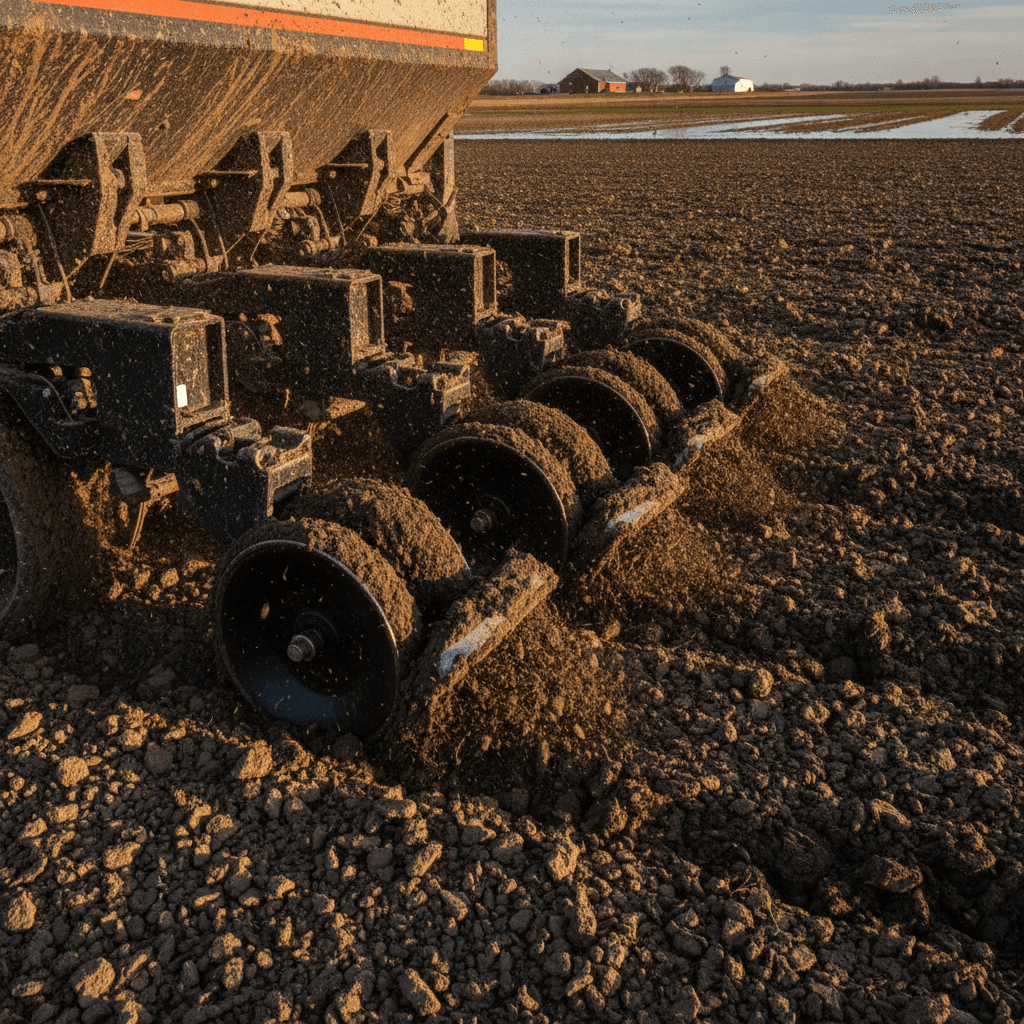
How Do Farmers Near Fargo Decide Whether Their Planter’s Gauge Wheel Scrapers Are Actually Keeping Up — Or Falling Behind in Heavy Spring Soils?
The short answer: if you’re not checking your gauge wheel scrapers before the planting window opens — and again after the first muddy pass — you’re probably not catching the problem until it’s already cost you time and stand. Farmers around Fargo and across the Red River Valley deal with some of the heaviest, stickiest soils in the Northern Plains. When those soils are wet in April or May, a scraper that looks fine in the shop can fall completely behind in the field within the first hour of planting.
This is one of those topics that doesn’t get nearly enough straight talk in the ag equipment world. Most manufacturers show you photos of clean gauge wheels on dry ground. What they don’t tell you is exactly how to evaluate whether your scraper setup is actually doing its job when the soil is fighting back — and what to do when it isn’t.
What a Gauge Wheel Scraper Is Actually Supposed to Do
A gauge wheel scraper has one job: keep the face of the gauge wheel clear so it can maintain consistent contact with the soil wall and hold your seed trench at the right depth. When mud packs onto the gauge wheel face, the effective diameter of the wheel increases. That means your planter thinks it’s running at the right depth when it’s actually riding higher — and your seeds are ending up shallower than target, or the depth varies row to row depending on how much buildup each wheel is carrying.
In heavy clay soils near Fargo, or in the gumbo conditions you get across eastern North Dakota and into western Minnesota, this isn’t a minor variance. You can be off by a quarter inch or more before you’d ever notice it visually. By the time you catch it on a population check or a stand count, the window to replant is already gone.
The Signs Your Scraper Is Falling Behind — Before You Pull the Planter Out of the Field
You don’t have to wait for a bad stand count to know something’s wrong. Here’s what to watch for during a planting pass:
- Mud bridging between the scraper and the gauge wheel face. If you’re seeing soil building up rather than being shed, the scraper isn’t keeping contact or isn’t positioned correctly.
- Uneven tire wear on the outer lip of the gauge wheel. This often signals the wheel has been running with debris packed against it, changing the load distribution.
- Depth variance row to row that you can’t explain with field topography. If some rows look great and others look shallow or inconsistent, scraper performance is one of the first things to check.
- Visible mud cake on the wheel after a pass, even in conditions that aren’t especially wet. A working scraper in decent soil shouldn’t let a thick layer build up.
- Scraper contact that looks fine stationary but loses position under field load. Worn mounting hardware or a bent bracket can cause a scraper to ride out of position the moment the planter is under pressure.
The tricky part is that none of these problems announce themselves loudly. They just quietly cost you depth consistency and stand uniformity across the field.
Where Most Scraper Setups Fall Short — And What’s Missing From Most Competitor Products
Here’s something worth knowing: the majority of gauge wheel scraper solutions on the market treat the scraper as a bolt-on accessory — a separate part you have to source, mount, and maintain alongside the gauge wheel itself. That means more hardware to track, more failure points, and more time diagnosing which component is actually causing your problem when something goes wrong.
The Steel Ring from Jung Enterprise takes a different approach. It’s designed to mount directly to the tire lip of the gauge wheel — protecting the lip from wear while also functioning as a built-in scraper that keeps the wheel face clear. You’re not adding a separate part. The scraper function is part of the ring itself. That means one less thing to adjust, one less thing to lose in the field, and one less component to check when you’re troubleshooting depth problems in the middle of a planting day.
The design is patented (US 11,707,013 B2 and related patents), American-made, and mounts with six screws. It’s field-tested to just 1/16 inch of wear after 13,000 planted acres across three seasons. For farmers in North Dakota and South Dakota dealing with wet springs and heavy soils, that durability number matters — because you’re not buying this once and hoping it holds. You need to know it’s actually going to last.
How to Evaluate Scraper Performance Before the Season — Not After
The best time to check this is before you ever leave the yard. Here’s a basic pre-season evaluation that takes less than twenty minutes per planter unit:
- Spin each gauge wheel by hand and watch the scraper contact point. It should maintain consistent contact with the wheel face through the full rotation — not intermittently touching or riding out.
- Check for any flex or play in the scraper mounting. Even a small amount of movement under field load will cost you scraper effectiveness in sticky soils.
- Look at the tire lip itself. If you’re seeing deformation, cracking, or significant wear on the outer lip, the gauge wheel has been running without adequate lip protection — and your depth control has likely already been compromised.
- Check for debris or dried soil packed in the scraper contact zone. This can prevent proper contact even on a scraper that looks fine otherwise.
If you find problems during this check, address them before planting starts. Around Fargo, you may only get a 10- to 14-day window where conditions are actually right to plant. You can’t afford to burn two of those days pulling a planter back to the shop once you’re in the middle of a run.
What This Means for No-Till and Strip-Till Operations
No-till and strip-till fields in the Northern Plains add another layer to this problem. Residue concentration in the seed trench zone means gauge wheels are already working harder, and any scraper that doesn’t handle both residue and mud buildup simultaneously is going to fall behind fast. This is especially true in North Dakota and South Dakota fields that had heavy corn residue the prior season. The combination of sticky clay, residue, and early-season moisture creates conditions that will expose every weakness in your scraper setup within the first few passes.
If you’re running a no-till drill in addition to a row-crop planter, it’s worth evaluating each implement separately. The gauge wheel geometry and scraper contact angles can differ significantly between a planter and a drill, and a solution that works well on one may not transfer directly to the other. Jung Enterprise’s products are designed with compatibility across planters, air seeders, and no-till drills — which makes it easier to standardize your parts approach across multiple implements rather than sourcing different solutions for each one. You can see the full product lineup at jungenterprise.net/our-products.
FAQ: Gauge Wheel Scrapers in Heavy Spring Soils
How often should I inspect gauge wheel scrapers during planting season?
At minimum, check contact and buildup at the end of each planting day. In heavy clay conditions near Fargo or across eastern North Dakota, it’s worth a quick visual check every few hours if conditions are especially wet or sticky. Catching a debris bridge early takes two minutes. Diagnosing why your stand counts are off after the fact takes a lot longer.
Can a worn tire lip affect how well a scraper works?
Yes — and this is an underappreciated connection. If the tire lip is deformed or worn down, the scraper’s contact geometry changes. A scraper calibrated for a new tire may lose effective contact as the lip wears, which means you can have a scraper that looks correctly mounted but is no longer doing its job. Protecting the tire lip with a Steel Ring prevents this degradation from starting in the first place.
Does planting speed affect how much mud builds up on gauge wheels?
It can. Higher speeds increase the centrifugal force on the wheel face, which can help shed some loose material — but in truly sticky gumbo clay, speed doesn’t overcome poor scraper design. A scraper that maintains consistent mechanical contact with the wheel face is more reliable than one that depends on speed to stay clear.
Is there a meaningful difference between a scraper built into the gauge wheel assembly versus a bolt-on scraper?
In terms of field reliability, yes. A separate bolt-on scraper adds hardware that can work loose, bend, or fall out of position independently of the gauge wheel. An integrated design eliminates that failure point. For high-hour operations or custom planters running back-to-back jobs, that simplification matters more than it might seem on paper.
Does Jung Enterprise ship to farmers near Fargo and across North Dakota?
Yes. Jung Enterprise is based in Ipswich, South Dakota, and ships across the Northern Plains — including North Dakota, South Dakota, Minnesota, and beyond. For farmers or ag dealers in the Fargo area looking to stock or order parts ahead of planting season, contact the team directly to discuss timing and availability.
Get the Right Scraper Setup Before Planting Season Opens
If you’re heading into a spring planting season with gauge wheel scrapers you haven’t tested under field conditions, now is the time to sort that out — not when you’re already in the field at 7 a.m. and conditions are perfect. Jung Enterprise builds patented, American-made gauge wheel and steel ring solutions specifically designed for the kind of heavy, wet spring soils you deal with across the Northern Plains. Contact the team at jungenterprise.net/contact-us or call (605) 281-0497 to talk through what your planter setup needs before the window opens.