
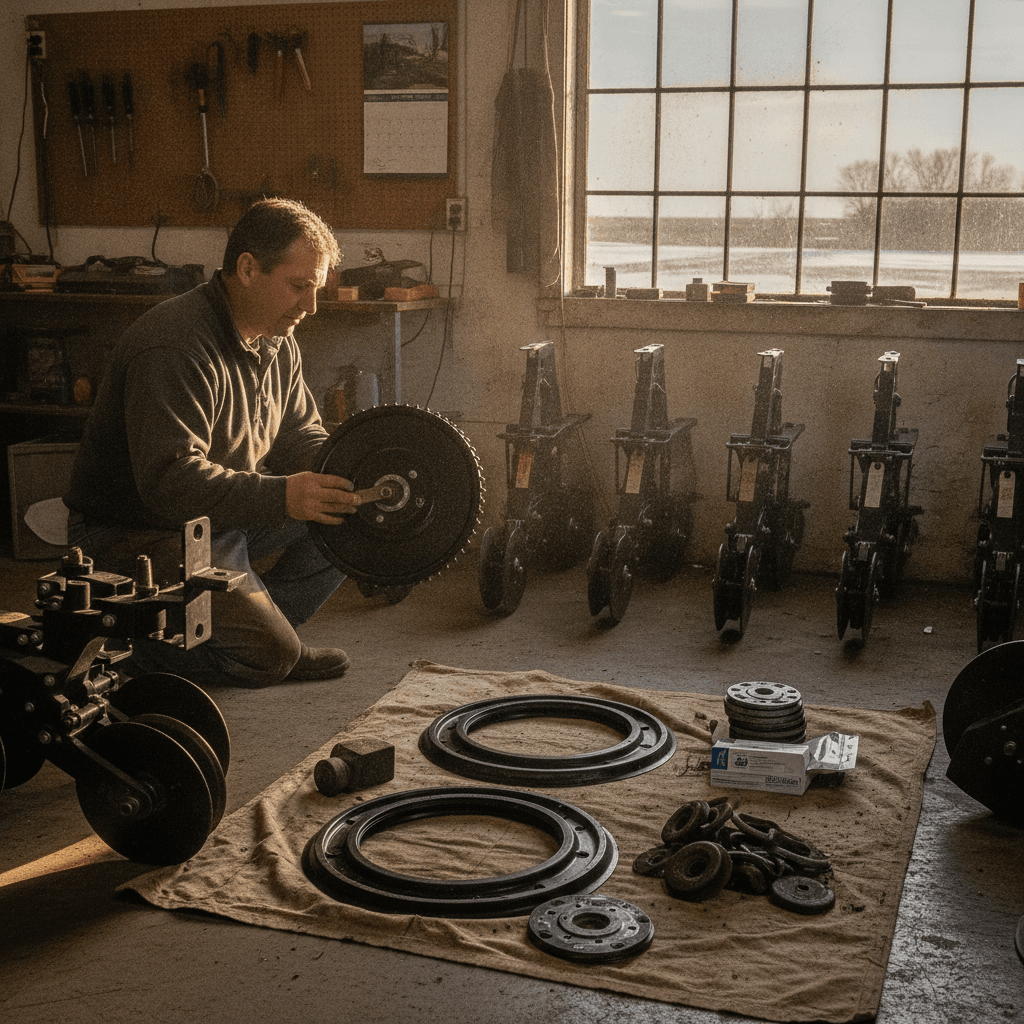
How Do Farmers Near Fargo Decide Which Planter Parts to Prioritize When the Budget Is Tight Before Planting Season?
If you’re farming near Fargo and you’ve got a list of parts your planter needs but not enough budget to cover all of them before the window opens, you’re not alone. This happens every spring. Input costs are up, cash flow is tight between harvest and planting, and the dealer’s parts counter has no shortage of things to sell you. The question isn’t really “what does my planter need?” — it’s “what does it need right now if I want to get through planting without losing a day to a breakdown?” That’s a harder question, and it’s one that most equipment manufacturers and parts suppliers don’t answer directly. Here’s how to think through it.
Start With What Failure Actually Costs You — Not What the Part Costs
The mistake most farmers make when budgeting planter parts is comparing sticker prices instead of comparing the cost of failure. A part that costs $40 and fails on day three of planting in wet conditions might cost you a half-day of downtime, a dealer service call, and lost yield on a field that got planted two days late in deteriorating conditions. That’s not a $40 problem anymore.
Across the Northern Plains — North Dakota, South Dakota, Minnesota — planting windows can be brutally short. In a wet spring near Fargo, you might have four or five real days to plant corn before conditions close back down. Losing half a day to a plugged gauge wheel or a dislodged wheel retainer isn’t just an inconvenience. It’s a yield event.
So the first question to ask about any part isn’t “how much does it cost?” It’s “if this fails at 7 a.m. on the third day of planting, what does that actually cost me?” That reframes the whole conversation.
Rank Parts by Two Factors: Failure Likelihood and Failure Consequence
Once you’re thinking in terms of failure cost, you can build a simple triage framework. Every part on your list falls somewhere in a two-by-two: high or low likelihood of failure this season, and high or low consequence if it does fail.
- High likelihood, high consequence: Replace before planting. No debate.
- High likelihood, low consequence: Stock a spare. Fix it in the field when it goes.
- Low likelihood, high consequence: Inspect closely. Replace if there’s any doubt.
- Low likelihood, low consequence: Defer. Put it on the post-harvest list.
For most row-crop operations running planters or air seeders in the heavy clay and gumbo soils common across eastern North Dakota and into Minnesota and Iowa, gauge wheels and their associated hardware fall squarely in the first two categories. Here’s why.
Where Gauge Wheels, Steel Rings, and Wheel Retainers Fall in That Framework
Gauge wheels control your planting depth. If they’re worn, cracked, or running with sloppy bearings, you lose depth consistency — and you likely won’t know it while you’re planting. You’ll know it when you pull emergence counts. By then, it’s too late. That makes worn or damaged gauge wheels a high consequence failure, even when they’re still technically turning. If yours are showing significant wear or the hub is loose, replace them before the season. The curved spoked gauge wheels from Jung Enterprise are field-tested to only 1/16″ of wear after 13,000 planted acres across three seasons — which means when you put them on, you’re not replacing them again next year.
Steel rings are a different animal. Most farmers near Fargo haven’t dealt with patented steel tire lip protection before — it’s a newer product category that most of the big-name competitors either don’t offer or handle with add-on scraper kits that create more hardware to manage. The Jung Enterprise steel ring mounts with six screws, protects the tire lip from wear and debris damage, and functions as a built-in scraper — no separate scraper part needed. If your gauge wheel tires are showing lip wear or you’ve been fighting mud plugging through heavy spring conditions, a steel ring is a high-likelihood failure prevention item with a real durability payoff. One part, one install, and it addresses two problems at once.
Wheel retainers are the part most operators overlook entirely — right up until a gauge wheel pops off a row unit mid-field. A wheel retainer keeps the gauge wheel seated on the planter or air seeder. It’s not glamorous, but a missing or worn retainer means you’re one bad bounce away from losing a gauge wheel in a field. That’s a high consequence, low cost fix. If yours are original equipment and you don’t know how many acres they have on them, it’s worth checking before planting season opens. Learn more about how the Jung Enterprise wheel retainer works and whether your setup needs one.
What the Big Competitors Don’t Tell You About Budget Prioritization
Here’s a gap worth naming directly: most of the major planter parts manufacturers — Yetter, Schaffert, Copperhead Ag, Exapta, the rest — do a reasonable job explaining what their individual products do. What they don’t do well is help you decide in what order to spend limited money across multiple part categories. Their content is organized by product, not by your decision-making process. That leaves farmers doing the triage on their own, usually standing at a parts counter with a service advisor who has an incentive to sell all of it.
The honest answer is that not every part needs to be replaced every year, and not every part has the same urgency. A steel ring on a healthy tire is a long-term investment in reduced wear costs. A worn gauge wheel bearing is a planting emergency waiting to happen. Those aren’t the same priority, and it’s worth treating them differently when cash is tight.
A Pre-Season Inspection Checklist That Actually Helps
Before you decide what to buy, spend an hour doing a real inspection of your planter or air seeder. Here’s what to check on gauge wheels and related hardware:
- Spin each gauge wheel by hand. Roughness, grinding, or wobble = bearing failure likely.
- Check the tire lip for cracking, chunking, or wear channels — that’s where a steel ring pays off.
- Look at each wheel retainer. If it’s cracked, deformed, or clearly worn, replace it.
- Check spoke condition on gauge wheels if you’re running open-spoke designs — broken spokes throw off balance and depth control.
- Run a quick depth consistency check by pressing down on each row unit and watching for variation.
What you find in that inspection tells you exactly where you fall in the triage framework. You don’t need to replace everything — you need to replace the things that are actually likely to fail in field conditions near Fargo this spring.
Jung Enterprise builds all three of these products — steel rings, wheel retainers, and curved spoked gauge wheels — out of Ipswich, South Dakota, for exactly this kind of real-field operation. Patented American-made designs, not imports. If you want to see the full lineup before you make your pre-season parts decisions, browse all products here.
Frequently Asked Questions
How do I know if my gauge wheels are worn enough to replace before planting near Fargo?
If the tire lip shows visible wear channels, the hub has any detectable wobble, or the wheel spins rough by hand, those are all signs to replace before the season. Depth inconsistency at emergence is the expensive way to find out.
Can a steel ring and a wheel retainer be installed on the same gauge wheel setup?
Yes. The steel ring protects the tire lip and scrapes debris during operation. The wheel retainer keeps the gauge wheel seated securely on the row unit. They serve different functions and can both be run together on compatible setups.
If I can only afford to upgrade one item this season, what should it be?
It depends on your current condition. If your gauge wheels are worn and you’re running in variable-depth soils, that’s the first fix. If your tires are healthy but you’ve been fighting mud plugging in wet springs, a steel ring addresses that directly. If your retainers are original equipment on a high-hour planter, don’t skip those — they’re the lowest-cost item with one of the higher failure consequences.
Do Jung Enterprise gauge wheels and steel rings work on air seeders, or just planters?
Both. Jung Enterprise products are compatible with planters, air seeders, and no-till drills across multiple OEM gauge wheel sizes. If you’re running an air seeder in the Red River Valley or across North Dakota, the same wet-spring plugging problems apply — and so do the same solutions.
Is it worth buying replacement gauge wheel parts in the fall after harvest instead of waiting until spring?
Yes, for most farmers. Post-harvest (September through November) is when you have time to actually inspect, order, and install without a planting window breathing down your neck. Parts availability is better, you’re not paying rush shipping, and you go into spring already ready. It’s how the farmers who don’t lose planting days to parts delays tend to operate.
Ready to Sort Out Your Pre-Season Parts List?
If you’ve got questions about which Jung Enterprise products fit your planter or air seeder setup, or you want to talk through what your operation actually needs before the window opens, reach out directly. We’re a working shop out of Ipswich, South Dakota — not a call center. Contact Jung Enterprise here and we’ll give you a straight answer.