
How Do Farmers Near Huron Compare Gauge Wheel Specs on Paper Versus What Actually Holds Up in the Field?
Spec sheets don’t plant corn. If you’re sitting near Huron in February trying to decide which gauge wheel to order before the ground opens up, you’ve probably run into a wall of polymer compounds, durometer ratings, and load capacity numbers that don’t mean much until you’ve actually run the part through 13,000 acres of South Dakota gumbo. The gap between what a manufacturer prints on a data sheet and what holds up in real conditions is wider than most farmers expect — and it costs real money when you pick the wrong part.
Here’s what to actually look at when you’re comparing gauge wheel options, and where spec sheets tend to hide the truth.
What Spec Sheets Tell You — and What They Leave Out
Most gauge wheel spec sheets cover material composition, outer diameter, width, and sometimes load rating. That’s a start. But a few things that matter most in the Northern Plains almost never show up on a product page:
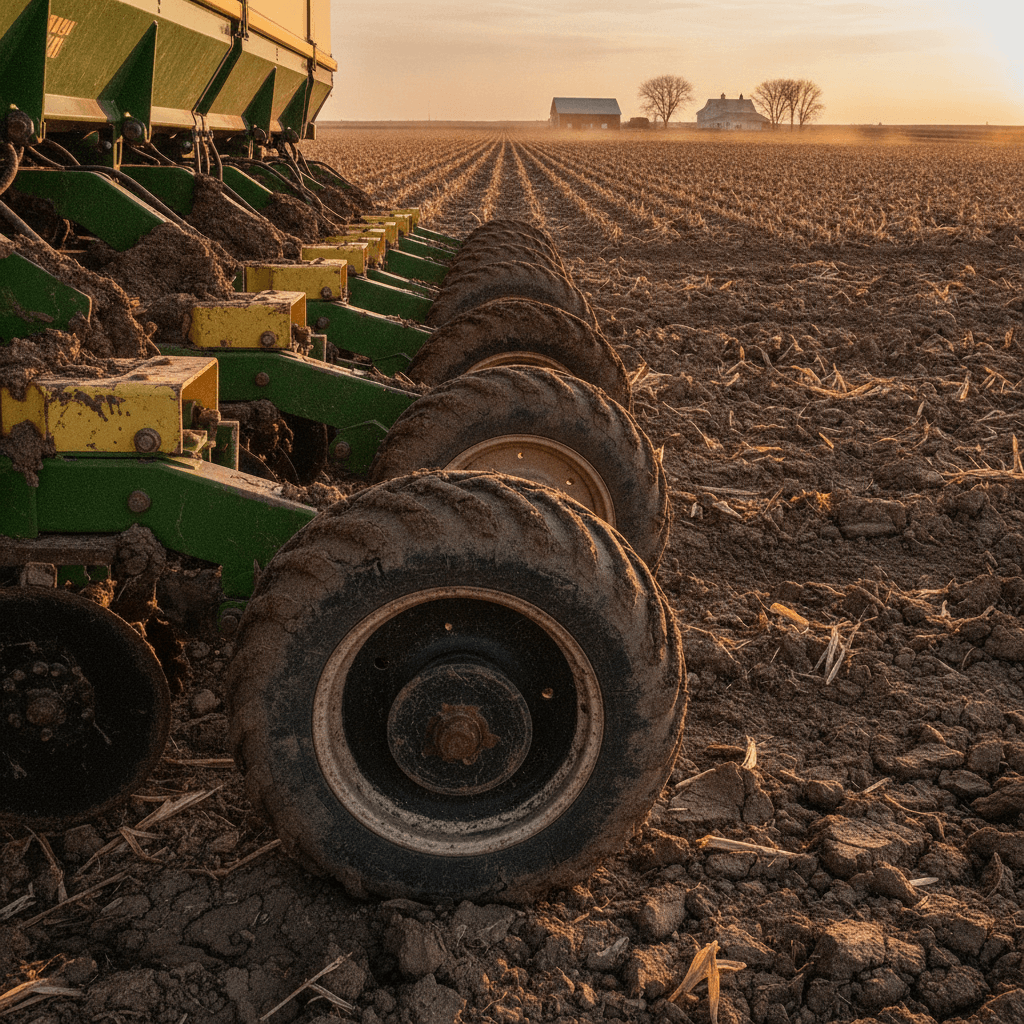
- How the spoke design handles wet clay. A solid or minimally-spoked wheel that looks fine in a catalog will pack with gumbo mud within half a pass in heavy Beadle County soil. Open curved spoke designs shed that material instead of carrying it around.
- Whether the tire lip is protected. The rubber tire lip is usually the first thing to wear out on a gauge wheel — especially in abrasive conditions. Spec sheets almost never call this out, but it’s the failure point that sends you back to the parts shelf mid-season.
- Actual field wear data. Durometer numbers tell you how hard a compound is at rest. They don’t tell you how much that compound wears per acre in real field conditions. Wear rate over a multi-season period is what matters — and most manufacturers don’t publish it because they haven’t tested it that way.
The most useful number we’ve seen in this industry is one most farmers never see on a competitor’s product page: 1/16 inch of wear after 13,000 planted acres over three seasons. That’s what Jung Enterprise’s parts have posted in field testing. Compare that against an OEM replacement that’s visibly worn in a single season and you start to understand why paper specs don’t tell the full story.
The Mud Problem Spec Sheets Almost Never Address
If you farm in the Huron area or anywhere in central South Dakota, you already know what happens when a gauge wheel starts carrying mud. Depth control goes out the window. The wheel stops doing its job and starts acting like a drag. Depending on how fast you catch it, you’re either pulling the planter to clean wheels or discovering the problem at harvest when you see the skip patterns in the stand.
The gauge wheel designs that handle this best aren’t always the ones with the best-looking spec sheet. Curved spoked gauge wheels — with an open spoke geometry designed to let soil pass through rather than pack in — are the field answer to this problem. You can read the engineering rationale in a spec sheet all you want, but the real test is whether the wheel is still running clean after two hours in April mud. Jung Enterprise’s curved spoked gauge wheels were designed specifically around that field reality, not around what looks good in a product table.
The Part Most Farmers Overlook When Comparing Gauge Wheel Systems
Here’s a gap that most gauge wheel comparisons — including those from well-known competitors — don’t adequately cover: tire lip wear and what’s protecting it.
The rubber tire lip on a gauge wheel is the contact point with the soil and with the furrow wall. It takes the most abuse, especially in abrasive sandy-clay mixes or in crop residue-heavy no-till conditions. Most product comparisons focus on the spoke design, the bearing, or the overall diameter. The tire lip usually gets a footnote if it gets mentioned at all.
Jung Enterprise’s Steel Ring was built around this specific failure point. It mounts with six screws directly on the gauge wheel, protects the tire lip from wear, and functions as a built-in scraper to keep mud from packing the wheel. That’s two problems solved with one part — no separate scraper kit, no extra hardware to lose track of. It’s covered under US patent 11,707,013 B2, which means the design is original, not a knockoff of something else. You can see the full product details here.
When you’re comparing gauge wheel systems near Aberdeen or anywhere else in South Dakota, ask the supplier directly: what’s protecting the tire lip, and is that included in the price you’re quoting? If the answer is “a separate scraper kit” or “nothing,” you’re not comparing apples to apples.
How to Read a Gauge Wheel Comparison the Right Way
Here’s a practical checklist for evaluating gauge wheel specs before you buy — whether you’re near Huron, ordering from a dealer in Ipswich, or sorting through options online:
- Ask for actual wear data, not just material specs. What did it measure after 5,000 acres? 10,000? If the manufacturer can’t answer that, the spec sheet number is just a starting point.
- Check the spoke design against your soil conditions. Open curved spokes perform differently than closed or minimal-spoke designs in wet clay. Make sure the design matches what you actually plant in.
- Find out what happens to the tire lip. Is there a protector? Is it built in or a separate part? What’s the expected life on the lip specifically?
- Confirm compatibility with your planter or air seeder. Diameter and width need to match your row unit. If you’re running a no-till drill with non-standard gauge wheel sizing, confirm fitment before ordering.
- Look for American-made, field-tested proof points. Imported parts often meet a spec on paper and miss it in the field. If a manufacturer is testing their own product in Minnesota, Iowa, or the Dakotas under actual planting conditions, that matters more than a factory certification from overseas.
What Competitors Don’t Tell You About Spec-to-Field Gaps
Most of the major gauge wheel suppliers — including the well-known names farmers near Huron and across the Northern Plains have been ordering from for years — publish product pages with materials, dimensions, and compatibility charts. What’s consistently missing is honest, published wear data from real field seasons, and a direct explanation of how the product handles the tire lip failure point.
That’s not a knock on any specific competitor. It’s just a gap in how the industry talks about these parts. At Jung Enterprise, we built around those gaps because that’s what came up in real conversations with farmers running planters in real South Dakota conditions. The numbers we can stand behind — 13,000 acres, three seasons, 1/16 inch of wear — come from field testing, not a lab.
Frequently Asked Questions
Do curved spoked gauge wheels fit my existing planter without major modifications?
In most cases, yes. Jung Enterprise’s curved spoked gauge wheels are designed for compatibility across multiple OEM brands and common gauge wheel sizes used in planters, air seeders, and no-till drills. Confirm your diameter and row unit specs before ordering, and contact us directly if you’re unsure about fitment.
Does the Steel Ring work on gauge wheels that already have a scraper installed?
The Steel Ring functions as a built-in scraper, so in most cases you won’t need a separate scraper. If you already have one mounted, you’d typically remove it before installing the Steel Ring. The six-screw mount is straightforward and doesn’t require specialized tooling.
How do I know if my current gauge wheels are worn enough to replace?
Visible deformation on the tire lip, inconsistent planting depth across the field, and mud plugging that wasn’t present in previous seasons are the most common signs. If you’re seeing skip patterns or depth variation at emergence, the gauge wheels are worth inspecting before you assume it’s a seed or population issue.
Does Jung Enterprise sell direct to farmers near Huron, or only through dealers?
Both. You can order directly through Jung Enterprise, or ask your local ag dealer about stocking our parts. For farmers near Huron or across South Dakota who want to compare options before buying, reaching out directly is the fastest way to get accurate fitment and pricing information.
Is there a meaningful difference between buying OEM gauge wheels and aftermarket parts from a manufacturer like Jung Enterprise?
OEM parts are built to meet a minimum performance standard for the equipment they ship with. Aftermarket parts from a specialized manufacturer can be engineered specifically around the failure points OEM designs don’t address — like tire lip wear and mud plugging. The question isn’t brand loyalty; it’s whether the part solves the actual problem you’re dealing with in your specific field conditions.
If you’re comparing gauge wheel options for this planting season and want straight answers on fitment, wear data, or how Jung Enterprise parts stack up against what you’re running now, reach out to us directly. We’re based in Ipswich, we work with farmers across South Dakota, North Dakota, Minnesota, and Iowa, and we’d rather answer your questions before you order than after something doesn’t work in the field.