
How Do Farmers Near Ipswich Figure Out If Their Planter Is Actually Hitting Target Population — Before They Find Out at Harvest?
If your planter is set for 32,000 seeds per acre but your stand count comes back at 28,500, the problem likely didn’t start with your meter — it started with your depth. Inconsistent planting depth is one of the most common and most quietly expensive mistakes in row-crop planting, and around Ipswich, where wet spring soils and short planting windows collide, it’s a problem that shows up every single year. The good news is you can catch it before you ever leave the field — if you know what to look for.
Why Population and Depth Are the Same Problem
Most farmers think of seed population and planting depth as two separate settings — population is a meter issue, depth is a gauge wheel issue. That’s not entirely wrong, but it misses the real connection. When your planting depth varies by half an inch or more across rows or across a field, you’re effectively planting into different soil temperature and moisture environments at the same time. Seeds at 1.5 inches may emerge three to four days ahead of seeds at 2.5 inches. That gap in emergence translates directly into uneven canopy development, pollination timing issues in corn, and yield drag that never shows up as a “broken part” — it just shows up as lower-than-expected bushels.
Depth variance is driven by gauge wheel performance more than almost any other single factor. If your gauge wheels are worn, plugged with mud, or riding on packed soil instead of floating with the disk opener, they can’t hold consistent depth. In clay and gumbo soils common across the Northern Plains from Ipswich south toward Huron and east toward Watertown, this problem gets amplified fast once things get wet.
The Field Check Most Farmers Skip Before the First Pass
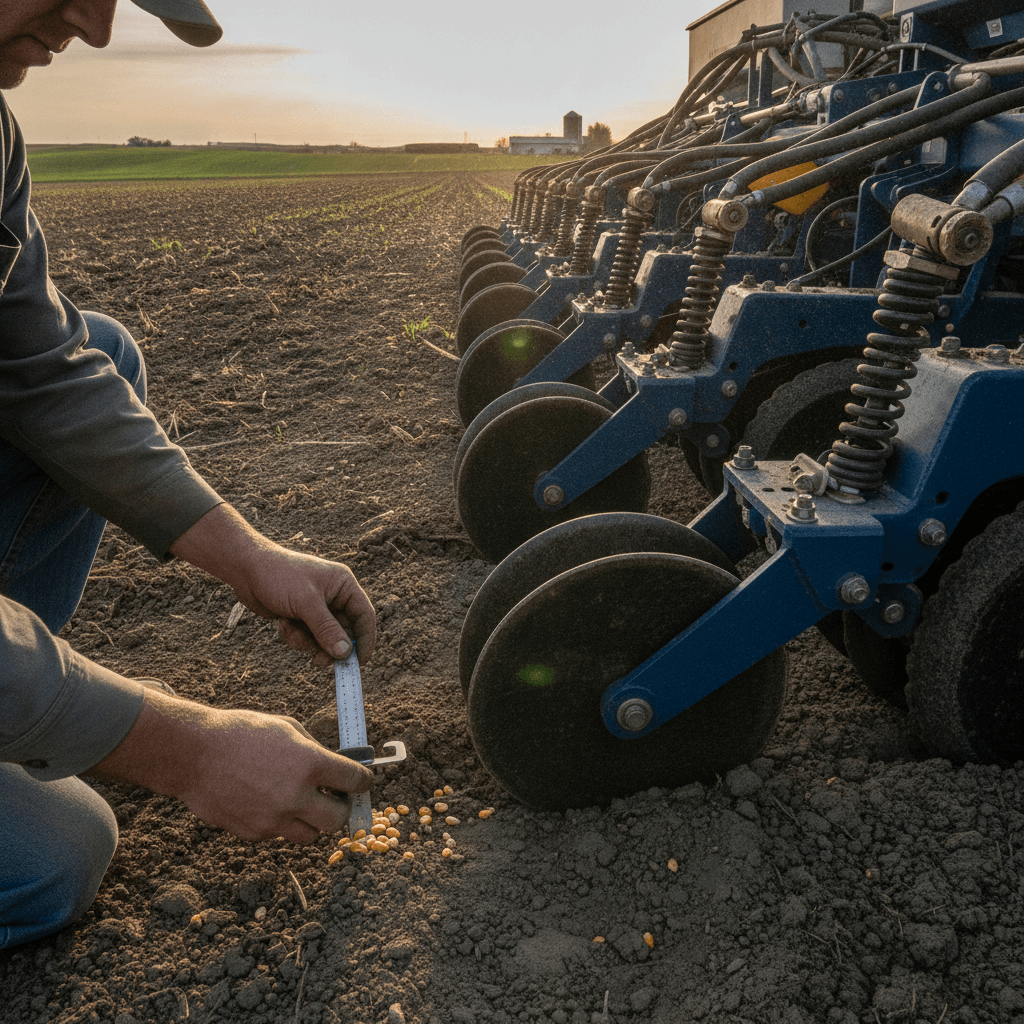
Before you run a single row, you can do a manual depth check that takes about 20 minutes and tells you more than most monitors will. Lower the row unit into a section of your field with representative soil conditions. Run it forward by hand or at creep speed, then stop, dig behind the disk, and measure where the seed actually landed — not where the display says it should be. Do this across multiple row units. If you’re seeing more than a quarter-inch of variance between units, you have a setup problem that will cost you population uniformity before you hit the end of the first pass.
What causes that variance? Usually one of three things: worn or mud-packed gauge wheels that can’t maintain consistent contact with the soil, uneven down-force application across units, or gauge wheel geometry that doesn’t match the disk opener profile on your specific planter. All three are fixable before you plant — none of them fix themselves mid-season.
What Competitor Resources Miss on This Topic
A lot of the major planting equipment companies do a decent job explaining meter calibration and singulation. What they don’t explain well is the mechanical link between gauge wheel condition and the population numbers you actually end up with. The focus tends to be on electronics — monitors, singulation sensors, downforce sensors — and those are useful tools. But a sensor can tell you a seed was released at the right interval and still not tell you it landed at a consistent depth. That gap in the information chain is where stand counts go sideways.
The mechanical side of the row unit — specifically the gauge wheel — is where the depth story either holds together or falls apart. If the gauge wheel is plugged with debris, the disk opener can’t read true soil surface. If the gauge wheel tire lip is worn or the wheel itself is deflecting under load, depth will wander. These aren’t exotic problems. They’re the kind of thing that happens gradually over two or three seasons until one spring you’re standing in a field wondering why your stand looks like it got planted by two different people.
Jung Enterprise’s curved spoked gauge wheels address this directly. The open-spoke design sheds mud instead of packing it, which means the wheel stays in contact with actual soil surface — not a layer of clay buildup that raises your effective running height by a quarter inch without you knowing it. They’ve been field-tested to only 1/16 inch of wear after 13,000 planted acres over three years, which means the depth geometry you set up in the shop is still the depth geometry you’re running late in the season when other wheels have started to drift.
Checking Population Accuracy in the Field During the Season
Once you’re planting, there are a few simple ways to verify you’re hitting your target population before you’ve committed the whole farm to a potential problem.
- Row unit seed trench inspection: Stop periodically and dig a short trench behind a row unit — 17.4 feet of trench behind a 30-inch row represents 1/1000th of an acre, so counting seeds in that length gives you a quick population-per-thousand estimate. Do it for multiple rows, not just one.
- Emergence uniformity check: When corn or soybeans emerge, uneven stand rows aren’t always a meter problem — erratic emergence timing that clears up after a few days can point to depth inconsistency from a wheel that was marginal at the start of the field and plugged up by the end.
- Visual gauge wheel inspection mid-field: Pull up a row unit mid-pass and look at the gauge wheel contact surface. If there’s mud packing between spokes or against the tire, you’re already losing depth accuracy. On solid-spoke or flat-face wheels, that buildup happens faster and is harder to clear without stopping.
Why Ipswich-Area Conditions Make This More Urgent
Spring planting near Ipswich doesn’t give you a long runway to troubleshoot. The window between soils being fit to work and conditions turning wet again — or drying out too fast — can be measured in days, not weeks. Farmers in this part of South Dakota, as well as those running fields around Aberdeen and east toward Watertown, know that losing a day to equipment problems during that window isn’t just an inconvenience. It’s yield potential that doesn’t come back.
That’s why getting your gauge wheels right before you plant — not after — matters more here than in parts of the country with longer, more forgiving planting windows. Running a worn or mud-prone gauge wheel into heavy spring soils and hoping it holds depth is a gamble that rarely pays off. The cost of a set of reliable gauge wheels is small compared to the cost of a 10% population variance across a few hundred acres of corn.
You can browse the full range of planting components at Jung Enterprise’s product page to see what’s available for your planter configuration before the season starts.
FAQ: Planter Population Accuracy and Gauge Wheel Performance Near Ipswich
Can worn gauge wheels really affect my seed population numbers?
Yes. Worn gauge wheels allow planting depth to vary, which leads to uneven emergence timing. Seeds that emerge days apart behave like different plant populations competing with each other, even if the meter released them at the correct interval. Stand counts suffer even when the meter is working perfectly.
How often should I check planting depth during a planting pass?
At minimum, check depth at the start of each field and again after any significant soil condition change — transitioning from dry to wet ground, tilled to no-till, or light to heavy residue. If you’re seeing variable emergence after the fact, increase your mid-field checks next season.
Do open-spoke gauge wheels actually stay cleaner in South Dakota clay soils?
In field conditions, yes. The curved spoke design allows mud to release rather than accumulate. This matters most in the wet clay soils common across the Northern Plains — the kind of conditions you’ll hit regularly around Ipswich, Huron, and the surrounding region during a typical April or early May planting window.
What’s the easiest way to tell if a gauge wheel is causing my depth problem versus a down-force issue?
Lower your row unit into the soil by hand with no forward motion and observe whether the gauge wheel sits flush against the soil surface on both sides of the disk. If it rocks, floats, or has visible mud packing preventing contact, the gauge wheel is your issue. If it sits firm but depth still varies, check your down-force settings and springs next.
Does Jung Enterprise make gauge wheels that fit my planter brand?
Jung Enterprise’s curved spoked gauge wheels are designed to fit planters, air seeders, and no-till drills across multiple OEM brands and gauge wheel sizes. Contact them directly at (605) 281-0497 or email help@jungenterprise.net to confirm fitment for your specific equipment before ordering.
Talk to Jung Enterprise Before the Season Starts
If you’re running corn or soybeans near Ipswich and you’re not fully confident your planter is going to hold depth from the first pass to the last, it’s worth a conversation before you find out the hard way. Jung Enterprise is based right here in Ipswich, South Dakota, and builds patented American-made gauge wheel and planter components that are field-tested in the same conditions you’re dealing with — not tested somewhere else and shipped in.
Reach out through the contact page, call (605) 281-0497, or email help@jungenterprise.net to ask about fitment, availability, or which components make the most sense for your operation. Don’t wait until planting season is already on top of you.