
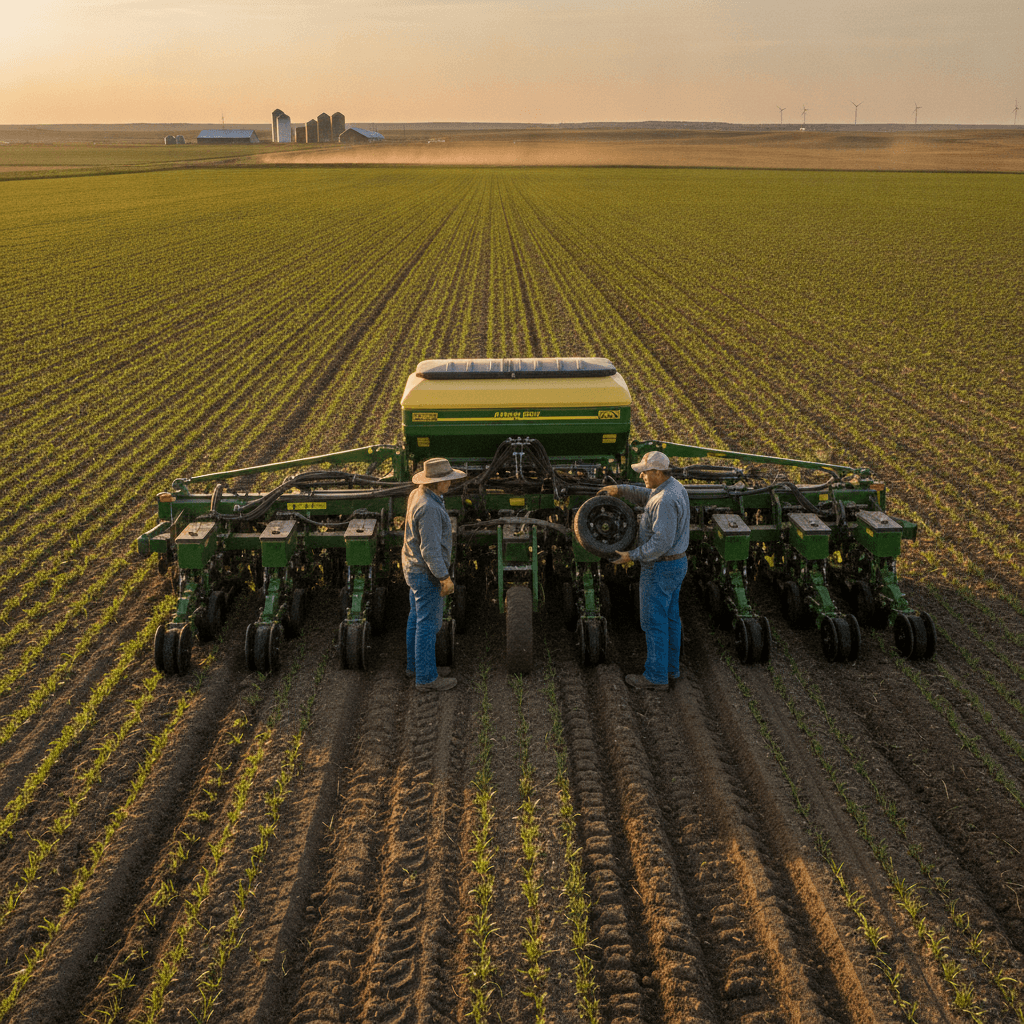
How Do No-Till Farmers Near Bismarck Choose the Right Gauge Wheel Size — And Why Getting It Wrong Costs You at Planting Time?
The short answer: you match gauge wheel diameter and width to your specific row unit specs, confirm the hub bore fits your axle, and make sure the spoke design can actually shed the soil type you’re planting into. For no-till farmers near Bismarck dealing with heavy Northern Plains soils, that last part matters more than most people think — and it’s the detail that almost every competitor product page skips entirely.
If you order a gauge wheel that’s a quarter-inch off in diameter or runs a spoke design that packs with clay, you’re not going to catch it until you’re three passes into planting and your seed depth starts drifting. By then, you’ve burned part of your window. Here’s how to get it right before the drill ever hits the field.
- Start With Your Row Unit, Not the Wheel
- Why Spoke Design Is a Soil-Type Decision, Not Just a Preference
- OEM vs. Aftermarket Gauge Wheels — What the Size Charts Don't Tell You
- The Sizing Problem That Hits No-Till Harder Than Conventional
- Frequently Asked Questions
- Get the Right Fit Before Planting Season
Start With Your Row Unit, Not the Wheel
The most common mistake is shopping for gauge wheels by brand first and row unit second. That’s backwards. Your row unit determines everything — the gauge wheel diameter your planter or no-till drill is designed to run, the hub bore size, the flange width, and the lateral clearance around the disk blade. If any of those measurements are off, you’re fighting the equipment instead of working with it.
Before you order anything, pull the gauge wheel off one row unit and measure it directly:
- Overall diameter — measure rim edge to rim edge across the center
- Tire section width — the widest point of the tire when mounted
- Hub bore diameter — the opening that slides onto your axle
- Bolt pattern — number of holes and spacing, if it’s a bolt-on wheel rather than a press-fit bearing setup
Cross-reference those numbers with your OEM parts manual or call your dealer. If you’re running a multi-brand operation — which is common on larger farms across North Dakota, South Dakota, Minnesota, and Nebraska — you may have two or three different row unit configurations in the same shed. Don’t assume a wheel that fits your corn planter also fits your no-till drill on soybeans.
Why Spoke Design Is a Soil-Type Decision, Not Just a Preference
This is the section that most competitor product pages completely ignore. They’ll list a gauge wheel, show a diameter and hub bore, and leave it at that. What they don’t tell you is that the spoke geometry determines whether the wheel stays clean in your specific soil conditions — and in the gumbo and heavy clay soils you’ll find across much of North Dakota and the Northern Plains, that’s a planting-day make-or-break issue.
Solid or near-solid wheels pack with wet clay almost immediately. Once they pack, they stop rolling freely, start skidding, and lose their ability to control seed depth. You end up with inconsistent furrow depth across the field, uneven emergence, and yield variability that doesn’t show up until well after planting — by which point it’s too late to fix.
Open, curved-spoke designs shed mud rather than hold it. The curve matters because it deflects soil laterally as the wheel turns rather than letting it compact into the spoke pockets. Jung Enterprise’s curved spoked gauge wheels are built specifically around this principle — the open-spoke geometry keeps the wheel running clean through the kinds of wet spring conditions that are routine near Bismarck and across the Corn Belt’s northern edge.
OEM vs. Aftermarket Gauge Wheels — What the Size Charts Don’t Tell You
OEM replacement wheels from your planter manufacturer are sized correctly by definition. The problem is they’re usually priced at a premium, often back-ordered when you need them most, and some of the rubber formulations wear faster than you’d expect in high-abrasion no-till conditions where the wheel is constantly contacting soil, residue, and the disk blade’s furrow edge.
Quality aftermarket gauge wheels — and not all aftermarket is created equal — can match OEM sizing precisely while using harder-wearing materials and better spoke designs. The key is verifying the measurements yourself rather than trusting a generic fitment guide. Ask the supplier for exact specifications, not just a model compatibility list. Compatibility lists are often written broadly and don’t account for minor OEM changes across production years.
At Jung Enterprise out of Ipswich, every gauge wheel is built to specific dimensional tolerances so it drops in where an OEM wheel came out. There’s no guessing about fitment. And the durability numbers back it up — field testing has shown only 1/16 inch of wear after 13,000 planted acres over three seasons. That’s meaningful when you’re running a no-till operation and putting serious miles on every row unit each spring.
The Sizing Problem That Hits No-Till Harder Than Conventional
In conventional tillage, a gauge wheel that’s slightly undersized might drift a bit without causing catastrophic depth problems because the soil is already worked and relatively uniform. In no-till, there’s no margin. The gauge wheel is running against undisturbed ground with crop residue, variable surface moisture, and potentially frozen or crusted soil right at the surface.
If your gauge wheel diameter is even slightly off from spec, you’re either planting shallower than intended — risking poor germination and uneven emergence in cold Northern Plains soils — or deeper than intended, which puts seed below the warm, moist zone you’re targeting. Neither one is acceptable when planting corn or soybeans into a narrow spring window where two weeks of delayed emergence can cost you real yield.
This is why getting the size right at the start of the season, not after the first pass, is worth taking the time to measure twice before you order. Contact Jung Enterprise with your row unit make, model, and gauge wheel measurements and we can confirm fit before anything ships.
Frequently Asked Questions
What gauge wheel diameter do most planters and no-till drills use?
The most common sizes run in the range of 13 to 15 inches in diameter, but this varies by manufacturer and row unit generation. Always measure your existing wheel rather than assuming a standard size applies to your equipment.
Can I run the same gauge wheel on my planter and my no-till drill?
Possibly, but don’t assume it. Planter row units and no-till drill row units often have different hub bore sizes and axle configurations even if the outer diameter looks similar. Verify measurements on both machines before ordering a common part.
How do I know if my gauge wheel spoke design is causing depth problems?
Walk your rows after a pass in wet conditions and look at the wheels themselves. If you see soil packed into the spoke pockets, the wheel isn’t shedding mud the way it should. Also check seed depth consistency across multiple rows — significant variation often points to gauge wheels that aren’t rolling cleanly.
Do curved spoke gauge wheels fit the same mounting hardware as my current wheels?
Yes — Jung Enterprise’s curved spoked gauge wheels are designed to fit standard mounting hardware and hub configurations across major OEM planter brands. The spoke design change doesn’t affect the mounting interface.
How long should a quality gauge wheel last in no-till conditions near Bismarck?
In heavy residue no-till conditions on Northern Plains soils, a quality gauge wheel should realistically last multiple seasons. Jung Enterprise’s wheels showed only 1/16 inch of wear after 13,000 planted acres — that’s the kind of durability that makes sense for operators who can’t afford mid-season downtime during the planting window.
Get the Right Fit Before Planting Season
Gauge wheel sizing isn’t complicated, but it does require you to measure what’s actually on your equipment rather than guessing from a fitment chart. If you’re running no-till or strip-till near Bismarck or anywhere else across the Northern Plains, the combination of right sizing and an open-spoke design built to shed gumbo clay is what keeps your planting depth consistent from the first pass to the last.
Jung Enterprise is a family-owned American manufacturer based in Ipswich, South Dakota, and we build gauge wheels, steel rings, and wheel retainers that are patented, field-tested, and designed for the actual conditions row-crop farmers deal with across this region. Reach out before your planting season runs you over — we can help you confirm sizing, check compatibility, and get parts moving before you need them. Contact us here or call (605) 281-0497.