
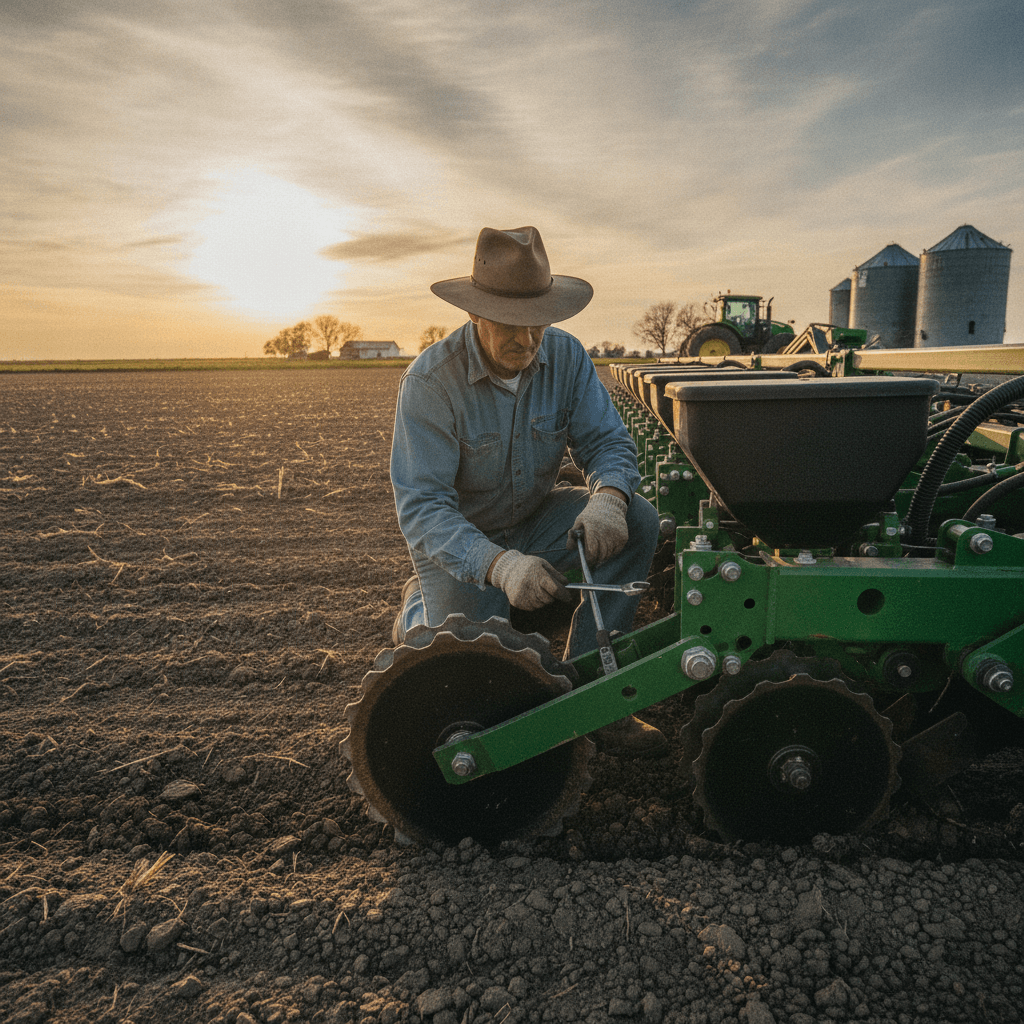
How Do Farmers Near Watertown Know Whether Their Planter’s Steel Ring Is Actually Mounted Correctly — Or Just Waiting to Fail Mid-Season?
If you’re farming near Watertown and you’ve already got a steel ring on your planter gauge wheels, good. That’s a smart call — especially heading into wet spring conditions where clay and gumbo soils will plug up a bare tire lip before you get to the end of the first pass. But here’s the thing: a steel ring that’s installed wrong gives you most of the problems of a worn-out gauge wheel and almost none of the protection you paid for. Uneven contact, skipped scraping, screw gaps, and ring wobble will all show up the moment conditions get muddy — which in eastern South Dakota usually means the first week of planting. This article walks through exactly what correct installation looks like, what warning signs to catch before you’re in the field, and why getting the mounting right matters more than most product listings bother to explain.
Why Installation Quality Gets Overlooked — And Why That’s a Problem
Most competitor product pages show you a photo of the finished steel ring on a gauge wheel and tell you it mounts with six screws. That’s true. But what they don’t tell you is what can go wrong between the photo and the field — and what a bad mount actually looks like after 50 acres on heavy ground. That gap in the information is exactly where problems develop for farmers who assumed “it’s on, so it’s good.”
A steel ring that isn’t seated flush against the tire lip won’t scrape consistently. If even two of six mounting screws are undertorqued, the ring can flex under load — which means it lifts slightly on one side, lets mud push in behind it, and eventually works loose entirely. On a 16-row or 24-row planter in the middle of corn planting near Watertown, a ring that comes loose mid-field doesn’t just mean downtime. It means depth inconsistency across that row for however long it took you to notice.
What a Correct Steel Ring Mount Actually Looks Like
Before you take your planter out of the shed, here are the specific things to check on every row unit that has a steel ring installed.
1. Flush Seating Against the Tire Lip
With the ring mounted, look at the contact edge between the ring and the tire lip from the side. There should be no visible gap anywhere around the full circumference. If you can see daylight between the ring and the tire at any point, the ring isn’t seated correctly. This usually means the ring was mounted on a tire that’s slightly out of round, or the screws were run in unevenly. Back the screws out and reseat the ring before final torque.
2. Even Screw Torque Across All Six Points
The Jung Enterprise Steel Ring mounts with six screws spaced around the ring. Run them in gradually in a cross pattern — the same way you’d torque a wheel — not around the circle in order. If you tighten them sequentially, the first screws pull the ring slightly off-center before the last ones go in, and you end up with uneven clamping pressure. Check each screw after full torque to confirm none backed out during the process.
3. No Ring Wobble When Spun by Hand
Before mounting the gauge wheel back on the row unit, spin it by hand and watch the ring. It should track true with no wobble or lateral movement. Even a small wobble means something isn’t seated right. Catch it now and it takes five minutes to fix. Catch it after two weeks of planting and you’re looking at a worn tire contact edge and possible ring replacement.
4. Scraper Lip Alignment
One of the real advantages of the Jung Enterprise steel ring is that the built-in scraper lip means you don’t need a separate scraper component. But that scraper only works if the ring is mounted at the correct angle relative to the tire. Check the product documentation for your specific gauge wheel size and confirm the ring orientation before final install. A ring that’s flipped or cocked even slightly won’t scrape — it’ll just ride along doing nothing while mud builds up behind it.
The Gap Nobody Talks About: What Happens to the Ring Over the First Season
Most product pages focus on initial install and move on. But what should a correctly-mounted steel ring look like after 500 acres? After 2,000? This is something the major competitors almost never address in detail — and it matters if you’re trying to decide whether a ring is wearing normally or failing early.
Jung Enterprise’s steel rings have been field-tested to only 1/16″ of wear after 13,000 planted acres across three years. That’s the benchmark. If you’re seeing more wear than that at a significantly lower acre count, something is wrong — either with mounting, with the soil conditions the ring is being asked to handle, or with the ring itself. Check the mounting torque after the first 200–300 acres of the season. Screws can back off slightly as the ring seats in through normal field vibration, and catching that early prevents the bigger problems later.
For no-till operations in eastern South Dakota and into western Minnesota, the wear profile will also look different than it does in conventional-till ground. No-till residue and harder soil entry angles put more lateral stress on the ring. That’s not a reason to avoid steel rings in no-till — it’s a reason to inspect mounting a little earlier in the season and keep an eye on the scraper lip contact through the first few hundred acres.
A Quick Pre-Season Mounting Checklist for Farmers Near Watertown
- Inspect tire lip condition before mounting. If the tire lip is already badly grooved or deformed from previous seasons without a ring, the new ring may not seat flush. Address the tire first.
- Clean the mounting surface. Dirt, rust scale, or old debris between the ring and tire will prevent full contact. Wire-brush the tire lip before installing.
- Use the cross-pattern torque sequence. Not sequential around the circle.
- Verify no gap around the full circumference after final torque.
- Spin-check for wobble before reassembly.
- Re-check torque after the first 200–300 acres.
This checklist takes less than ten minutes per row unit. On a 24-row planter, that’s a few hours in the shop before planting — which is a lot cheaper than a service call in the middle of a three-day planting window when the forecast turns wet.
If you want to see the full product specs and compatibility details before your pre-season inspection, the Jung Enterprise products page covers everything across the full gauge wheel line, including steel ring sizes for different OEM applications.
Frequently Asked Questions — Steel Ring Installation Near Watertown
Can I mount a steel ring on a gauge wheel that already has visible tire lip wear?
It depends on how much wear. Minor wear — shallow grooves, slight scuffing — usually isn’t a problem as long as the contact surface is still reasonably round and the ring seats flush. Deep grooves or a deformed lip are a different story. If the ring can’t seat fully because the tire surface is uneven, you’ll end up with gaps that defeat the purpose of the ring. In that case, replace the tire first.
How tight do the mounting screws actually need to be?
Firm and even — not gorilla-tight. You’re clamping a steel ring to a rubber tire lip, not bolting a wheel to an axle. The goal is consistent clamping pressure across all six points, not maximum torque on any one screw. Follow the installation specs in the product documentation. Overtightening a single screw can distort the ring or strip the mounting hole.
Does the ring need any kind of sealant or adhesive at the tire contact?
No. The six-screw mechanical mount is designed to hold without sealants. Adding adhesive can actually make re-inspection and removal harder, and it won’t improve seating if the ring isn’t mechanically flush to begin with. Get the mechanical fit right and the mount will hold through the season.
How do I know if my gauge wheel size is compatible with the Jung Enterprise steel ring?
Jung Enterprise steel rings are built to fit multiple common gauge wheel sizes across major OEM planter brands. Check the product page or contact the shop directly to confirm fit for your specific planter. The quickest way is to have your gauge wheel diameter and tire lip width ready when you call.
What’s the difference between the built-in scraper on the Jung steel ring versus a separate scraper arm attachment?
A separate scraper arm is an additional part that can wear, break, get knocked out of adjustment, or fall off entirely. The built-in scraper on the Jung steel ring is part of the ring itself — there’s nothing to adjust, nothing extra to fail, and nothing to lose in the field. If the ring is mounted correctly, the scraper is always in the right position. That’s one fewer thing to think about during a busy planting season near Watertown or anywhere else in eastern South Dakota.
Ready to Check Your Setup Before Planting Season?
Jung Enterprise is based in Ipswich, right here in South Dakota, and we build and sell directly to farmers across the Northern Plains — including the Watertown area, eastern South Dakota, and into North Dakota and Minnesota. If you’ve got questions about whether your current steel ring install is correct, what size fits your planter, or whether it’s time to upgrade before the next season, we’re straightforward to reach and we’ll give you a straight answer.
Contact Jung Enterprise here — or call us at (605) 281-0497. We’d rather help you catch a mounting problem in the shop than hear about it when you’re stuck in the field.