
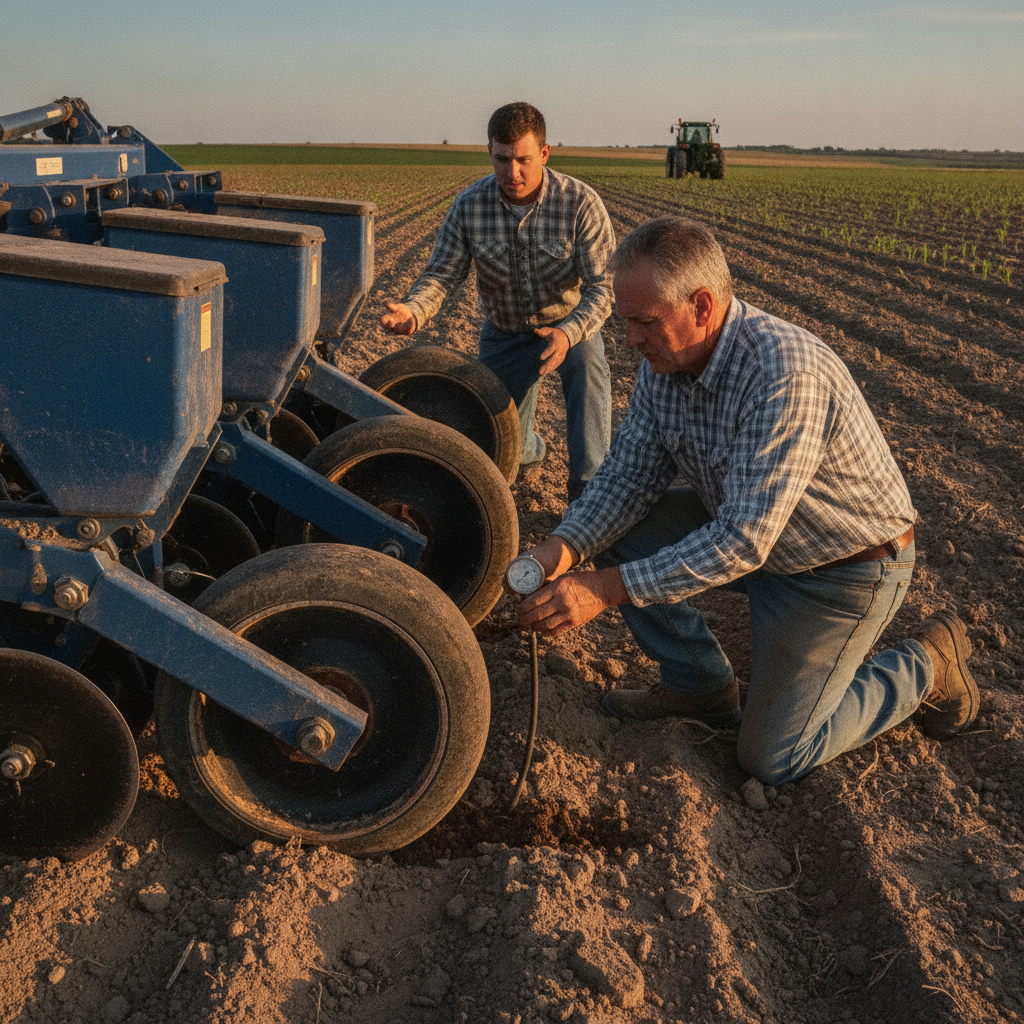
How Do Corn and Soybean Farmers Near Huron Know Whether Their Planter’s Gauge Wheel Is Actually Maintaining Consistent Tire Pressure Through a Full Spring Run — Or Just Slowly Going Flat While Seed Depth Drifts?
If you’re farming near Huron and your stands came in uneven last spring — some spots with solid emergence, others thin and patchy — and you can’t point to a clear reason, slow gauge wheel tire pressure loss is one of the first places worth looking. It’s not dramatic. The tire doesn’t go flat overnight. It just loses a couple pounds of pressure over a few days of running, the gauge wheel starts riding differently against the soil surface, and your seed depth drifts by a half-inch or more without any alarm going off. By the time you notice it in the field, you’ve already planted a lot of acres off-depth.
This is a topic that gets almost no attention from the major planter parts companies. Most of them talk about gauge wheel design, spoke geometry, mud-shedding — all real issues — but very few address the connection between tire pressure loss and seed depth drift as a maintenance problem in its own right. That’s a gap worth closing, because it costs farmers real bushels every year.
Why Gauge Wheel Tire Pressure Matters More Than Most Farmers Think
The gauge wheel’s whole job is to ride the soil surface at a consistent height so the row unit plants at the depth you set. That depth control depends on the tire holding its shape. When tire pressure drops — even a few PSI — the tire deflects differently under load. The sidewall flattens slightly, the effective rolling diameter changes, and the row unit sits lower than it should. That translates directly into seeds going deeper than intended.
In most soil conditions, a half-inch of extra depth on corn might not kill the stand. But in cold, wet soils like you see across South Dakota in a typical late-April window, seeds planted too deep sit in cold, saturated ground longer than they need to. Germination stalls. Stand counts drop. And you’re looking at replant decisions during a planting window that’s already tight.
The reverse is also true. If a tire has been leaking slowly and you catch it and re-inflate mid-run, that row unit suddenly plants shallower than the others. Now you have depth variability row-to-row, which is one of the harder problems to diagnose after the fact because it doesn’t look like a mechanical failure — it just looks like a rough stand.
What Causes Gauge Wheel Tires to Lose Pressure in the First Place
Most slow leaks on gauge wheel tires come down to a few things:
- Tire lip damage from contact with hard debris or the gauge wheel rim. When the tire lip gets worn or nicked, it stops seating cleanly against the rim and allows a slow bleed. This is especially common after several seasons of running through rocky or abrasive ground conditions.
- Valve stem wear or damage from repeated inflation checks. Gauge wheel valve stems take more abuse than people expect — especially on older machines where access is awkward and the stem gets bumped during service.
- Rim corrosion or pitting that breaks the bead seal over time, particularly on machines that sit outside through winter.
- Physical impact damage from rocks, frozen clods, or hard residue at planting speed.
The tire lip wear issue is the one that connects directly to what a Steel Ring from Jung Enterprise is built to prevent. The patented steel ring (US 11,707,013 B2) mounts to the gauge wheel with six screws and wraps the tire lip to protect it from exactly this kind of contact wear. It also acts as a built-in scraper, so mud and debris that would otherwise pack against the tire lip and work their way under the bead get cleared off instead of grinding away at the seal.
How to Actually Catch Pressure Loss Before It Costs You Stands
The fix here isn’t complicated, but it requires treating gauge wheel tire pressure as a regular check rather than a one-time pre-season setup. Here’s what that looks like in practice:
- Check pressure at the start of each day during planting. Two minutes per row unit is all it takes. Keep a small gauge in the cab or on the planter frame.
- Mark your baseline. Write down what you inflate each tire to and check against that number. A tire that loses two PSI overnight on Monday but four PSI by Thursday is telling you something.
- Inspect the tire lip and bead area when you find a slow leak. If the lip is visibly worn or the bead isn’t seating flush, you’re looking at a part that needs attention — not just more air.
- Don’t mix inflation pressure between row units on the same planter. Every gauge wheel on the machine should be running at the same pressure. Variance between units means variance in planting depth across rows.
Farmers running Curved Spoked Gauge Wheels from Jung Enterprise have noted that the open-spoke design keeps mud from packing into areas around the tire that could interfere with bead contact — which is a secondary benefit beyond the primary depth-control and mud-shedding function. After 13,000 planted acres over three seasons, field-tested units showed only 1/16″ of wear, which means the geometry that sets your depth stays consistent far longer than a standard gauge wheel.
What Competitors Don’t Tell You About This Problem
If you spend time on the websites of the major gauge wheel and planter parts suppliers, you’ll find plenty of discussion about mud-shedding, spoke design, and depth control features. What you won’t find is a direct, practical breakdown of how tire pressure management connects to depth consistency across a full run. It gets treated as an operator problem rather than a product and maintenance problem — and that framing lets equipment suppliers off the hook while farmers deal with the consequences in their stand counts.
The honest truth is that a well-designed gauge wheel with a protected tire lip — one that isn’t slowly losing its bead seal to contact wear — reduces the frequency of pressure loss problems in the first place. That’s not a guarantee against valve stem issues or corrosion, but it removes one of the more common causes. Near Aberdeen and Watertown, where spring soils can be both wet and abrasive depending on the year, that protection matters across the entire run.
Frequently Asked Questions
What PSI should I run my planter gauge wheel tires at?
Most gauge wheel tires run between 15 and 25 PSI depending on the tire size and OEM spec for your planter. Check your row unit manual for the recommended pressure and stick to it consistently across all units on the machine. Don’t guess, and don’t eyeball it.
How much seed depth change can I expect from a few PSI of pressure loss?
This varies by tire size and row unit design, but even a 5 PSI drop can cause enough sidewall deflection to shift planting depth by a quarter to a half inch. In cold, wet soils, that’s enough to slow germination meaningfully and reduce stand counts.
Does a steel ring actually help prevent slow tire pressure leaks?
It addresses one of the common causes — tire lip wear that breaks the bead seal over time. By protecting the tire lip from abrasion and contact damage, the steel ring helps maintain a consistent bead seat. It’s not a cure-all for valve stem leaks or rim corrosion, but it removes a real failure point.
How often should I check gauge wheel tire pressure during planting season?
Daily checks are worth the two minutes it takes, especially during the first week of running when any existing leaks will show themselves quickly. After that, every two to three days is a reasonable baseline unless you’ve had rocky or hard-residue conditions that could have caused impact damage.
Can I use the same gauge wheel setup for both corn and soybeans near Huron?
Often yes, though you should verify your depth settings are adjusted between crops — soybeans typically plant shallower than corn. The gauge wheel itself can often run across both, but tire pressure and depth settings both need to be confirmed when you switch, not assumed to carry over.
Ready to Stop Chasing Pressure Loss Problems Before Planting Season?
If your gauge wheel tires are losing pressure season after season and you’ve traced it back to tire lip wear or bead seat damage, it’s worth looking at what a properly designed steel ring and upgraded gauge wheel can do to extend your service life and hold depth through a full spring run. Jung Enterprise builds patented, American-made parts tested in real Northern Plains field conditions — not on paper.
Reach out to Jung Enterprise to talk through your planter setup, gauge wheel compatibility, and what parts make sense for the conditions you’re running in around Huron and across South Dakota. We’re based in Ipswich and we work directly with farmers and ag dealers across the region.