
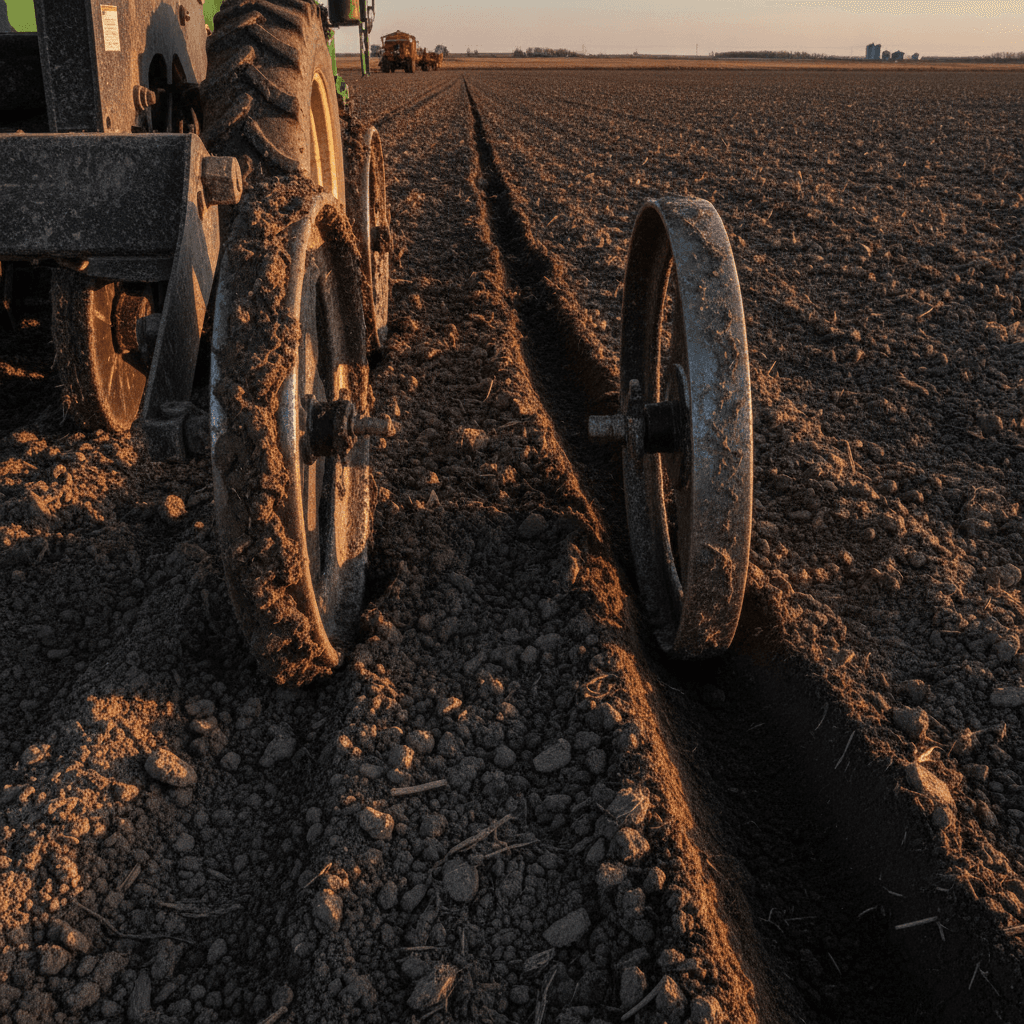
How Do Farmers Near Huron Know Whether Their Planter’s Steel Ring Is Actually Holding Its Scraper Position — Or Slowly Migrating Out of Place Between Fields?
If you’re running a planter through the gumbo ground around Huron and central South Dakota, you already know how fast a gauge wheel can pack up with mud. A steel ring with a built-in scraper is supposed to keep that from happening — but only if it stays exactly where it was installed. The question most farmers don’t think to ask until mid-season: is the ring still sitting flush and tight, or has it worked itself sideways enough that the scraper blade is no longer contacting the tire at the right angle? That’s a quiet failure mode, and it’s one that most competitors in this space don’t address directly.
- Why Scraper Position Actually Matters More Than Most Farmers Realize
- What Causes a Steel Ring to Migrate Out of Position
- What the Competitors Aren't Telling You About Scraper Retention
- How to Check Whether Your Steel Ring's Scraper Is Still in the Right Position
- Frequently Asked Questions
- Talk to Jung Enterprise Before Your Planting Window Closes
Why Scraper Position Actually Matters More Than Most Farmers Realize
The scraper function on a steel ring isn’t a bonus feature — it’s the main reason the ring prevents mud buildup in the first place. The geometry has to be right. If the ring rotates even slightly out of its mounted position, the scraper edge moves off its designed contact point on the tire. What you’re left with is a ring that looks fine from twenty feet away but is no longer doing the cleaning work it’s supposed to do.
In heavier soils — the kind of sticky clay you run into across Beadle County and the surrounding area near Huron — mud builds fast. A gauge wheel that isn’t getting scraped clean on every rotation starts accumulating a mud crown on the tire lip. That changes effective planting depth. Your disk openers are still cutting at the right setting, but the gauge wheel is now riding on a mud platform instead of firm soil. You can lose a quarter inch to half inch of effective depth without the monitor telling you anything is wrong.
The problem compounds across a long field. By the time you’ve made a few passes, you’ve got uneven emergence across the field that you’ll blame on soil variability — when the real culprit was a scraper that wasn’t sitting right by the third pass of the morning.
What Causes a Steel Ring to Migrate Out of Position
There are three main reasons a steel ring doesn’t hold its mounting position through a full planting season:
- Inadequate fastening design. Some rings rely on friction fit, snap-on clips, or just a couple of attachment points. In heavy field conditions with constant vibration and side loading, those designs creep. A six-screw mounting pattern — evenly distributed around the ring — is the standard that actually holds.
- Loose hardware that wasn’t checked post-installation. Even a properly designed ring can migrate if the mounting screws back out. This is a simple maintenance issue, but it catches a lot of operators off guard because there’s no obvious symptom until the scraper stops working.
- Ring material that flexes under load. Thinner or lower-grade steel rings can deform under the side loads that come with running through heavy residue or hard crown conditions. Once the ring distorts slightly, it no longer sits flat against the gauge wheel hub and the scraper position shifts.
Jung Enterprise’s patented steel ring (US Patent 11,707,013 B2) mounts with six screws distributed evenly around the ring. That six-point pattern isn’t arbitrary — it’s what keeps the ring from walking under load. The scraper is integrated into the ring itself, so there’s no separate part to slip, adjust, or lose. And because the scraper is part of the ring’s geometry, if the ring stays in position, the scraper stays in position. Those two things aren’t independent of each other the way they are on add-on scraper designs.
What the Competitors Aren’t Telling You About Scraper Retention
If you go looking for detailed guidance on scraper position maintenance from the major players in gauge wheel accessories — the Yetters and Schafferts and Copperhead Ag setups of the world — you’ll find product descriptions that tell you what the scraper does, but almost nothing about what keeps it doing that through a full season under real field conditions. The installation instructions are usually one page. Long-term position integrity across thousands of acres in variable soils? That’s not covered.
That matters when you’re running 1,000 or 2,000 acres out of Huron and Aberdeen and you need equipment that works at acre 1,800 the same way it worked at acre 10. Jung Enterprise’s steel ring has been field-tested across 13,000 planted acres with only 1/16 inch of wear recorded over three years. That’s the kind of durability number that tells you the ring isn’t moving, isn’t deforming, and isn’t letting the scraper drift. It’s holding position because the design forces it to.
How to Check Whether Your Steel Ring’s Scraper Is Still in the Right Position
You don’t need special tools for this. Before every planting day — or at minimum every few hundred acres in wet, heavy conditions — do a quick visual check on each row unit:
- Look at the scraper blade relative to the gauge wheel tire. The blade should be sitting flush and contacting the tire at a consistent angle around the circumference. If it’s visibly cocked or lifted away on one side, the ring has moved.
- Run your hand around the back of the ring where it mounts to the gauge wheel hub. It should feel solid, not rocking or loose. Any movement you can feel by hand is enough to throw the scraper off its contact angle.
- Check the mounting screws. If any are backing out, address it immediately. Loctite or lock washers can help in high-vibration applications, but a properly torqued six-screw ring shouldn’t require it under normal conditions.
- Look at the tire surface after a muddy pass. A scraper that’s working correctly will leave a clean channel on the tire as it rotates. If you’re seeing mud buildup on the tire face even with a ring installed, the scraper position has drifted.
These checks take two minutes per row unit. Running them at the start of the day and after the first pass in a new field condition — especially when you hit wetter zones — is the kind of maintenance habit that keeps you out of trouble during a short planting window in South Dakota and North Dakota, where a lost day can mean a week’s worth of yield drag.
For a look at the full lineup of parts built to stay in place across the season, the Jung Enterprise product page covers all three core products — steel rings, wheel retainers, and curved spoked gauge wheels — with specs and compatibility details.
Frequently Asked Questions
How often should I check the steel ring scraper position during planting season?
Check it at the start of each planting day and after the first pass in significantly different soil conditions — especially when moving from drier ground into wet zones. In heavy clay or gumbo conditions near Huron, daily checks are worth the two minutes per row unit.
Can a steel ring’s scraper position drift even if the ring looks fine from the outside?
Yes. The scraper angle is precise, and even a small amount of ring rotation or tilt is enough to pull the blade off its contact point. The ring can appear fully intact while no longer doing the cleaning work you installed it for. Physical contact with the tire is what matters, not how the ring looks from a distance.
Does the six-screw mounting pattern actually make a difference compared to fewer attachment points?
In practice, yes. More evenly distributed attachment points reduce the leverage that vibration and side loading can apply to any single fastener. Rings mounted with two or three points give the ring more room to pivot under load. Six points around the circumference is significantly more resistant to that kind of migration across a full season of field use.
Will Jung Enterprise’s steel ring fit my gauge wheel size?
Jung Enterprise’s steel rings are designed to fit across multiple OEM gauge wheel sizes and brands used on planters, air seeders, and no-till drills. Contact the shop directly to confirm fitment for your specific row unit configuration.
Is the scraper built into the Jung Enterprise steel ring, or is it a separate attachment?
The scraper is integrated into the ring itself — it’s not a separate clip-on or bolt-on piece. That means there’s nothing independent to slip out of position. If the ring holds, the scraper holds. That’s the design advantage of a purpose-built integrated system over add-on scraper solutions.
Talk to Jung Enterprise Before Your Planting Window Closes
If you’re farming near Huron, Aberdeen, or anywhere across central and northeastern South Dakota, you know how little margin there is in a wet spring planting window. Equipment that works correctly at the start of the day needs to still be working correctly at the end of it — without field adjustments, lost time, or guesswork about whether the scraper is actually contacting the tire.
Jung Enterprise is a family-owned, American-made manufacturer based in Ipswich, South Dakota. Every product is field-tested, patented, and built to hold its position through a full season of hard use. If you want to know whether a steel ring is the right fit for your setup — or you want to talk through installation on your specific planter or air seeder — reach out directly. Contact Jung Enterprise here or call (605) 281-0497. Real answers, no sales runaround.