
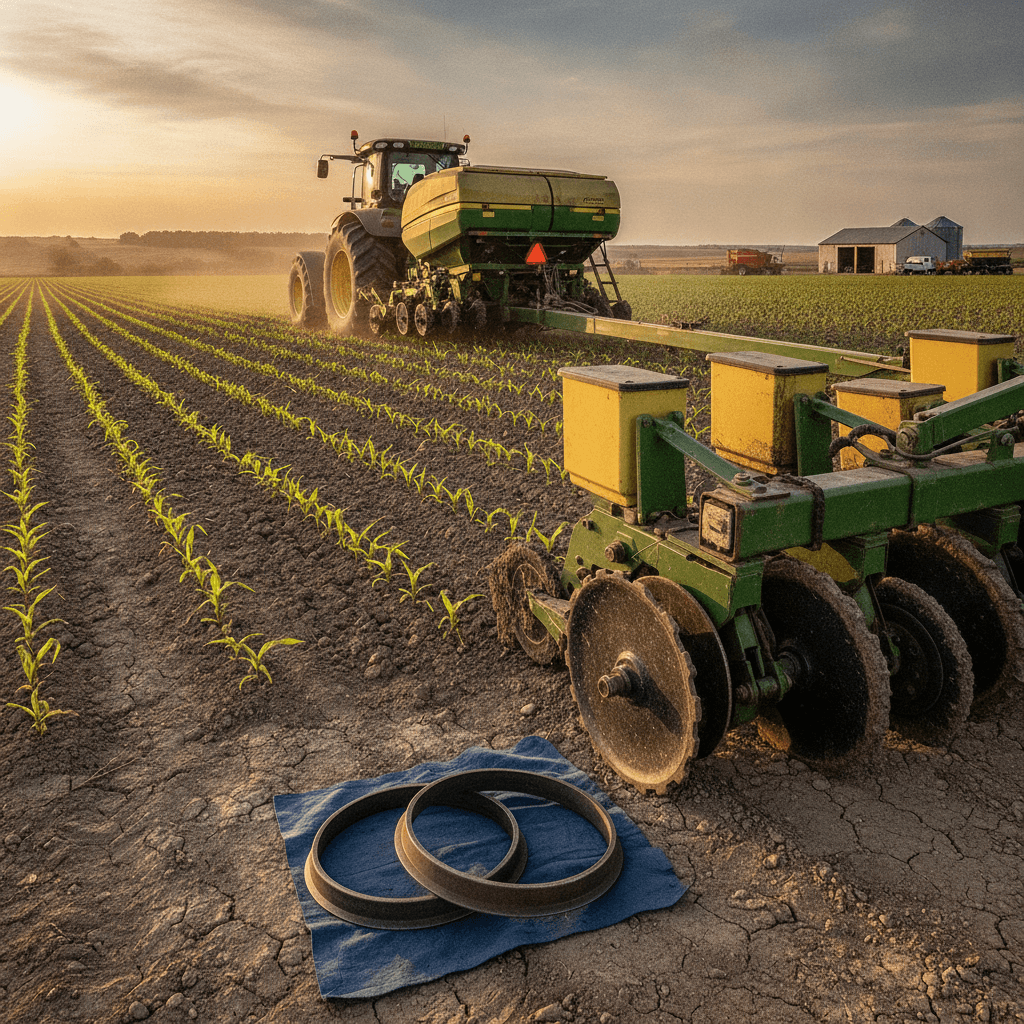
How Do Farmers Near Mitchell Know Whether Their Planter’s Steel Ring Is Actually Rated for the Acres They’re Putting On — Or Just Built to Look the Part?
If you’re farming near Mitchell, South Dakota and someone asks how many acres your steel ring is rated for, the honest answer for most brands is: nobody told you. Most suppliers will show you a photo, give you a price, and let you figure out the rest in the field. That’s a problem when you’re dropping corn and soybeans across hundreds or thousands of acres in a planting window that doesn’t give you second chances. A steel ring that looks the part but doesn’t last the season isn’t a bargain — it’s a liability.
Here’s what you should actually be asking, and what the numbers look like when a manufacturer is willing to back their product with field data instead of catalog copy.
- What "Durability" Actually Means for a Steel Ring — and Why Most Suppliers Don't Publish It
- How to Actually Evaluate a Steel Ring Before You Buy It
- The Part Nobody Talks About: What Happens When the Steel Ring Fails Mid-Season
- Does This Apply to Air Seeders and No-Till Drills Too?
- Frequently Asked Questions — Steel Ring Acre Ratings Near Mitchell, SD
- Ready to Get Actual Numbers on a Steel Ring That's Been Field-Tested?
What “Durability” Actually Means for a Steel Ring — and Why Most Suppliers Don’t Publish It
The job of a steel ring is straightforward: it sits on the outer lip of your gauge wheel tire, protects that lip from abrasive soil contact and debris, and — on a properly designed ring — doubles as a built-in scraper to knock mud off the gauge wheel face before it builds up and throws off your planting depth.
What’s not straightforward is knowing how long a given ring will actually hold up across real field conditions. South Dakota soils — especially in the areas around Mitchell and extending toward Huron — can shift from sandy loam in a dry year to heavy, sticky gumbo in a wet spring. That variation in soil texture, combined with the abrasion from crop residue in no-till and strip-till systems, puts real stress on the steel ring’s contact points every single pass.
Most competitors won’t publish wear data. Browse their product pages and you’ll find plenty of descriptions about steel grade and mounting hardware, but you won’t find a number like: this ring showed 1/16″ of wear after 13,000 planted acres over three years. That’s the kind of field-tested figure that tells you something real about longevity. It’s also the kind of data Jung Enterprise actually has — because the Jung Enterprise Steel Ring has been run through that test in actual field conditions, not a lab.
If a supplier can’t or won’t tell you their wear rate over a known number of acres, that tells you something too.
How to Actually Evaluate a Steel Ring Before You Buy It
When you’re comparing steel rings — whether you’re sourcing through a dealer near Sioux Falls or ordering direct — these are the questions worth asking before you commit to a part that’ll be running during the most critical two to three weeks of your year:
- How many acres has this ring been field-tested across? If the answer is vague or absent, push harder or move on.
- What’s the measured wear rate? Not “minimal wear” — an actual number. 1/16″ over 13,000 acres is a benchmark worth comparing against.
- Does it include a built-in scraper, or is that a separate purchase? Some designs require you to buy a scraper as an add-on. The Jung ring includes scraper function by design — it’s not an accessory, it’s part of how the ring works.
- How does it mount? The Jung steel ring mounts with six screws, which distributes load and reduces the chance of loosening under field vibration. Ask whether any competitor’s ring uses fewer fastener points and what that means for long-term retention.
- Is it patented? Jung Enterprise holds US Patent 11,707,013 B2 and related patents on their steel ring design. That matters not just for legal protection — it’s evidence that the design was developed with enough innovation to merit patent review, not just sourced from an overseas catalog.
The Part Nobody Talks About: What Happens When the Steel Ring Fails Mid-Season
Here’s the gap that most competitor content completely skips over: what actually happens to your operation when a steel ring fails partway through the season — not when you’re swapping it out at the end of the year.
In a normal spring planting window across South Dakota, you might have 10 to 14 days where conditions are right and the calendar allows. If a steel ring fails in week one — lip cracking, scraper position shifting, or the ring separating from the tire under load — you’re either stopping to diagnose a depth problem you haven’t identified yet, or you’re finishing the field on a degraded setup and finding out in the fall what that cost you in stand.
The farmers running Jung Enterprise parts out of Ipswich know that the design isn’t just about surviving the season — it’s about not forcing a decision mid-field between fixing it now and finishing the pass. A ring that’s shown 1/16″ of wear over three full seasons isn’t going to fail on you in week two of a single spring. That consistency is worth more than a lower per-unit price on a part you might be replacing once a season anyway.
Does This Apply to Air Seeders and No-Till Drills Too?
Yes. If you’re running an air seeder rather than a standard row planter — common in the Northern Plains and across parts of South Dakota — the same acre-rating question applies. Air seeders cover ground fast and in more varied conditions than a conventional corn planter, which means the steel ring takes more cumulative abuse per season. The Jung steel ring is compatible across planters, air seeders, and no-till drills, so the durability numbers translate regardless of your equipment type.
For no-till operations specifically, residue contact adds another wear variable that makes field-tested data even more important. If a ring’s wear rate was tested in tilled ground only, that number doesn’t mean much when you’re running through heavy corn stalks.
You can review the full product lineup — including the curved spoked gauge wheels and wheel retainer — to see how the components work together to reduce downtime across the full row unit.
Frequently Asked Questions — Steel Ring Acre Ratings Near Mitchell, SD
How do I know if my current steel ring is wearing out before it completely fails?
Check the contact edge of the ring where it meets the soil. If you’re seeing visible grooving deeper than about 1/16″ — or if the scraper edge has migrated out of position — the ring is past its useful life. You should also watch for mud buildup resuming on the gauge wheel face, which means the scraper function is gone.
Is 13,000 acres over three years a realistic number for a South Dakota farm?
For a mid-size row-crop operation running corn and soybeans near Mitchell, 13,000 acres over three planting seasons is a reasonable benchmark — roughly 4,000 to 4,500 acres per year. For larger operations or custom planters logging more ground per season, you’d want to multiply the wear rate proportionally and evaluate accordingly.
Why don’t more competitors publish wear data for their steel rings?
Honestly, most don’t conduct structured field tests the way they should. It’s easier to market on steel grade and price than to run a part through three seasons and measure it. Jung Enterprise does that testing because the numbers actually support the product.
Can the Jung steel ring handle heavy gumbo soils like what you find around Mitchell in a wet spring?
Yes. The built-in scraper is specifically designed to shed mud before it accumulates on the gauge wheel face — which is the root cause of depth problems in heavy, sticky soils. The six-screw mount also keeps the ring from shifting under the lateral load that gumbo conditions create.
Where is Jung Enterprise located and can I get parts quickly during planting season?
Jung Enterprise is based in Ipswich, South Dakota — about two hours north of Mitchell. During planting season, getting parts quickly matters. Reach out directly to check availability and lead times before the window opens.
Ready to Get Actual Numbers on a Steel Ring That’s Been Field-Tested?
If you’re near Mitchell, Huron, or anywhere across South Dakota and you want to know exactly what you’re buying before planting season starts — not after a ring fails at row 4 in the middle of a wet field — contact Jung Enterprise directly. We’ll talk through your equipment setup, your soil conditions, and whether our parts are the right fit. No pressure, no guesswork.
Jung Enterprise. Built in Ipswich. Tested in the field. (605) 281-0497 | help@jungenterprise.net