
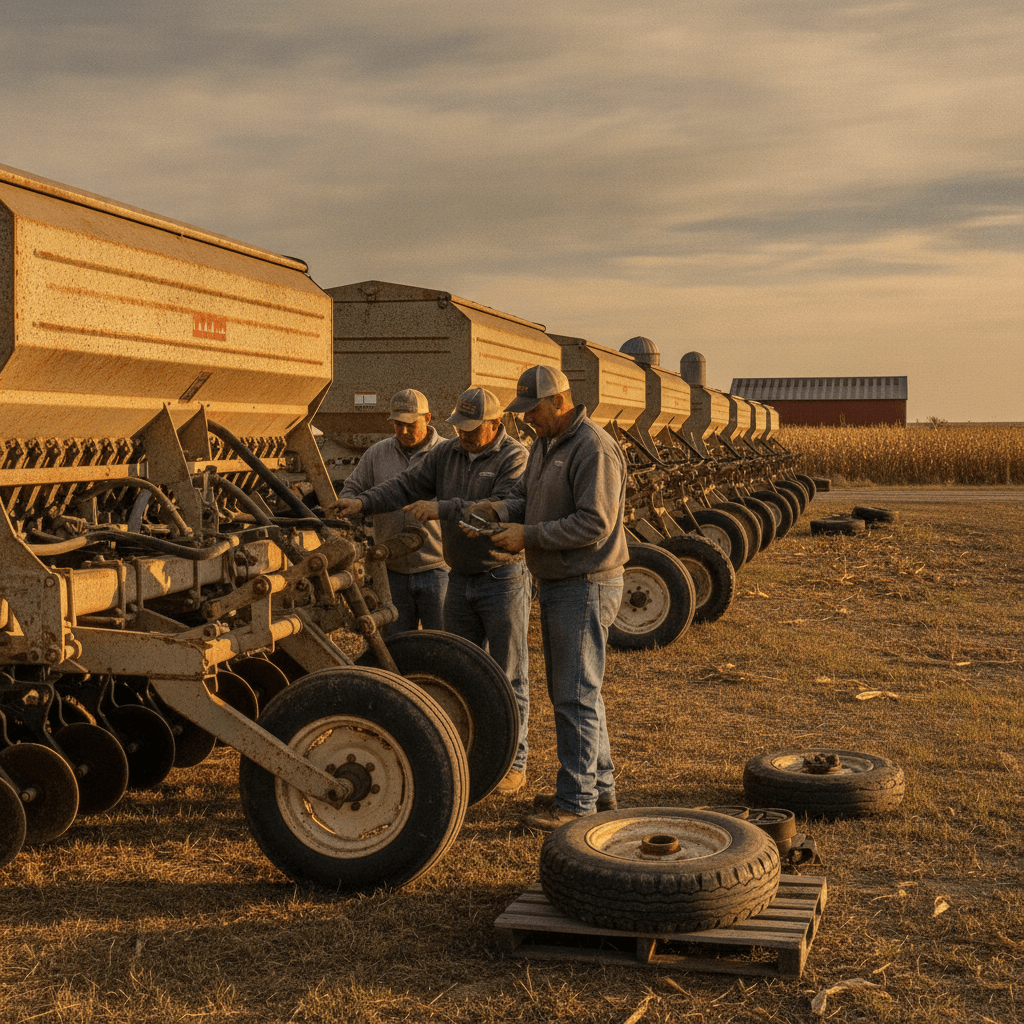
How Do Farmers Near Mitchell Know Whether Their No-Till Drill’s Gauge Wheels Are Actually Compatible — Or Just Close Enough to Cause Problems?
The short answer: you confirm diameter, width, hub bore, and bearing spec against your drill’s row unit — then you verify the wheel actually sheds mud in your soil conditions. If you’re running a no-till or air seeder operation near Mitchell and you’ve ordered a replacement gauge wheel that “fits most brands,” you already know that’s not the same as fits yours. A wheel that’s a quarter-inch off in diameter throws off your planting depth. A wheel that’s close on the hub bore but just slightly loose will wobble and wear out twice as fast. And a wheel that can’t shed the heavy clay soils across central South Dakota is going to pack up and drag your depth control sideways before you finish the field.
This is one of the most under-discussed topics in the no-till parts market — and it’s where a lot of farmers get burned buying parts based on a photo or a generic fitment chart rather than actual specs matched to their drill.
Why Gauge Wheel Compatibility Is More Complicated on No-Till Drills Than Row-Crop Planters
Row-crop planters have been fairly standardized for decades. No-till drills and air seeders are a different situation. The variety of OEM configurations — John Deere, Great Plains, Case IH, Krause, Morris, Bourgault — means that gauge wheel diameter, hub width, spoke design, and bearing type can vary significantly even within the same brand across different model years. A wheel that drops right into a 2013 Great Plains drill may not properly seat in a 2019 model.
The three dimensions that actually determine whether a gauge wheel is truly compatible:
- Outside diameter: This controls planting depth. Even a 3/8-inch difference in diameter changes seed placement. On no-till corn or soybeans in variable terrain around Mitchell or Huron, that variance will show up in your stand.
- Hub bore and bearing fit: A sloppy hub fit causes lateral play at the axle. That translates to uneven depth across the row — and accelerated wear on both the wheel and the axle bolt.
- Width and spoke configuration: No-till drills see more residue and harder soils than row-crop planters. A solid or narrow-spoked wheel that can’t clear residue and mud will load up fast, especially in the clay-heavy soils across central and south-central South Dakota.
What Competitor Parts Listings Usually Miss — And Why It Costs You
Browse the product pages from most gauge wheel suppliers and you’ll find a fitment list that reads something like “fits John Deere, Great Plains, Case IH, and more.” What you won’t find is a clear callout of which specific model numbers and years, what the hub bore tolerances are, or whether the wheel has been field-tested in gumbo conditions or just spec-matched on paper.
That’s a real gap. And it’s one that matters more the further north and west you farm. The moisture-heavy spring conditions across South Dakota and into Minnesota and Nebraska mean that a wheel that “fits” but can’t shed mud is essentially useless during the stretch of days that matter most — your planting window.
At Jung Enterprise in Ipswich, the curved spoked gauge wheels are built with an open-spoke design specifically because it sheds residue and mud. That’s not an aesthetic choice — it’s a functional one that comes from field testing, not a spec sheet. Over 13,000 planted acres across three seasons, these wheels showed only 1/16 inch of wear. That’s a number you can plan around. “Fits most brands” is not.
How to Actually Verify Compatibility Before You Order
Here’s the practical process. Before you call a supplier or place an order, pull the following information from your drill:
- Make, model, and year of your no-till drill or air seeder
- Current gauge wheel outside diameter (measure it, don’t assume from the manual — worn wheels will read smaller)
- Hub bore diameter and bearing part number if you have it
- Width of the existing wheel
- Whether your row units use a fixed axle bolt or a retaining clip system
If a supplier can’t answer specific fitment questions with those details in hand, that’s a signal. A part that fits on paper may still require shimming, different hardware, or create clearance problems with your row unit frame. Ask directly: has this wheel been tested on my specific drill model? What’s the hub bore tolerance? Is there a wheel retainer needed to keep it properly seated?
Speaking of which — if you’re replacing gauge wheels on a no-till drill, the wheel retainer question is worth raising at the same time. Gauge wheels that dislodge mid-pass aren’t just a downtime problem. They leave you with uncontrolled depth on that row for however long it takes you to notice — which in a busy planting window could be multiple acres.
The Soil Condition Variable That Fitment Charts Don’t Account For
Farmers near Mitchell and Pierre deal with soils that shift dramatically between wet and dry conditions. Heavy clay and gumbo soils that are saturated in early May can transition to a hard crust within a week. A gauge wheel that works fine in those drier conditions may pack with mud and lose effective depth control when soils are wet — even if the wheel technically “fits” the drill.
This is why spoke design matters as much as dimensional fit. Open curved spokes actively clear mud as the wheel rotates. A solid or minimal-spoke wheel accumulates mud, builds weight, and can create enough drag to affect row unit depth and down pressure balance. That’s not a compatibility issue you’ll catch on a fitment chart — it’s something you only learn from running the equipment in real field conditions.
Protecting the tire lip on gauge wheels used in abrasive soils is the other piece of this. A steel ring mounted to the tire lip — Jung Enterprise’s patented design covered under US 11,707,013 B2 — functions as both a wear protector and a built-in scraper. For no-till drills running in residue-heavy fields near Aberdeen or across the corn and soybean country of eastern South Dakota and into Minnesota and Nebraska, that dual function reduces the number of separate parts you’re managing and extends the life of the tire itself.
Frequently Asked Questions
Does gauge wheel diameter affect planting depth the same way on a no-till drill as on a row-crop planter?
Yes. The gauge wheel controls seed furrow depth by rolling alongside the opener and limiting how deep it penetrates. If the wheel diameter is off — even by a small amount — your depth is off. On no-till drills with multiple row units, that variance compounds across the drill width.
What’s the most common mistake farmers make when ordering replacement gauge wheels for a no-till drill?
Ordering by approximate diameter without confirming hub bore, bearing fit, and spoke design. A wheel that measures close to the right diameter but sits loosely on the hub will wear prematurely and cause depth inconsistency. Always confirm hub bore spec before ordering.
Do curved spoked gauge wheels work on air seeders, or only row-crop planters?
Curved spoked gauge wheels are compatible with both air seeders and no-till drills — not just row-crop planters. Confirm your specific make and model fitment before ordering, but the open-spoke design is especially useful in air seeder applications where residue and wet soil conditions are common.
How often should gauge wheels on a no-till drill be inspected for wear?
Check hub play and tire lip condition at the start of each season and again at mid-season if you’re running high acres. Bearings that have developed lateral play, and tire lips showing significant wear or cracking, are both signals that depth control is being compromised — even if the wheel looks functional from a distance.
Is a wheel retainer necessary if the gauge wheel seems to stay in place on its own?
A wheel that hasn’t dislodged yet isn’t the same as a wheel that’s properly retained. In rough field conditions — rocky ground, heavy residue, hard-to-soft soil transitions — a wheel without a proper retainer can work loose over time. The retainer is insurance against a wheel coming off mid-pass when you can’t afford the downtime.
Get the Right Fit Before Planting Season
If you’re running a no-till drill or air seeder near Mitchell, Huron, Pierre, or anywhere across central South Dakota and you’re not completely sure your gauge wheels are a true fit — not just a close one — it’s worth a conversation before the season starts. Jung Enterprise manufactures patented, American-made gauge wheels, steel rings, and wheel retainers from Ipswich, SD, and we’ll give you straight answers on fitment for your specific equipment.
Don’t wait until a wheel fails mid-field to figure out the right part. Contact Jung Enterprise and tell us what you’re running — we’ll help you confirm compatibility and get you set up before the window opens.