
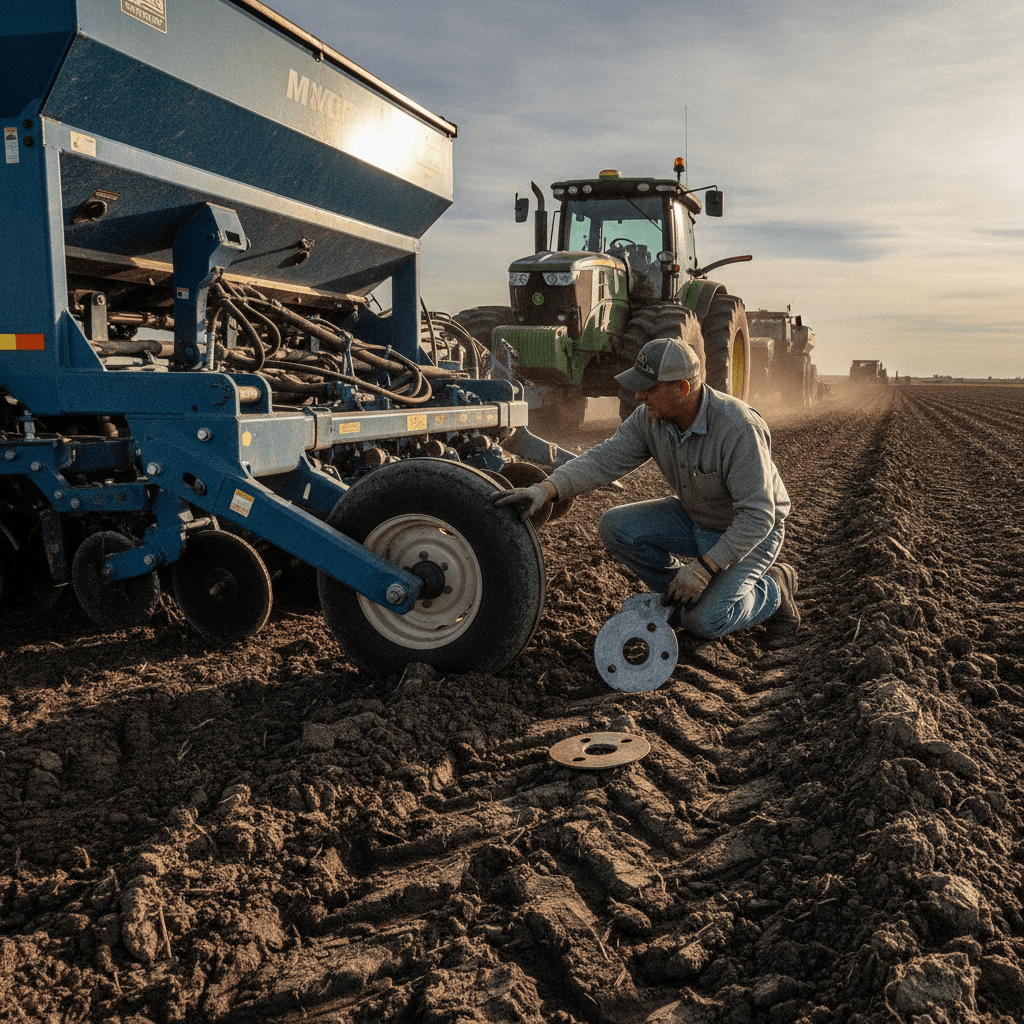
How Do Farmers Near Fargo Know Whether Their No-Till Drill’s Gauge Wheel Retainer Is Actually Keeping the Wheel Seated — Or Just Waiting to Fail at the Worst Possible Time?
If you’re running a no-till drill near Fargo and you’ve never thought twice about your gauge wheel retainer, that’s probably the problem. The retainer is the part that keeps the gauge wheel seated on the hub — and when it lets go, you don’t usually get a warning. You get a wheel that’s walked off the spindle mid-field, a row unit that’s dragging wrong, and a planting window that’s already tight enough without stopping to sort out hardware. This is one of those components that gets ignored until it fails, and around Fargo and across the Red River Valley, where wet spring soils put serious lateral stress on every part of the row unit, a cheap or worn retainer is a real liability.
What a Gauge Wheel Retainer Actually Does — And Why It Matters More on a No-Till Drill
The gauge wheel retainer’s job is simple: it holds the gauge wheel on the hub so it can’t dislodge during operation. That sounds straightforward, but the forces working against it are not. On a no-till drill, especially in the heavy clay and gumbo soils common across eastern North Dakota and western Minnesota, the gauge wheel is constantly being pushed sideways by residue, soil clumps, and uneven ground. Roots, frozen chunks of soil in early-season fields, and thick corn stalk residue all create lateral loads that a poorly designed or worn retainer can’t handle.
Standard row planters deal with some of this too, but no-till drills — running at faster speeds across heavier residue loads and harder ground — put significantly more stress on the entire gauge wheel assembly. The retainer is the last line of defense between a properly seated wheel and a wheel that’s off the machine entirely.
Signs Your Retainer Is Failing Before the Wheel Actually Comes Off
Most retainer failures don’t happen all at once. They develop over time, and if you know what to look for during pre-season inspection, you can catch the problem before it costs you a field pass or worse.
- Visible lateral play in the gauge wheel: Grab the wheel and try to move it side to side. Any meaningful wobble means the retainer isn’t holding firm.
- Worn or deformed retainer clip or ring: If it looks stretched, cracked, or like it’s been compressed and re-seated multiple times, it’s not going to hold through a full season.
- Gauge wheel that’s visibly canted: A wheel that’s sitting at an angle on the hub — even slightly — is already partially dislodged. That’s a retainer that’s lost its grip.
- Uneven depth across rows: When a gauge wheel isn’t fully seated, it doesn’t control depth the way it should. If you’re seeing inconsistent furrow depth row-to-row and can’t explain it elsewhere in the system, check the retainers.
None of these problems announce themselves loudly. You’ll usually only catch them if you’re doing a real pre-season inspection — not just a walk-around glance before you pull out of the shed.
What Competitors Don’t Tell You About Retainer Design
Most of the big names in planter parts — whether you’re looking at aftermarket suppliers or OEM replacement kits — treat the wheel retainer like a commodity. It’s often a small clip or ring that meets the minimum spec to hold the wheel under normal conditions. What they don’t spell out is what happens in abnormal conditions: wet spring soils, heavy residue loads, hard entry into crusted ground. That’s where generic retainer designs fall short, and that’s the conversation most competitor product pages skip entirely.
At Jung Enterprise, based in Ipswich, South Dakota, the Wheel Retainer is purpose-built to prevent the gauge wheel from dislodging during real-world field conditions — not just under ideal circumstances. It installs easily and is designed to hold the wheel stable and secure even when the ground is throwing everything it has at the row unit. That’s not marketing language. That’s the problem it was built to solve.
Why Fargo-Area Farmers Face a Harder Test Than Most
The soils around Fargo and the Red River Valley are some of the heaviest in the country — dense, wet, and sticky in the spring. Farmers in this area know what it means to plant into fields that feel like concrete one day and gumbo the next. That variability is brutal on gauge wheel assemblies. When the drill hits a wet, sticky patch, lateral forces on the gauge wheel spike. When it transitions into harder ground, the impact loads jump. A retainer that’s borderline in average Corn Belt conditions is often already failing here by mid-season.
Farmers near Bismarck and Aberdeen run into similar conditions — frozen-then-thawed soils in early May, heavy residue from the previous crop, and planting windows that don’t give you time to deal with preventable equipment failures. Getting the retainer right before the season starts is the kind of preparation that pays off when you’re 200 acres into a field and everything is still running the way it should be.
Easy Installation Shouldn’t Mean Compromised Holding Power
One honest tradeoff worth naming: some retainers that are easy to install are easy to install because they’re not gripping as aggressively as they should. There’s a balance between serviceability and holding strength, and the better designs manage both. Jung Enterprise’s wheel retainer is built to install without a fight and hold without backing off during the season. You shouldn’t have to choose between a part you can swap in the field quickly and a part that stays put for the full planting run.
If you want to see how it fits into the broader gauge wheel system, the full product lineup gives you a clear picture of how the retainer, steel ring, and curved spoked gauge wheels work together as a system rather than a collection of individual parts.
Frequently Asked Questions
Does the gauge wheel retainer fit both planters and no-till drills?
Yes. Jung Enterprise’s wheel retainer is compatible with multiple OEM gauge wheel configurations across planters, air seeders, and no-till drills. If you’re unsure about your specific setup, reach out before you order — it’s better to confirm fit than to guess and lose time.
How do I know if my current retainer is worn enough to replace?
If you can move the gauge wheel laterally with your hand, if the retainer looks stretched or deformed on inspection, or if you’ve been running the same retainer for two or more seasons in heavy-use conditions, it’s worth replacing. Don’t wait until the wheel actually comes off.
Can a bad retainer affect seed depth accuracy?
Absolutely. If the gauge wheel isn’t fully seated and stable, it can’t control furrow depth consistently. A wheel that’s canted or partially dislodged will give you variable depth across the row — which shows up as uneven emergence and yield drag later in the season.
Is this an issue specific to no-till drills, or does it affect standard planters too?
Both can experience retainer failure, but no-till drills typically face higher stress because of operating speed, residue load, and harder ground entry. Farmers in heavy-residue environments or clay-dominant soils like those around Fargo and across North Dakota and Minnesota should inspect retainers more often than the general guidance suggests.
Does Jung Enterprise sell directly to farmers, or only through dealers?
Both. Jung Enterprise sells direct and also works with ag dealers and distributors across the region. If you’re a dealer looking to stock wheel retainers for your local customers, that’s a conversation worth having directly with the team in Ipswich.
Don’t Wait for the Wheel to Tell You It’s Done
The gauge wheel retainer is one of those parts that earns zero attention when it’s working and costs you a lot when it’s not. If you’re farming near Fargo, running a no-till drill through heavy spring soils, and you haven’t looked at your retainers since last season, now is the time — not when you’re three rows into a field at planting. Jung Enterprise builds parts for operators who can’t afford preventable downtime. That’s the whole point.
Contact the team at Jung Enterprise directly to talk through your setup, confirm compatibility, or place an order. Reach out through the contact page, call (605) 281-0497, or email help@jungenterprise.net. Made in America, field-tested, and built to hold.