
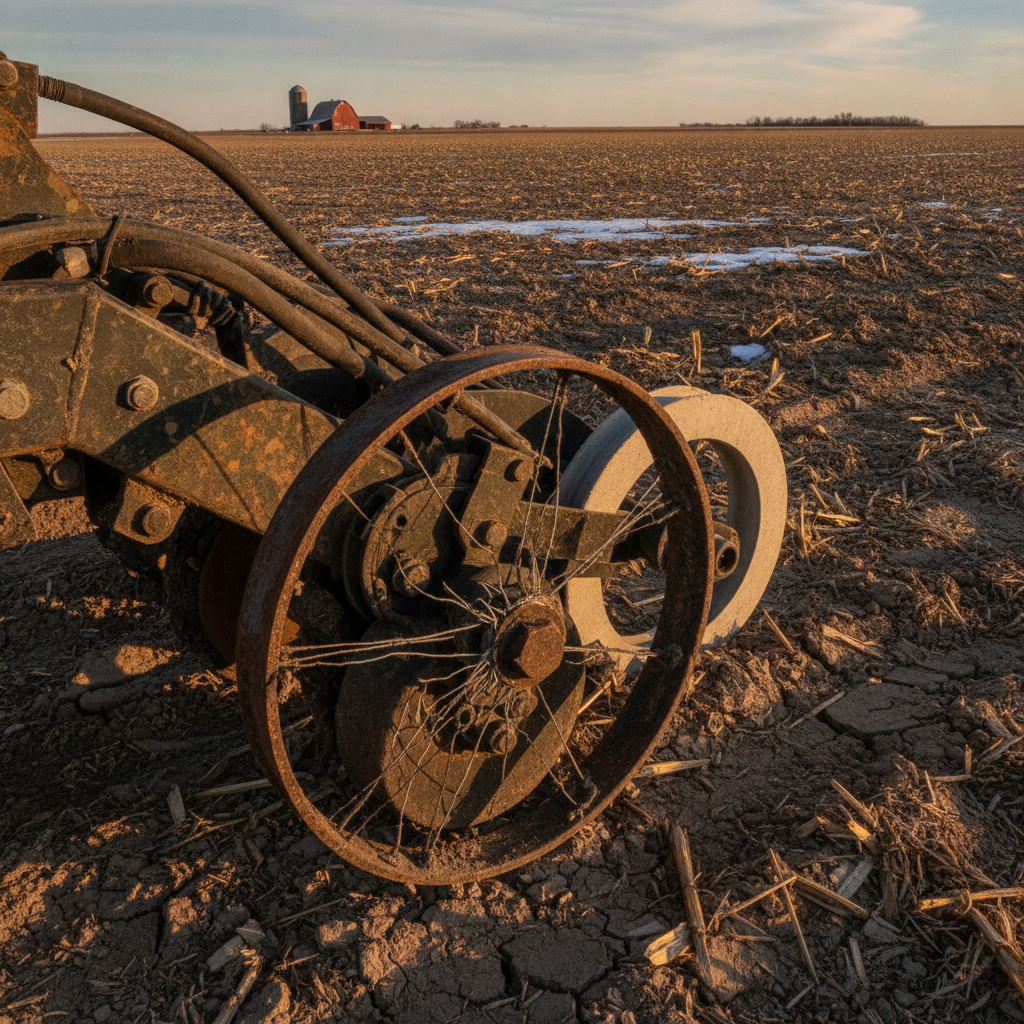
How Do No-Till Farmers Near Watertown Know Whether Their Planter’s Steel Ring Is Actually Holding Up Through Freeze-Thaw Soil Conditions — Or Just Cracking Under Thermal Stress Before the Season Even Ends?
If you’re farming no-till ground near Watertown, you already know what a South Dakota winter does to equipment. Temperatures swing hard — well below zero in January, then back above freezing by late February or early March, then down again before planting even starts. That thermal cycling doesn’t just affect your soil structure. It works on every metal part sitting in your machine shed or still bolted to your planter in the field. And for no-till operators who depend on precise gauge wheel function row after row, a steel ring that’s been compromised by freeze-thaw stress is a problem that usually shows up at the worst possible time — not in the shop, but three hundred acres into a narrow planting window.
Most competitor content on steel rings focuses on mud plugging, wear rates, and installation steps. That’s useful information, but it skips over a question that matters specifically to Northern Plains farmers: does the steel ring you’re running actually hold up through repeated freeze-thaw cycles without cracking, deforming, or losing its fit against the gauge wheel tire?
Why Freeze-Thaw Stress Is a Real Issue for Steel Ring Components
Steel contracts and expands with temperature. That’s not news. But the problem with planter components isn’t the expansion itself — it’s the repeated cycling. A steel ring that gets cold, contracts slightly, then warms back up and re-expands, then goes through that same cycle dozens of times before you ever plant a kernel, is under cumulative stress. If the ring was manufactured with inconsistent wall thickness, weak welds, or sub-spec steel alloy, that cycling creates micro-fractures you won’t see until the ring cracks under field load or loses its tight fit and starts moving on the tire lip.
In no-till conditions near Watertown and across eastern South Dakota, that fit is especially critical. No-till ground carries more residue than tilled fields, which means your gauge wheels are constantly pushing through material that creates lateral force on the ring. If thermal cycling has already loosened the ring’s integrity, that sidewall pressure is what finally fails it — usually mid-field, mid-season, mid-planting window.
What to Actually Check on Your Steel Ring Before Spring Planting
Don’t wait until April to find out your steel ring is compromised. Here’s what to look at during your pre-season inspection, particularly if your planter sat outside through any part of a South Dakota winter:
- Check the mounting fit: The ring should still seat firmly against the tire lip with no rocking, wobbling, or visible gap. If it’s shifted, thermal cycling may have changed the fit, or the screws have backed out from contraction-expansion movement.
- Inspect the screws: All six mounting screws should be fully seated and torqued. Cold temperatures cause fasteners to back out when the metal contracts. If even one screw is loose, re-torque the full set before you assume the ring is field-ready.
- Look for cracks along the ring face and weld points: Freeze-thaw stress fractures typically start at the weld or at a transition point where wall thickness changes. Use good light and run your fingers along the ring surface. A crack you can feel but not see is still a crack.
- Check the scraper function: The steel ring on your gauge wheel doubles as a built-in scraper — it’s part of what keeps mud from packing up against the tire. If the ring has shifted or deformed from thermal stress, it may no longer be positioned to scrape effectively, even if it looks intact.
These checks take less than twenty minutes per planter unit. That’s cheap insurance against a part failure that costs you half a day of planting when the soil window is already tight.
Why Material and Manufacturing Quality Determine Whether Your Ring Survives a Northern Plains Winter
This is where the gap in most competitor content is obvious. Yetter, Schaffert, Copperhead — they’ll tell you how their products shed mud or extend wear life. What you won’t find from most of them is a straight answer on what steel alloy they use, how the ring is manufactured, or what quality control looks like before the part ships. That matters for farmers in Watertown, Aberdeen, and across North Dakota and Minnesota, where thermal stress on planter components is part of normal operating reality.
At Jung Enterprise out of Ipswich, the Steel Ring is designed and manufactured to handle exactly this kind of environment. The patented design (US 11,707,013 B2) uses consistent wall geometry that reduces the stress concentration points that cause freeze-thaw cracking. The six-screw mount keeps the ring seated even as metal moves through temperature cycles. And the built-in scraper function isn’t a secondary feature — it’s part of why the ring’s fit against the tire lip has to stay precise across the full operating temperature range.
Field testing backs this up. After 13,000 planted acres over three years, wear measured at only 1/16 of an inch. That’s real-world data from actual field conditions, not a lab spec. If a ring is going to fail from thermal stress, it typically shows up well before 13,000 acres. The fact that the Jung steel ring held dimensional integrity through that kind of use is a meaningful indicator of manufacturing quality — not just a marketing number.
No-Till Operations Carry Extra Risk When Components Fail
Strip-till and no-till operators between Watertown and Aberdeen are dealing with surface residue loads that add lateral force to every row unit pass. When a steel ring fails in a no-till field, you don’t just lose tire lip protection — you lose the scraper function at the same time. That means mud packs into the gauge wheel zone, depth control drifts, and you may not catch it until you notice seed emergence irregularities weeks later. By then, the yield impact is already locked in.
Keeping your planter components in spec before the season starts — not after the first problem shows up — is the difference between a clean planting run and a reactive mess. That’s especially true in the Northern Plains, where you might get a seven- to ten-day window between workable soil and the next wet stretch.
Frequently Asked Questions
Can a steel ring loosen from freeze-thaw cycles even if it was installed correctly?
Yes. Thermal expansion and contraction can back out fasteners over time, particularly if the planter sat outside through a hard winter. Always re-check screw torque and ring fit as part of your pre-season inspection, even if you installed the ring correctly the previous fall.
How do I know if my steel ring’s scraper function has been affected by cold-weather deformation?
Put the ring against the tire lip and check whether the scraper edge makes consistent contact around the full circumference. If there are gaps or if the ring rocks instead of sitting flush, it’s either deformed or the mount has loosened. Either way, it needs attention before planting.
Is there a difference between a steel ring designed for Northern Plains conditions versus one built for milder climates?
Material grade and manufacturing consistency matter more than a regional spec label. What you’re looking for is a ring made from consistent-grade steel with reliable weld quality and a mount design that keeps the ring seated through thermal movement. Cheap or inconsistently made rings show their weakness in exactly the kind of winter cycling that Watertown and surrounding areas see every year.
Should I replace a steel ring that shows any cracking, or can small cracks be ignored?
Replace it. A small crack under field load in heavy no-till residue can propagate fast. A failed ring mid-season costs you far more in downtime and depth-control problems than the cost of a replacement ring before planting starts.
Does Jung Enterprise’s steel ring fit multiple gauge wheel sizes and planter brands?
Yes. The Jung Enterprise steel ring is designed for compatibility across multiple OEM gauge wheel sizes and planter, air seeder, and no-till drill brands. Contact the team directly with your machine specs to confirm fit before ordering.
If you’re running no-till ground near Watertown, across Codington County, or anywhere in eastern South Dakota and western Minnesota where freeze-thaw is a real seasonal factor, don’t go into spring planting assuming your steel ring is still performing the way it was installed. A quick inspection now is worth more than a repair call in May. Reach out to Jung Enterprise with your planter specs and we’ll help you confirm whether your current setup is ready — or whether it’s time for a replacement before the window opens.