
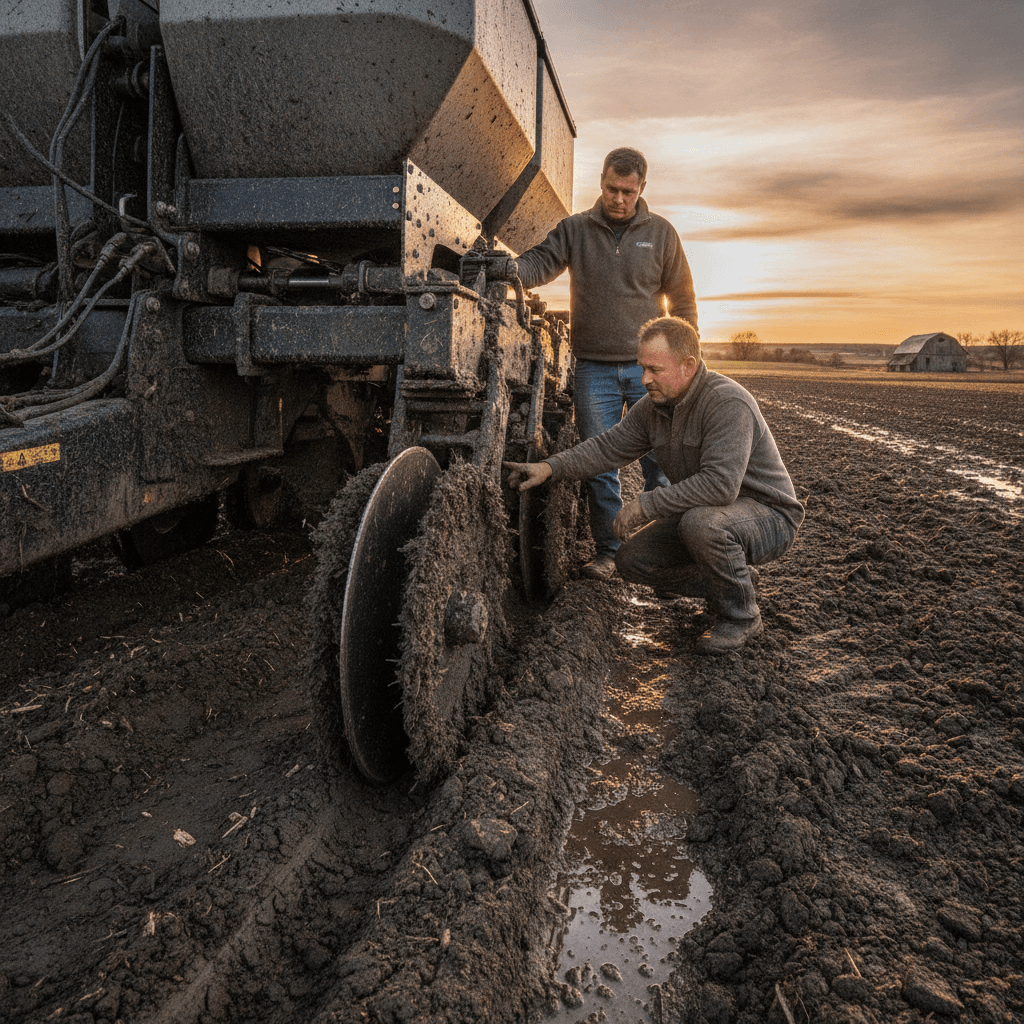
If you farm near Ipswich or anywhere across northeastern South Dakota, you already know what a wet field entry does to your planter — and it’s not pretty. The first two or three passes through a field that’s still too wet don’t just look bad. They can quietly wreck your seeding depth for a hundred acres before you realize what happened. The question most farmers don’t think to ask until later: were your gauge wheels actually controlling depth during that wet entry, or were they riding on a mud raft and dropping seed wherever they felt like it?
Most of the competitor content out there covers gauge wheel wear, gauge wheel sizing, and whether to replace them. What almost nobody covers is what happens to depth performance during and immediately after a wet field entry — and why the design of your gauge wheel matters just as much in that first muddy pass as it does a hundred acres in.
What Actually Happens to Depth Control When You Enter a Wet Field
When the soil surface is saturated — the kind of gumbo conditions you see in the heavy clay ground around Aberdeen and Huron — gauge wheels don’t behave the same way they do in firm, ideal planting conditions. Here’s the sequence that causes problems:
- Mud packs into the gauge wheel face. Solid or closed-spoke gauge wheels fill up fast in wet, sticky soil. Once packed, the effective diameter of the wheel changes, and so does your depth.
- The gauge wheel stops rolling clean. A wheel caked with mud doesn’t roll — it skids. A skidding gauge wheel isn’t depth-controlling anything. It’s just dragging.
- The seed trench gets inconsistent. When the gauge wheel can’t maintain consistent contact with the soil surface, the furrow opener rides too deep in soft spots and too shallow in firm spots. You end up with variable emergence across that early part of the field.
- Mud gets pressed into the trench. Packed gauge wheels don’t just fail to control depth — they actively push mud sideways into the open trench, affecting seed-to-soil contact and moisture management around the seed.
None of this shows up in your monitor as a depth alarm. You won’t know until stand counts come back patchy or emergence is uneven on those first few passes.
Why Open-Spoke Gauge Wheel Design Is the Difference — Especially at Field Entry
This is the part most farmers don’t dig into deeply enough, and it’s a gap in what most competitor product pages actually explain. Solid gauge wheels and partially-closed designs hold mud. Period. In the conditions you face in South Dakota, Minnesota, and Iowa during a wet May planting window, that’s a real problem.
The Curved Spoked Gauge Wheels from Jung Enterprise are built around an open-spoke design specifically so mud sheds out as the wheel rotates. There’s no solid face for mud to pack against. When you’re making that first pass into a field that’s marginally fit, the wheel keeps rolling clean instead of building up a mud layer that throws your depth off.
That matters more at field entry than at any other point in the planting pass. The soil conditions are least consistent right at the edge of the field — headlands are often wetter, more trafficked, and more disturbed than the main field. If your gauge wheels plug up in the first 50 feet, you’re already behind before you’ve planted an acre worth keeping.
The Steel Ring Scraper Function — And Why It’s Not Just About Wear Protection
Most farmers think of the steel ring primarily as a tire lip protector. That’s accurate — it prevents wear on the gauge wheel tire where it contacts the furrow opener disc. But the built-in scraper function matters just as much in wet conditions.
The Jung Enterprise Steel Ring (patented under US 11,707,013 B2) is designed to double as a scraper, so you don’t need a separate scraper arm or add-on component. In wet field conditions, the scraper function keeps the tire face cleaner as the wheel rotates. That’s one fewer place for mud to accumulate and disrupt consistent ground contact.
Farmers near Ipswich running planters in the clay-heavy soils of Edmunds and Brown counties especially notice the difference. When you’ve got that heavy, sticky gumbo that grabs onto everything, a scraper that’s built into the ring itself means one less separate part to adjust, break, or replace mid-season.
What to Check After a Wet Field Entry Before You Keep Going
If you started in a field that was wetter than it should have been — and in the Northern Plains during a short planting window, you sometimes don’t have the luxury of waiting — here’s what to actually look at before you run another 200 acres:
- Pull seed trench samples from the wet entry passes. Dig up 10 seeds from the first few passes and measure actual depth versus your set depth. If you’re off by more than a quarter inch consistently, your gauge wheels were not controlling depth on entry.
- Look at the gauge wheel face. If there’s mud baked into the spokes or face, that’s your culprit. Clean wheels, then check whether the design allows mud to shed on its own going forward.
- Check tire lip wear. Wet soil entry accelerates wear on the tire lip where it contacts the disc. If the lip is already showing wear, a steel ring should be on your list before the next pass.
- Watch stand emergence on those entry passes. Mark where the wet entry rows are and come back at V2–V3 to compare stand counts. It gives you a real number for what wet-entry depth loss actually cost you.
Durability in the Field, Not Just on Paper
Jung Enterprise’s gauge wheel components have been field-tested across 13,000 planted acres over three years, showing only 1/16″ of wear over that span. That’s not a lab number — that’s actual field-run data. In the clay soils common across northeastern South Dakota and into North Dakota and Minnesota, component durability under wet conditions matters. Parts that wear fast or fail in the first muddy season aren’t saving you anything.
If you’re running a custom planting operation out of Huron or Aberdeen and you’re billing by the acre, downtime for a failed gauge wheel or a plugged system isn’t just an inconvenience — it’s money left in the field for every hour the planter is stopped.
Frequently Asked Questions
Can my planter’s monitor tell me when gauge wheels are plugged and affecting depth?
Not directly. Most planter monitors track singulation, population, and sometimes downforce — but they don’t flag depth loss from a plugged gauge wheel. You have to catch that manually by pulling seed trench samples, especially after a wet field entry.
Does gauge wheel design actually affect depth consistency, or is that mostly a downforce issue?
Both matter, but they work together. Downforce gets the gauge wheel into contact with the soil. The wheel design determines whether it stays in clean, consistent contact once it’s there. A plugged or worn gauge wheel undermines your downforce settings regardless of what your monitor says.
Do Jung Enterprise’s Curved Spoked Gauge Wheels fit my planter brand?
Jung Enterprise makes gauge wheels compatible across multiple OEM planter brands and gauge wheel sizes — including planters, air seeders, and no-till drills. Check the full product overview or contact them directly to confirm fitment for your specific setup.
How do I know if the steel ring scraper is actually doing its job in the field?
After a planting pass in wet or sticky conditions, pull the gauge wheel and look at the tire face. If it’s running clean with minimal mud buildup, the scraper is working. If mud is packing up behind or around the ring, either the scraper isn’t making proper contact or the ring isn’t seated correctly.
Is it worth upgrading gauge wheels mid-season, or should I wait until fall?
If you’re seeing depth inconsistency or mud plugging problems right now, upgrading mid-season is worth it — especially if you have significant acres left to plant. The cost of poor stands on 500 acres is real money. If you’re done planting, fall or pre-planting is a good time to evaluate and swap before next season.
Talk to Jung Enterprise Before Your Next Wet-Condition Pass
Jung Enterprise is based in Ipswich and builds patented, American-made gauge wheel components specifically for the field conditions farmers across South Dakota, North Dakota, Minnesota, and Iowa deal with every spring. If you’re running into mud plugging, tire wear, or depth inconsistency — especially at field entry — reach out before it costs you more stand. Contact Jung Enterprise here to talk through what your planter setup needs.