
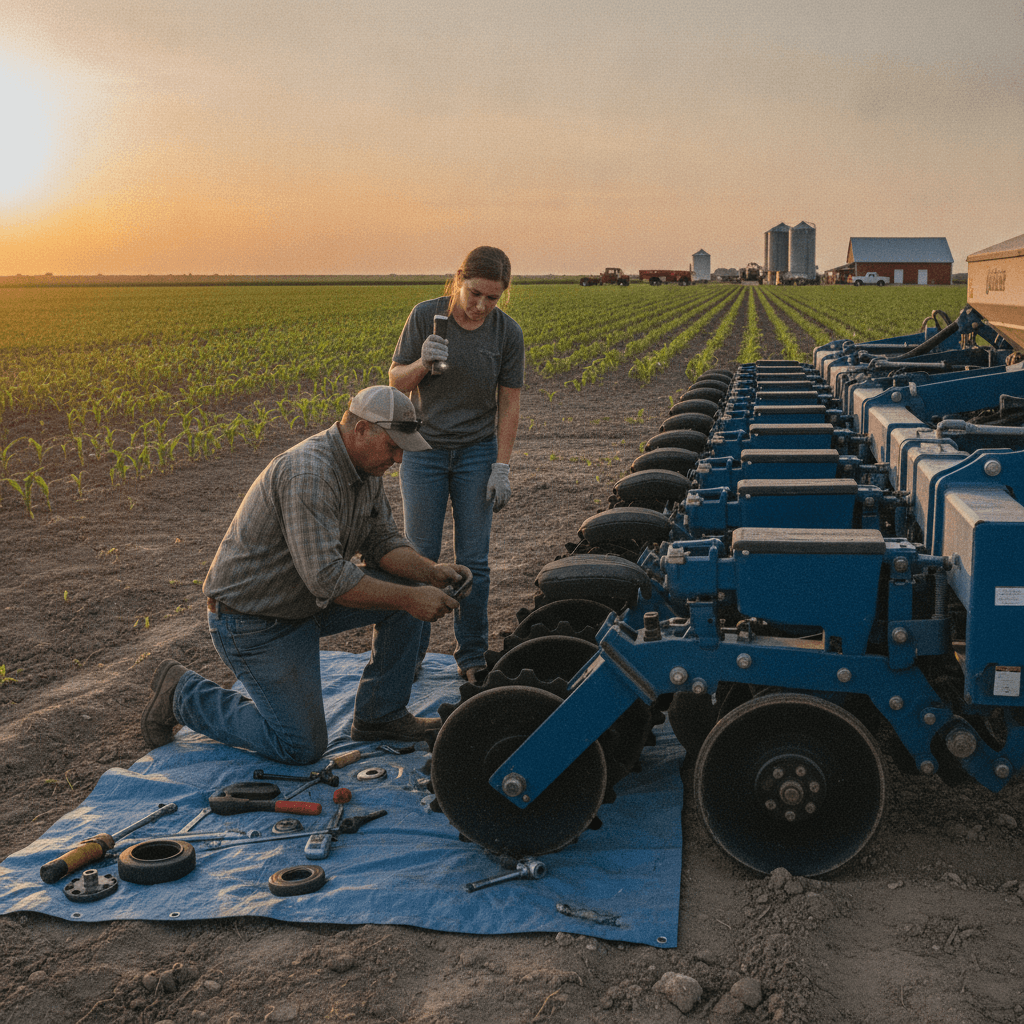
How Do Farmers Near Mitchell Know Whether Their Planter’s Gauge Wheels Are Actually Performing After a Mid-Season Overhaul — Or Just Reassembled Wrong?
If you pulled a gauge wheel off mid-planting near Mitchell to replace a worn tire or a failed bearing, and the planter went back together without any obvious issues, that’s not the same as confirming it’s actually running right. A gauge wheel that’s been torn down and reassembled — even by someone who knows what they’re doing — can go back together with subtle problems that won’t show up until you’re two fields deep and wondering why your stand is spotty. Here’s how to catch those problems before they cost you bushels.
- Why Mid-Season Overhauls Are a Different Animal Than Pre-Season Prep
- What a Correctly Reassembled Gauge Wheel Actually Looks Like in the Field
- The Reassembly Problem Nobody Talks About: Scraper Position After Reinstall
- Foam-Filled vs. Pneumatic: Does It Change What You Check After a Repair?
- When the Overhaul Reveals a Bigger Problem
- FAQ: Gauge Wheel Reassembly and Mid-Season Maintenance Near Mitchell, SD
- Ready to Stop Second-Guessing Your Gauge Wheel Setup?
Why Mid-Season Overhauls Are a Different Animal Than Pre-Season Prep
Pre-season gauge wheel work happens in the shop with time to think. Mid-season overhauls happen in the field, in the rain, or at 10 p.m. with a flashlight and the pressure of a closing planting window breathing down your neck. That’s not a knock on anyone — that’s just South Dakota in May. But the conditions that force a mid-season fix are the same conditions that lead to reassembly mistakes: misaligned scrapers, overtightened or undertightened mounting hardware, a wheel retainer that gets skipped because you figured it’d be fine, or a steel ring that goes back on in the wrong orientation.
None of those mistakes look wrong sitting still in the shop. They show up in the field as inconsistent depth, mud plugging, or a gauge wheel that eventually walks off the arm. And by the time you notice, you’ve already planted acres you’ll need to explain to yourself come August.
What a Correctly Reassembled Gauge Wheel Actually Looks Like in the Field
Before you put the planter back in the ground after any mid-season repair, run through these checks. Not because you’re doubting your work, but because the consequences of getting it wrong here are real.
- Depth gauge check on a hard, flat surface: Set your planter on concrete or packed gravel before heading back to the field. The repaired row unit should sit at the same ride height as adjacent units. If it’s riding higher or lower, something is off — often a mounting bolt torqued unevenly or a scraper that’s contacting the tire and pushing the wheel out of its correct position.
- Spin the wheel by hand: It should rotate smoothly with no grinding, catching, or wobble. Any lateral movement at the rim points to a bearing issue or an axle bolt that didn’t get fully seated. A wobbling gauge wheel doesn’t hold depth — it drifts.
- Check your scraper clearance: If your gauge wheel runs a built-in scraper — like the steel ring from Jung Enterprise — verify that the scraper lip is positioned correctly against the tire face after reassembly. The steel ring’s scraper function only works if it’s sitting where it’s supposed to. A ring that got flipped or shifted during reinstall may look fine but shed mud ineffectively.
- Confirm the wheel retainer is in place: This one gets skipped more than it should. The wheel retainer keeps the gauge wheel from dislodging off the row unit arm during field operation. If you were working fast during a mid-season fix, double-check it’s clipped in. A gauge wheel that walks off mid-field in a heavy clay soil south of Mitchell is a much bigger problem than the worn tire that started the whole repair.
- Watch the first 50 rows in the field: Walk behind the planter on the first pass or two. You’re looking for consistent seed trench depth, clean mud shedding off the gauge wheel, and no lateral bouncing at the wheel. If any of those are off, stop and diagnose before you keep going.
The Reassembly Problem Nobody Talks About: Scraper Position After Reinstall
Most competitor content on gauge wheel maintenance covers pre-season inspection and end-of-season replacement. What’s largely missing from the discussion — across most manufacturer and dealer sites — is what happens when a gauge wheel gets reassembled mid-season under pressure and the scraper relationship to the tire face changes.
On a standard foam-filled or pneumatic gauge wheel tire, the scraper has to maintain consistent contact with the tire lip to shed mud. If the scraper is a separate add-on part that got bumped, bent, or reinstalled at the wrong angle, it may not make full contact anymore. You’d never notice it looking at the wheel in the shop. But in a heavy, wet Davison County field, that half-inch of misalignment means mud is packing instead of shedding, and your seed trench starts getting pushed rather than opened cleanly.
The Jung Enterprise Steel Ring addresses this by building the scraper function directly into the ring itself. It mounts with six screws and sits flush against the tire lip — so after a reinstall, there’s no separate scraper to realign. The ring goes back on the same way every time. That matters during a fast mid-season repair when you’re working under pressure and can’t afford to second-guess whether the scraper geometry is right.
Foam-Filled vs. Pneumatic: Does It Change What You Check After a Repair?
Farmers near Mitchell and across central South Dakota run both foam-filled and pneumatic gauge wheel tires depending on their operation and soil type. The reassembly checks above apply to both, but pneumatic tires have one additional variable after a mid-season fix: pressure. If you had to dismount a pneumatic tire to get to a bearing, confirm the pressure is back to spec before the planter goes in the ground. A gauge wheel that’s been reassembled at correct torque but running soft on air will ride lower on one side and create exactly the kind of depth inconsistency that’s easy to misdiagnose as a soil problem or a parallel arm issue.
When the Overhaul Reveals a Bigger Problem
Sometimes a mid-season repair opens a row unit up and what you find is that the gauge wheel wasn’t the only thing wearing out — it was just the first thing that showed it. Check the axle bolt threads and the hub face for signs of uneven wear while you have the wheel off. If the hub is wallowed out or the threads are showing stress marks, a fresh tire or new curved spoked gauge wheel will only buy you a season before the same problem comes back. The curved spoked design from Jung Enterprise is built with an open-spoke pattern that sheds mud in heavy soils — which reduces the side-load stress that accelerates hub wear in the first place — but it still needs a sound mounting surface to perform correctly long-term.
Jung Enterprise builds its gauge wheel products out of Ipswich and field-tests them in real row-crop conditions. The steel ring has logged 13,000 planted acres over three years with only 1/16 inch of measured wear. That kind of durability matters when you’re doing a mid-season fix and need to know the replacement part is going to hold for the rest of the season — not just the next couple of fields.
FAQ: Gauge Wheel Reassembly and Mid-Season Maintenance Near Mitchell, SD
How do I know if my gauge wheel is sitting at the right depth after a mid-season repair?
Set the planter on a level, hard surface and compare ride height across all row units. The repaired unit should match its neighbors. If it’s off by more than a quarter inch, check your mounting bolt torque, scraper contact, and axle seating before going back to the field.
My gauge wheel looks fine spinning by hand but depth is still off in the field. What’s causing it?
The most common culprits after a reassembly are a scraper that’s contacting the tire unevenly and pushing the wheel position, a wheel retainer that’s not fully seated and allowing lateral movement under load, or a pneumatic tire that wasn’t reinflated to the correct pressure. Check all three before blaming the soil conditions.
Does the wheel retainer need to be replaced every time I take a gauge wheel off?
Not necessarily, but inspect it every time. If it’s cracked, deformed, or doesn’t snap firmly into position, replace it. A failed wheel retainer is a cheap fix in the shop and an expensive problem in the field.
Can I install a Jung Enterprise steel ring during a mid-season overhaul, or is that a pre-season job?
You can install it mid-season — the six-screw mount is straightforward and doesn’t require special tooling. If you’re already pulling a gauge wheel off for a tire or bearing replacement, it’s a reasonable time to add the steel ring so you’re not making the same stop twice.
How do farmers near Huron and Aberdeen handle mid-season gauge wheel repairs differently than pre-season work?
The repair itself is the same, but the verification step gets compressed because of time pressure. The difference is that pre-season you have days to observe how the repair holds up before the planter goes into a full field. Mid-season you have one pass. That’s why running through the basic checks — spin, height, scraper contact, wheel retainer — before you go back in the field matters more, not less, under that pressure.
Ready to Stop Second-Guessing Your Gauge Wheel Setup?
If a mid-season repair has you questioning whether your planter is back to running right — or if you’re tired of dealing with scrapers, depth drift, and mud plugging in the first place — Jung Enterprise builds parts designed to cut down on those mid-season headaches. Patented, American-made, and field-proven in the kind of soils you’re working with across South Dakota and the Northern Plains. Reach out to the team in Ipswich to talk through what your planter needs before the next field goes in the ground.