
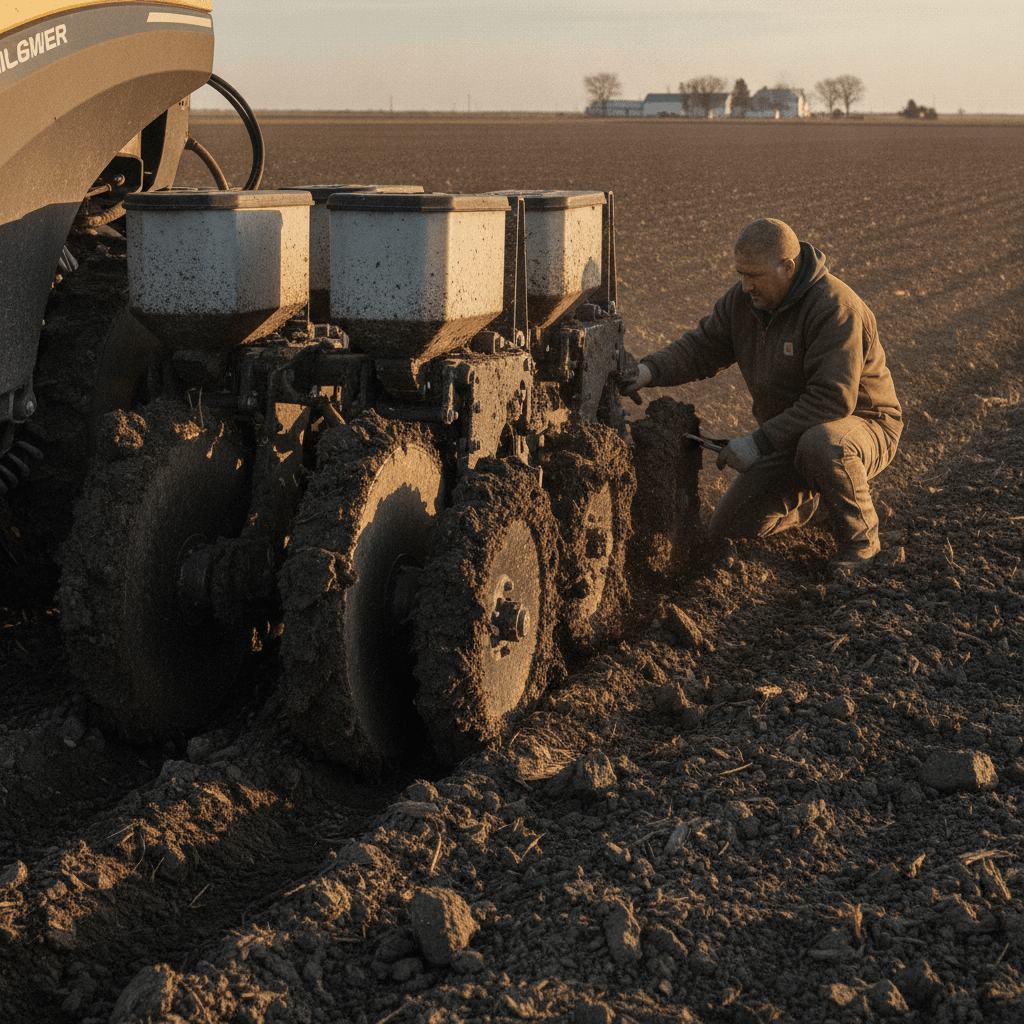
Why Are My Planter Gauge Wheels Plugging Up in Watertown? How to Stop Mud Buildup Before It Costs You a Day of Planting
If your gauge wheels are packing up with mud two hours into a wet morning near Watertown — or anywhere across eastern South Dakota — you already know what it costs you. It’s not just the stop to clean them out. It’s the planting depth that goes sideways, the uneven stand you’re counting seeds in six weeks later, and the narrowing window that doesn’t give that time back. Gauge wheel plugging is one of the most common complaints we hear from corn and soybean farmers across the Northern Plains, and it’s one of the least directly addressed problems in the parts market. Here’s what’s actually causing it, and what design features make a real difference when conditions turn against you.
What’s Actually Causing Your Gauge Wheels to Plug
The short answer: soil type, tire design, and speed all play a role — but the biggest culprit in heavy clay and gumbo soils is a solid or low-clearance wheel design that gives wet soil nowhere to go. As the wheel rotates, mud compresses between the spokes or against the tire sidewall, builds on itself, and eventually locks the wheel or forces it to ride on a solid mud cake instead of the actual soil surface. When that happens, your depth control is gone. You’re not planting at 1.75 inches anymore — you’re guessing.
Eastern South Dakota and the Minnesota border country around Watertown and Brookings are particularly brutal for this. The lake-bed soils in Codington County and the tight clay profiles south toward Huron hold moisture well into spring. When you’re trying to hit a narrow window in early May, those soils are often borderline — workable enough to run, wet enough to pack. That combination destroys solid-spoke wheels fast.
Why Open-Spoke Wheel Design Is Not a Small Detail
There’s a reason curved spoked gauge wheels exist: they shed material. A well-designed open-spoke wheel lets soil pass through as the wheel turns rather than trap it. The curve in the spokes adds another layer of function — as the wheel rotates, the curvature throws mud outward instead of letting it pack in the pocket between spokes.
This is not a new idea, but execution matters. A wheel with spokes that are too narrow, too flat, or spaced too tightly still plugs. What you want is a design where the spoke geometry and spacing are actually optimized for the way mud behaves under field conditions — not just a wheel that looks open in a catalog photo.
Jung Enterprise’s curved spoked gauge wheels are built specifically for this. The open-spoke design sheds mud without requiring you to add a separate scraper attachment or stop every few rounds to clear the wheels by hand. They’re compatible with planters, air seeders, and no-till drills across multiple OEM configurations — so you’re not retrofitting a solution that half-fits your equipment.
The Tire Lip Problem Most Farmers Don’t Notice Until the Wear Is Already Done
Here’s the part of gauge wheel plugging that doesn’t get talked about much: the tire lip on your existing gauge wheel takes a beating when mud and debris pack against it. Over time, abrasive soil material — especially in the sandy-clay mixes you find in parts of Aberdeen and Ipswich country — grinds down the tire lip. Once the lip wears, the tire loses its seating integrity. You start seeing wobble, inconsistent ground contact, and accelerated wear that shortens the tire’s service life significantly.
A steel ring mounted to the outside of the gauge wheel tire addresses this directly. It protects the tire lip from abrasive contact, and because it doubles as a built-in scraper, it actively prevents the mud from packing in the first place. Jung Enterprise’s patented Steel Ring (U.S. Patent No. 11,707,013 B2) mounts with six screws and requires no separate scraper assembly. After 13,000 planted acres across three years of real field use, measured wear on the ring came in at just 1/16 of an inch. That’s the kind of number that tells you something about long-term cost versus buying a replacement tire every season or two.
You can see the full details on the Steel Ring product page — it’s a straightforward product with a straightforward job, and it does it without adding complexity to your setup.
What Competitors Cover — And What They Miss
Most of the major planter attachment brands will sell you a mud scraper, a row cleaner, or a gauge wheel upgrade independently. What they generally don’t address is the combined problem: the tire lip wearing out at the same time the wheel is plugging, which are two failures feeding each other. You can add a bolt-on scraper and still have a tire lip that’s half-gone by the end of the season. And if the wheel design itself isn’t open enough to shed material, the scraper is fighting a losing battle anyway.
The other thing that gets glossed over is gauge wheel retention. A wheel that dislodges mid-row doesn’t just cause a depth problem — it can cause a safety issue and real downtime getting the planter back in service. Jung Enterprise’s Wheel Retainer is designed specifically to keep the gauge wheel seated on the planter or air seeder under field conditions, including the lateral forces you get in rough or rutted no-till ground. It’s a simple part that solves a problem most farmers have dealt with at least once.
Practical Advice for the Pre-Planting Check
Before you’re pulling planter out of the shed in late April, these are the things worth checking specifically for plugging risk:
- Inspect the tire lip on every gauge wheel. If you can feel a groove or see the lip is thin or cracked, don’t wait — that’s a tire that’s going to cause problems in wet conditions.
- Check spoke clearance and condition. Cracked or warped spokes on an older wheel close off the open area and turn a shedding wheel into a packing wheel fast.
- Confirm wheel seating. A gauge wheel that has any side-play or looseness at the hub is one that’s more likely to dislodge at a bad moment. A proper wheel retainer eliminates that risk.
- Think about your soil conditions for this season. If you had a wet fall and you’re heading into planting near Watertown or anywhere in the Codington County area, plan on tougher-than-average conditions for the first week or two. Equipment that performs fine in dry conditions will show its weaknesses fast.
Frequently Asked Questions
Will curved spoked gauge wheels work on my existing planter brand?
Jung Enterprise’s curved spoked gauge wheels are designed to fit multiple OEM planter configurations and gauge wheel sizes. Reach out directly with your planter make and model and we can confirm compatibility before you order.
How does the steel ring mount — do I need special tools?
It mounts with six screws using standard tools. There’s no welding, no drilling, and no need to modify the existing wheel or hub. Most operators can install it in the field without pulling the row unit off the planter.
I’m running no-till in North Dakota — are these parts built for that?
Yes. No-till and strip-till conditions are actually where the open-spoke design and tire lip protection matter most. Residue, harder soil entry angles, and wet springs in North Dakota put more stress on gauge wheel components than conventional tillage does.
How long does the steel ring actually last?
Field testing showed just 1/16″ of wear after 13,000 acres over three years. That’s meaningful durability in the real conditions this part was designed for — not a lab result.
Can I buy these through a local ag dealer near Aberdeen or Watertown?
Dealer and distributor relationships are part of how Jung Enterprise operates. Contact us directly if you’re interested in stocking these products locally — we work with ag dealers across South Dakota and the surrounding region.
If you’re tired of losing planting time to gauge wheel problems and want parts that were designed and field-tested for conditions like yours, reach out to Jung Enterprise. We’re based in Ipswich, we manufacture in the U.S., and we’re happy to answer specific questions about your planter setup before you commit to anything. Give us a call at (605) 281-0497 or send a message through the contact page.