
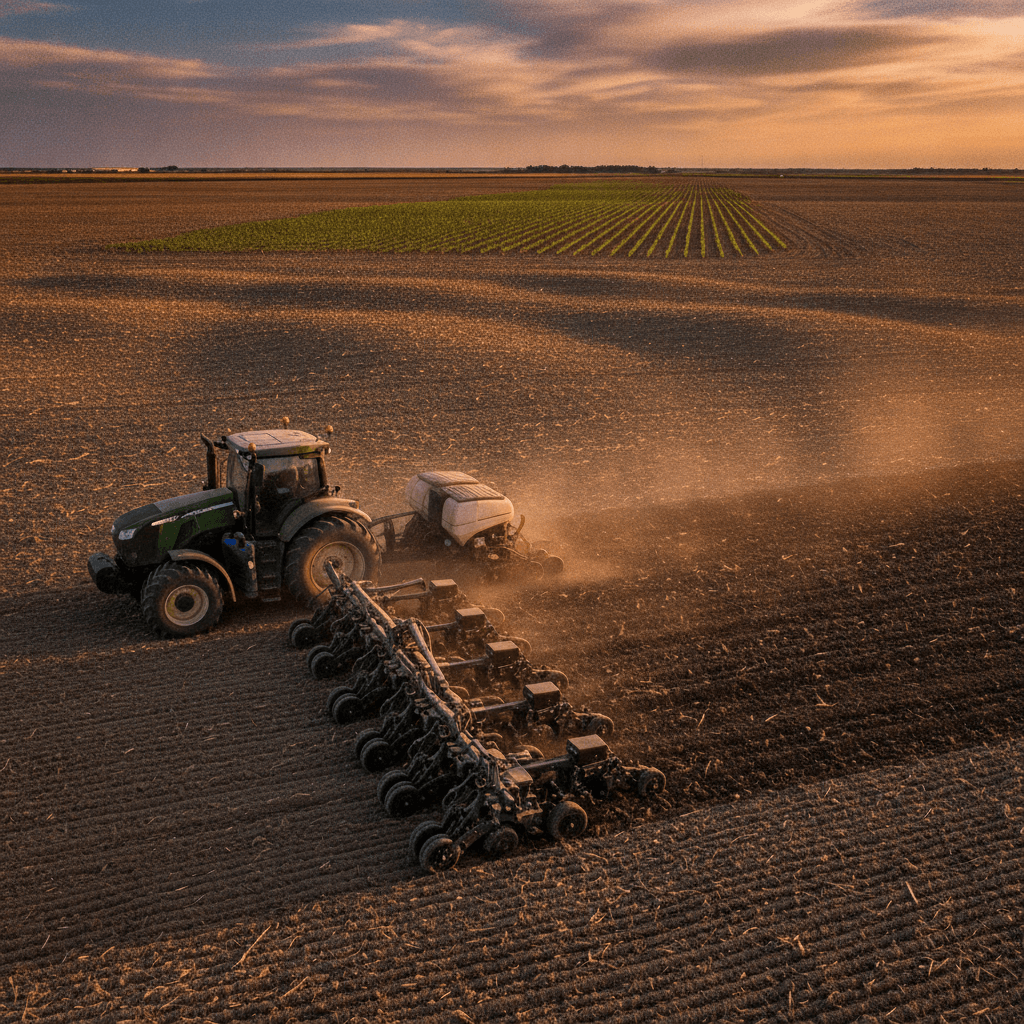
How Do Farmers Near Aberdeen Know Whether Their Planter’s Row Units Are Staying Level Across Varying Field Terrain — And Why It Matters More Than Most Think
If your planting depth is inconsistent and you’ve already chased bearings, down pressure, and seed meter calibration without finding the culprit, there’s a good chance the problem is sitting right in front of you — your row unit isn’t running level. For farmers near Aberdeen and across Brown County, where fields can roll from one end to the other and transition from firm knolls to wet, low-lying clay flats within the same pass, row unit frame angle is one of the most overlooked variables in planting performance. It doesn’t show up on your monitor. It doesn’t trigger a fault code. But it quietly kills emergence uniformity while you’re focused on everything else.
What “Running Level” Actually Means on a Row Unit
A row unit is designed to plant at a consistent depth when its frame runs parallel to the soil surface. When the frame tilts — nose up or nose down — the disc angle changes, the gauge wheel contact changes, and the seed trench depth changes with it. On flat ground, this is easy to manage. But when terrain undulates, the toolbar flexes, the hitch geometry shifts, and row units that were set correctly in the shop are no longer running the way you think they are in the field.
The practical result: seeds that should be going in at two inches end up at one and a quarter on the knoll and two and three-quarters in the swale. That kind of variation doesn’t sound like much, but it translates directly to uneven emergence — and uneven emergence in corn costs you yield in a way that’s almost impossible to recover from mid-season.
Why Terrain Near Aberdeen Makes This Worse Than in Flatter Country
Brown County isn’t table-flat like some ground further south toward Huron. The glacial topography around Aberdeen means you’re dealing with rolling fields, tile-drained low spots, and abrupt transitions between soil types — sometimes on the same 80-acre field. Clay gumbo in the low spots gives way to lighter, sandier knolls, and the moisture content between those two zones can be radically different on the same morning.
When a row unit transitions from firm ground to soft, wet clay, the down pressure loading changes, the gauge wheel penetration changes, and the effective planting depth shifts — even if nothing on your monitor moves. Farmers closer to the Minnesota border and in parts of North Dakota deal with similar conditions, and the setup decisions you make in the yard matter a lot once you’re in those variable fields.
The Role Gauge Wheels Play in Maintaining Depth on Uneven Ground
Gauge wheels are your primary depth control mechanism. They ride on the soil surface on either side of the disc blade and physically limit how deep the opener can penetrate. When the gauge wheel loses contact with the surface — or rides inconsistently — depth control goes with it.
In muddy conditions, which are common across the Northern Plains during May planting windows, standard gauge wheels can pack mud between the spokes, adding weight and reducing the wheel’s ability to ride the surface accurately. A mud-loaded gauge wheel isn’t rolling clean — it’s dragging a clump, and that affects both depth consistency and row unit behavior across terrain changes.
This is exactly why gauge wheel design matters beyond just basic compatibility. Jung Enterprise’s curved spoked gauge wheels are built with an open-spoke design specifically engineered to shed mud as the wheel turns, rather than packing it in. When your gauge wheel stays clean through a wet field pass, it maintains consistent contact with the soil surface — which means your depth stays where you set it, even when the terrain shifts under you.
What Competitors Aren’t Telling You About Row Unit Leveling and Gauge Wheel Interaction
Spend some time on the major competitor sites in this space and you’ll find plenty of content about down pressure systems, closing wheels, and seed meters. What you won’t find much of is a clear explanation of how gauge wheel design interacts with row unit frame angle across variable terrain — and why getting one right without the other still leaves you with a depth problem.
The gauge wheel doesn’t just set depth — it also stabilizes the row unit laterally as it moves through the soil. When a wheel is worn, packed with mud, or manufactured with a design that doesn’t maintain good surface contact on slopes and transitions, that stabilizing function degrades. You end up with a row unit that’s wandering slightly with every terrain change instead of tracking true. Over the course of a field, that wander adds up.
Jung Enterprise’s curved spoked gauge wheels have been field-tested across more than 13,000 planted acres with only 1/16″ of measurable wear over three seasons. That’s not a marketing claim — it’s a documented result from real working conditions. Consistent geometry over time means your depth control doesn’t drift as the season goes on, which matters especially to custom planters running back-to-back jobs across multiple farms near Aberdeen, Watertown, and into the Dakotas.
What to Check Before You Pull Into the Field
Here’s a practical pre-season check that doesn’t require special tools or a dealership visit:
- Park on flat, level ground and lower the planter. Look at each row unit from the side. The shank or leading edge of the unit should be roughly level — not nose-high or nose-low. If units vary noticeably from row to row, check your parallel linkage bushings and gauge wheel arm pivot points for wear.
- Check gauge wheel arm tension. The spring-loaded gauge wheel arms need to hold the wheels firmly against the soil surface. Weak or broken springs let wheels float, which kills depth control on any terrain change.
- Spin your gauge wheels by hand. They should spin freely with no binding and no detectable side wobble. Side wobble usually means a worn bearing or a bent hub — both of which affect how the wheel rides the surface.
- Look at tire lip condition. If the rubber lip where the gauge wheel tire meets the rim is cracked, chunked, or visibly eroded, the wheel isn’t seating properly against the disc blade. That gap lets soil in and compromises depth control.
- Do a field pass check at low speed. Have someone walk beside the planter on the first pass and watch how the row units behave through a terrain transition. Units that bounce or rock through the change are telling you something about linkage or gauge wheel contact.
Protecting the Gauge Wheel Tire Lip — The Part Most Farmers Ignore Until It’s Too Late
The gauge wheel tire lip wears against the opener disc every acre you plant. In abrasive soils — especially the sandy loam transitions on knolls near Aberdeen — that wear accelerates. Once the lip is gone, the seal between the gauge wheel and the disc breaks down, and soil starts packing into the gap. Depth goes haywire and you usually don’t notice until emergence tells you something went wrong.
Jung Enterprise’s Steel Ring mounts to the gauge wheel with six screws and protects that tire lip from direct disc contact wear. It also functions as a built-in scraper, which means you’re not buying a separate scraper part and trying to fit it alongside everything else on the row unit. The patent on this design — US 11,707,013 B2 — reflects a real engineering solution to a real field problem, not a cosmetic upgrade.
Frequently Asked Questions
How do I know if my row unit is running nose-high or nose-low in the field — not just in the shop?
The most reliable way is to make a slow pass through representative field conditions and pull the unit out of the ground at mid-pass. Look at the seed trench. A nose-high unit tends to leave a shallower trench with a rearward-sloping floor. A nose-low unit gouges deeper in the front. Comparing trench depth front-to-rear gives you a read on frame angle under actual field loading.
Does gauge wheel mud buildup actually affect row unit leveling, or just depth?
Both. A mud-packed gauge wheel adds uneven weight to one side of the row unit, which can create slight lateral tilt in addition to the depth error. On rolling terrain near Aberdeen, that compound effect — uneven depth plus slight lateral lean — shows up as erratic seed placement that’s hard to diagnose from the cab.
Can curved spoked gauge wheels fit my existing planter without modification?
Jung Enterprise’s curved spoked gauge wheels are designed to fit multiple OEM planter and air seeder configurations. Check the product page for compatibility details specific to your row unit setup, or contact the shop directly to confirm fit before ordering.
Is row unit leveling something a farmer can adjust themselves, or does it need dealer service?
Most leveling adjustments — shim adjustments at the toolbar mount, down pressure spring settings, and gauge wheel arm checks — are things a mechanically capable farmer can handle in their own shop. Where it gets complicated is worn parallel linkage bushings, which require more disassembly. That’s usually a job for a dealer or farm shop with a press.
How soon before planting season should I be checking this stuff near Huron or Aberdeen?
Late winter — February or early March — is the right window. By the time April comes, dealers are slammed and parts lead times stretch out. If you find worn gauge wheel hubs, bad bushings, or chewed-up tire lips in February, you’ve got time to order and install without pressure. Waiting until the ground is ready to plant is how you end up making a compromised decision on parts.
Talk to Jung Enterprise Before Planting Season
If you’re running into depth consistency problems and you’ve already worked through the usual suspects, row unit leveling and gauge wheel condition are worth a hard look before you write it off as a soil problem. Jung Enterprise, based in Ipswich and serving farmers across South Dakota, North Dakota, and Minnesota, builds parts specifically designed to keep row units tracking true and depth staying consistent — even in the variable terrain and heavy spring soils that define planting season across this part of the country.
Reach out to Jung Enterprise with your planter model and gauge wheel size. We’ll help you figure out what fits and what will actually solve the problem — not just dress it up until it fails again mid-field.