
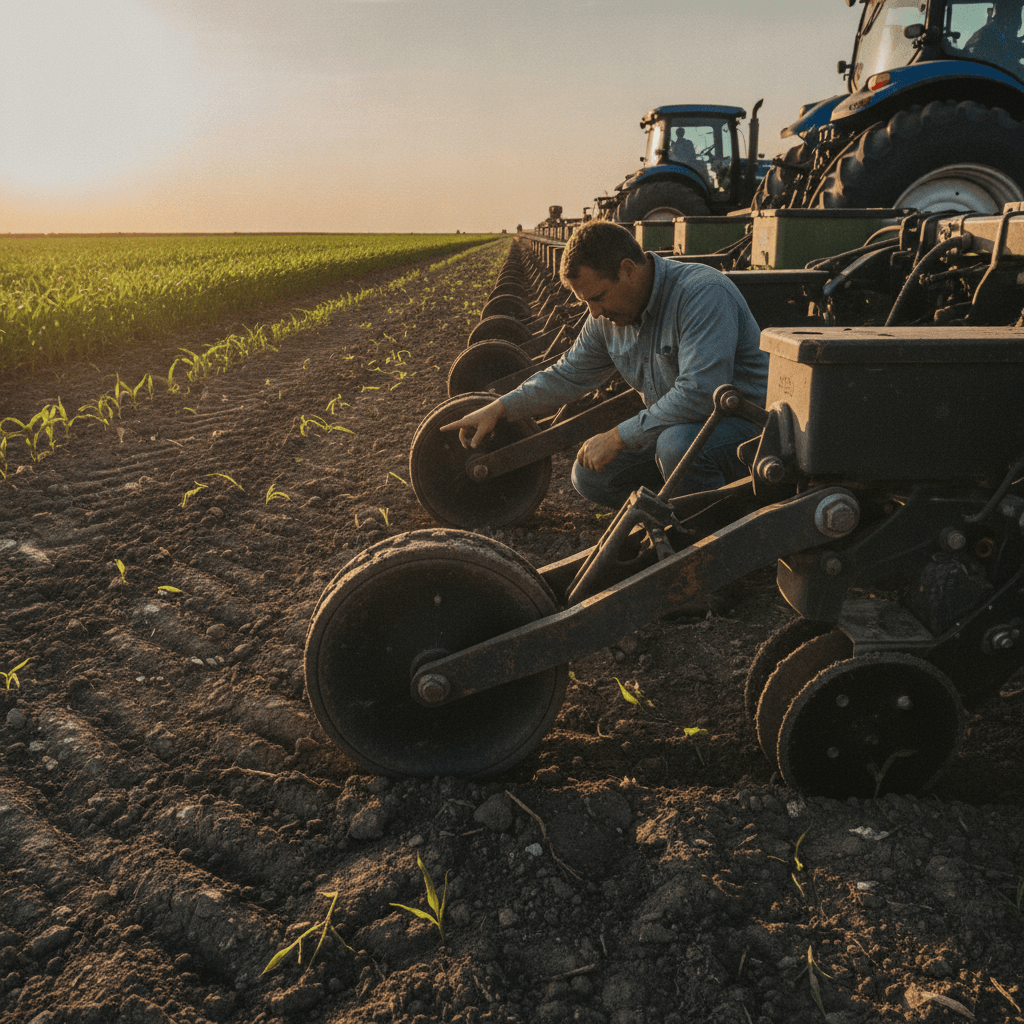
How Do Farmers Near Ipswich Know Whether Their Planter’s Row Unit Parallel Arms Are Causing Depth Problems — Before They Blame the Gauge Wheels?
If your planting depth is inconsistent and your gauge wheels look fine, don’t order new gauge wheels yet. Near Ipswich and across the Northern Plains, worn parallel arms on planter row units are one of the most common — and most overlooked — causes of depth variation from row to row. The symptom looks exactly like a gauge wheel problem. The fix is completely different. Knowing which one you’re dealing with before you start pulling parts saves you money, time, and a lot of frustration during a planting window that doesn’t give you room for either.
Why This Gets Misdiagnosed So Often
Parallel arms — the upper and lower linkage that lets each row unit float up and down independently — wear at the pivot bushings over time. When those bushings get sloppy, the row unit doesn’t just float vertically anymore. It starts to rock side to side, twist slightly, and lose the stable vertical plane it needs to hold consistent depth. The gauge wheel is still spinning. The disk opener is still cutting. Everything looks like it’s working. But the seed is going in at different depths across the pass, and you won’t know how bad it is until you’re pulling emergence counts or digging seeds at different points in the row.
The reason farmers blame gauge wheels first is simple: gauge wheels are the most visible moving part in the depth-control system. If depth is off, the gauge wheel gets the call. And sometimes it’s the right call — worn tires, mud plugging, wrong mounting, or a beat-up tire lip can all throw depth off. But if you’ve already checked your curved spoked gauge wheels and they’re clean, correctly mounted, and in good shape, and depth is still wandering, it’s time to look upstream at the parallel arms.
How to Check Your Parallel Arms in the Shop — Not Just in the Field
You don’t need a lot of tools for this. With the planter parked and the row unit hanging free, grab the gauge wheel arm or the row unit body itself and try to move it side to side. A small amount of play is expected. More than about an eighth of an inch of lateral slop at the bottom of the row unit is a red flag. On older units with high acreage, you may feel significant wobble — enough that you can see the row unit shift when you push it.
Here’s what you’re feeling for:
- Side-to-side movement in the row unit when the parallel arms should be holding it square
- Up-and-down play that feels loose rather than smooth — a grinding or catching sensation through the range of motion
- Uneven wear on the disk openers, especially if one side of the blade is more worn than the other on the same unit
- Rows that consistently plant shallower or deeper than adjacent rows, even after you’ve verified gauge wheel condition and down pressure
If you’re seeing two or more of those signs on the same unit, the parallel arm bushings are likely worn past the point where they’ll hold depth reliably through a full planting pass in South Dakota’s variable spring soils.
What Competitors Don’t Tell You About This Problem
If you’ve been browsing through manufacturer websites looking for help diagnosing depth inconsistency, you’ve probably noticed something: most of the content focuses on the gauge wheel or the closing wheel system. Parallel arm wear gets a mention in owner’s manuals and the occasional forum post, but there’s almost nothing that walks a farmer through how to distinguish a parallel arm problem from a gauge wheel problem when both can produce the same symptom — variable depth.
That gap matters, especially for farmers near Aberdeen, Huron, and across North Dakota and Minnesota who are running planters with significant hours and dealing with heavy clay and gumbo soils that put more stress on every pivot point in the row unit. Wet, sticky soils create more lateral forces on row units than most people account for when they’re thinking about wear rates.
Where Gauge Wheels Actually Fit Into This — And When They Are the Problem
Once you’ve ruled out or addressed parallel arm wear, the gauge wheel system is the next place to look. And this is where the condition of the gauge wheel itself — along with how it’s protected from wear — really matters for depth control.
Gauge wheels set the reference point for disk opener depth. If the tire lip is worn, chipped, or distorted from running without protection, the contact point with the soil shifts, and your depth reference drifts. In wet spring conditions around Ipswich and the surrounding area, mud packing between the spokes of a solid or semi-closed gauge wheel adds weight and throws off how the wheel rides against the soil. An open-spoke design sheds that material. A worn tire lip that hasn’t been protected gives you a moving target for depth.
The steel ring from Jung Enterprise addresses the tire lip wear issue directly. It mounts to the gauge wheel with six screws, protects the lip from the wear that causes that depth drift, and the built-in scraper keeps mud from packing and riding along. After 13,000 planted acres over three years, field testing showed only 1/16″ of wear on the steel ring itself — which tells you the tire lip underneath is staying in far better shape than it would without protection. That’s a meaningful number when you’re trying to hold a consistent 1.75″ or 2″ planting depth across every row in the field.
The Practical Sequence: What to Check and In What Order
If you’re dealing with depth inconsistency before or after planting season near Sioux Falls or anywhere else in the region, work through this order before you start ordering parts:
- First: Check parallel arm bushing play. Lateral slop at the row unit is the most common missed diagnosis.
- Second: Check gauge wheel condition — tire lip wear, bearing condition, spoke cleanliness, and mounting security.
- Third: Verify down pressure settings and whether they’re consistent across units.
- Fourth: Check disk opener condition and blade spacing. Worn blades affect how cleanly the furrow is cut and how reliably the gauge wheel references off the soil surface.
Skipping to step two when the problem is actually step one is how farmers end up buying gauge wheel parts that don’t fix anything.
Frequently Asked Questions
How much parallel arm play is too much on a planter row unit?
A general rule of thumb is more than 1/8″ of lateral movement at the bottom of the row unit when you push on it side to side. Some manufacturers publish tolerance specs — check your planter’s service manual for exact numbers, but if you can see the row unit visibly rock, it’s past the point of acceptable wear.
Can worn parallel arms damage gauge wheels faster?
Yes. When a row unit is rocking laterally instead of floating cleanly up and down, the gauge wheel runs at inconsistent angles against the soil. That side-loading accelerates tire lip wear and puts uneven stress on the gauge wheel bearings. Fixing the parallel arms first protects the gauge wheel investment.
Does Jung Enterprise’s steel ring work on gauge wheels with worn tire lips, or does the lip need to be in good shape first?
The steel ring is designed to protect the tire lip from further wear and to provide a stable, hard contact surface. If the lip is already significantly chipped or deformed, you may need a new gauge wheel. The steel ring works best as a preventive measure or when installed before wear becomes severe — it can’t reverse damage that’s already happened.
Are curved spoked gauge wheels better for catching parallel arm problems in the field?
Not directly — no gauge wheel will compensate for a row unit that’s rocking laterally. But an open-spoke gauge wheel does give you cleaner, more consistent soil contact in muddy conditions, which makes it easier to isolate whether your depth variation is coming from mud packing (a gauge wheel issue) or structural row unit movement (a parallel arm issue). Less noise in the system makes diagnosis easier.
Where can I get Jung Enterprise parts if I’m not near Ipswich?
Jung Enterprise ships direct and also works with ag dealers across South Dakota, North Dakota, and Minnesota. Contact them directly to find the closest option for your operation.
Get the Right Diagnosis Before You Buy Parts
Depth inconsistency costs you at harvest — whether it comes from worn parallel arms, a compromised gauge wheel, or both. The goal before planting season is to work through the system in the right order so you’re fixing what’s actually broken instead of replacing parts that were never the problem.
If you’ve ruled out parallel arm wear and you’re ready to address gauge wheel protection and depth control, Jung Enterprise builds American-made, patented parts that are field-tested in the same soils and conditions you’re dealing with here in the Northern Plains. Reach out to Jung Enterprise to talk through what your planter needs before the next planting season starts.