
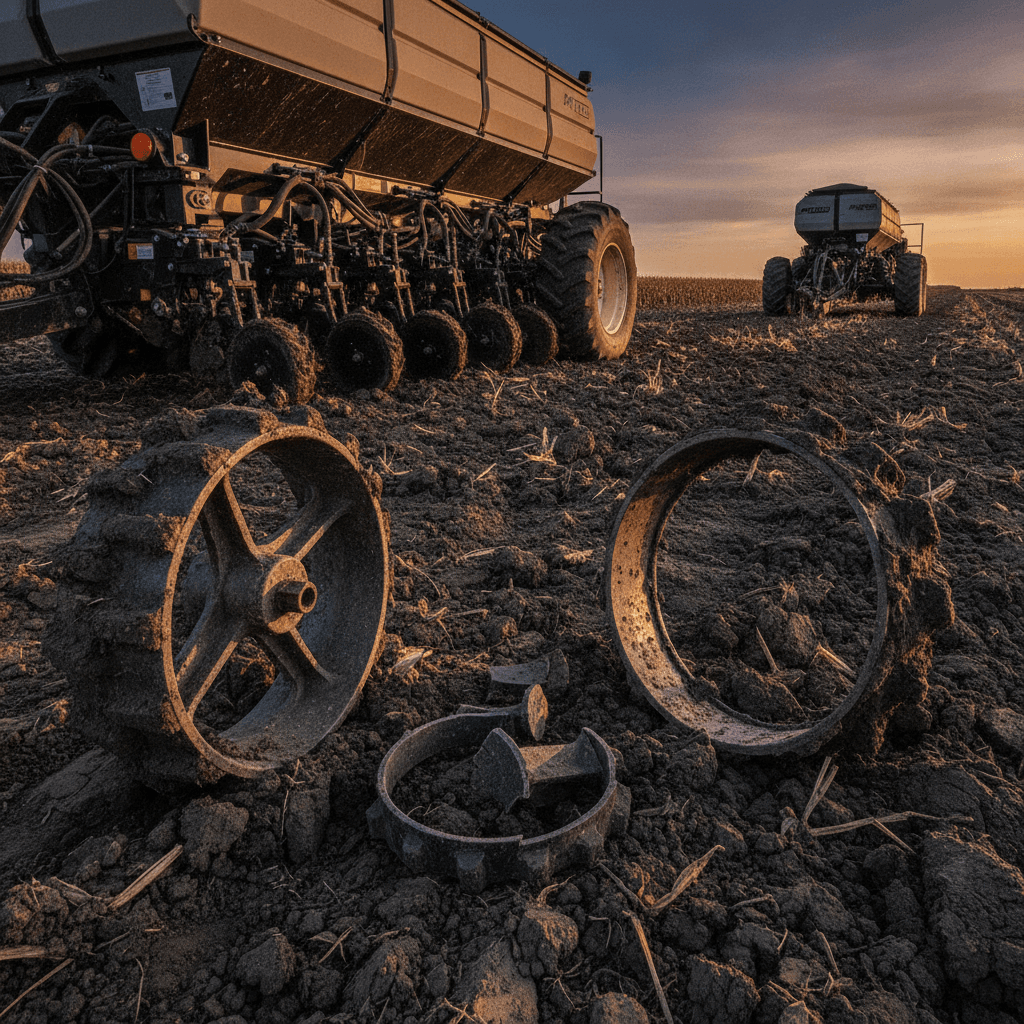
What Should Farmers Near Aberdeen Look for When Buying Replacement Parts for Air Seeders — And How to Avoid Getting Burned by the Wrong Gauge Wheel or Steel Ring
If you’re running an air seeder near Aberdeen and you need replacement gauge wheels or steel rings, the short answer is this: verify field-tested durability, confirm OEM compatibility, and don’t assume a lower price tag means the same performance. The longer answer matters a lot more, because in north-central South Dakota where spring can go from frozen to muddy to bone-dry in a two-week window, a parts failure mid-planting doesn’t just cost you a morning — it costs you yield potential on every acre you plant late.
What’s surprising is how little guidance exists on how to actually evaluate replacement planter and air seeder parts before you buy. Most competitor product pages list specifications and compatibility charts, but almost none of them walk you through the buying decision itself — what questions to ask, what proof points actually matter, and what red flags to watch for. That’s the gap this article is meant to fill.
- Why Air Seeder Parts Buying Decisions Are Different From Planter Row Unit Parts
- The Four Things That Actually Separate a Good Replacement Part From a Bad One
- What Competitors Don't Tell You About Steel Ring Installation
- Seasonal Timing: When to Buy and When to Wait
- Frequently Asked Questions: Air Seeder Parts Near Aberdeen
- Ready to Get the Right Parts on Your Air Seeder Before Next Season?
Why Air Seeder Parts Buying Decisions Are Different From Planter Row Unit Parts
Air seeders and large-frame no-till drills operate under different conditions than a 16-row corn planter. You’re typically covering more acres per day, running through heavier residue, and often doing it in soils that still have moisture in them. Near Aberdeen and across Brown County, that often means gumbo-clay conditions in late April and early May that will test any gauge wheel or tire lip harder than dry ground ever would.
The practical implication: parts that perform acceptably on a conventional planter in normal conditions may degrade faster on an air seeder running 12-hour days through wet, sticky soils. When you’re evaluating replacements, you need to ask whether the part was tested under conditions close to what you’re actually running — not just whether it fits.
The Four Things That Actually Separate a Good Replacement Part From a Bad One
1. Documented, Real-World Wear Data
Any manufacturer can say their part is durable. What separates a legitimate claim from marketing noise is specific numbers attached to real field conditions. At Jung Enterprise — a family-owned manufacturer based in Ipswich, about 45 miles southwest of Aberdeen — the steel rings have been field-tested to show only 1/16″ of wear after 13,000 planted acres across three years. That’s a concrete number. It’s the kind of data that tells you what you’re actually buying.
When you’re shopping for gauge wheels or steel rings, push the manufacturer for documented wear results. If they give you vague language about “heavy-duty construction” without any numbers behind it, take that seriously as a warning sign.
2. Compatibility That’s Confirmed, Not Assumed
Air seeders run across a wide range of frame sizes, coulter configurations, and gauge wheel assemblies depending on brand and model year. A part that’s listed as “universal fit” may still require modification, or may fit loosely enough to cause problems at speed or in hard-cutting conditions.
Before you order, confirm compatibility with your specific make, model, and gauge wheel size. Jung Enterprise’s full product line is built to fit across multiple OEM brands and gauge wheel dimensions — but the right way to buy is always to verify your application first, not assume.
3. Design Features That Solve the Problem You Actually Have
This is where the buying decision gets more nuanced. If mud plugging is your primary problem — and near Aberdeen in a wet spring, it usually is — a solid gauge wheel profile is going to make that problem worse, not better. An open-spoke curved gauge wheel design sheds mud and residue on the go instead of packing it in. That’s a design feature with a direct operational consequence.
Similarly, if tire lip wear is costing you gauge wheels every season, the fix isn’t just buying a new wheel — it’s protecting the tire lip so it stops wearing out in the first place. Jung Enterprise’s patented steel ring (US Patent 11,707,013 B2) mounts directly to the gauge wheel with six screws, protects the tire lip from wear, and doubles as a built-in scraper. That last part matters: you’re not buying a separate scraper and a separate protector. It’s one part doing both jobs, which means less hardware to manage and fewer potential failure points.
4. Country of Origin and Quality Control
Overseas-sourced planter parts have flooded the market over the last several years. Some are adequate. Many are not, and you often can’t tell the difference until you’ve put a few hundred acres on them. Inconsistent steel hardness, out-of-spec dimensions, and fitment issues that show up only under load are common complaints among farmers across South Dakota, North Dakota, and Minnesota who’ve gone the cheap import route and regretted it.
American-made parts with documented quality control and a US patent number are easier to verify and easier to stand behind. When something goes wrong — and eventually something always does — you want a manufacturer you can actually reach, not a shipping container that’s already back on a boat.
What Competitors Don’t Tell You About Steel Ring Installation
One area where the competitor content is noticeably thin is the practical side of steel ring installation on air seeder gauge wheels. Most product pages show a photo and list the patent number. They don’t explain what the installation actually looks like in the field, what tools you need, or what to check after installation.
Jung Enterprise’s steel ring mounts with six screws — that’s a straightforward installation that a farmer or shop mechanic can do without specialized tooling. The built-in scraper geometry is positioned to work as the wheel turns, so there’s nothing to adjust after install. If you’re prepping equipment in the shop during the off-season in September or October, this is a part you can add in an afternoon and be confident about come April.
For wheel retainers — which prevent the gauge wheel from dislodging off the planter or air seeder during operation — installation is similarly simple, but the stakes of skipping it are higher than most operators realize. A gauge wheel that dislodges mid-pass doesn’t just cause downtime. It can cause uneven seeding depth across the entire width of your air seeder until you notice it, which on a large-frame machine covering ground fast can mean a lot of affected acres before the problem gets caught. See the wheel retainer product page for specifics on fitment and installation.
Seasonal Timing: When to Buy and When to Wait
If you’re near Aberdeen and you haven’t evaluated your air seeder gauge wheels since last season, fall is the right time to do it — not the week before planting. Parts availability tightens up in February and March, lead times can stretch, and you don’t want to be making a sourcing decision under pressure when the window is already open.
Post-harvest inspection in October or November lets you pull the equipment in, check wear on gauge wheel spokes, tire lips, and retainer hardware while you still have time to order and install before the ground freezes. That’s how you go into spring with confidence instead of crossed fingers.
Frequently Asked Questions: Air Seeder Parts Near Aberdeen
Do Jung Enterprise steel rings fit air seeder gauge wheels, or just planter gauge wheels?
The steel rings are designed to fit both planters and air seeders across multiple gauge wheel sizes and OEM brands. Confirm your specific gauge wheel dimensions before ordering to make sure you’re getting the right fit.
How many acres should I expect from a quality replacement gauge wheel near Aberdeen?
With a field-tested design and proper installation, a quality gauge wheel should last multiple seasons under normal Northern Plains conditions. The 13,000-acre wear data point (1/16″ of wear over three years) is a reasonable benchmark for what durable, American-made parts can deliver.
Is the built-in scraper on the steel ring enough, or do I still need a separate mud scraper for gumbo soils near Aberdeen?
The steel ring’s scraper geometry is designed to handle typical wet-soil conditions including heavy clay. For extreme gumbo situations, the open-spoke curved gauge wheel design works alongside the steel ring to shed material — that combination is what most Northern Plains operators running no-till or strip-till setups rely on.
Can I install these parts myself, or do I need a dealer or shop to do it?
Both the steel ring (six-screw mount) and the wheel retainer are designed for field or shop installation without specialized tooling. Most farmers and equipment operators handle the install themselves during off-season prep.
Does Jung Enterprise ship to farmers near Aberdeen, or is this only available locally in Ipswich?
Jung Enterprise ships parts directly to farmers, ag dealers, and distributors across South Dakota, North Dakota, Minnesota, Iowa, Nebraska, and beyond. You don’t need to be local to Ipswich to order — though if you’re close enough to drive, that works too.
Ready to Get the Right Parts on Your Air Seeder Before Next Season?
If you’re running an air seeder, no-till drill, or large-frame planter near Aberdeen — or anywhere across the Northern Plains — and you want to know whether Jung Enterprise’s gauge wheels, steel rings, or wheel retainers are the right fit for your equipment, reach out directly. There’s no pressure, no script, just a straightforward conversation about what your machine needs and whether our parts make sense for your operation.
Contact Jung Enterprise here or call (605) 281-0497. We’re based in Ipswich and we’re here through planting season and beyond.