
How Do Farmers Near Pierre Know Whether Their Planter’s Row-to-Row Depth Consistency Is Actually Uniform — Or Just Averaging Out Across the Field?
If you’re farming near Pierre and you pull your planter across a field, you might be running at your target depth on average — and still have two or three rows quietly planting a half-inch shallower or deeper than everything else. That gap doesn’t show up on a monitor. It shows up in your stand count, your canopy closure, and eventually your yield map. Row-to-row depth consistency is one of the most underdiagnosed problems on row-crop planters in South Dakota, and the fix almost always starts with the gauge wheels.
Why Row-to-Row Depth Variation Is Harder to Catch Than You’d Think
Most farmers check planting depth by pulling a row unit out of the ground, digging a few seeds, and measuring with a ruler. That tells you what one row is doing at one spot. It doesn’t tell you whether Row 4 is running consistently at 2 inches while Row 11 is floating between 1.5 and 2.5 depending on soil texture changes. In the variable glacial till soils west of Huron and across much of central South Dakota, that kind of variation happens constantly — especially where you’re going from firm to soft ground within the same field.
The deeper problem is that most farmers are measuring a snapshot, not a pattern. And row-to-row variation by definition only becomes visible when you compare rows side by side, which almost nobody does systematically during planting.
What Actually Drives the Row-to-Row Gap
Three things tend to cause rows to drift from each other during planting:
- Uneven gauge wheel wear across the planter. If you replaced gauge wheels on some rows last season but not others, or if certain rows see heavier wear because of how the planter tracks, those rows will run at slightly different depths even with identical down-pressure settings.
- Mud and debris building up unevenly. In wet spring conditions — which Pierre and the surrounding area sees regularly — gauge wheels on some rows pick up more gumbo clay than others depending on soil texture and row position. That buildup raises the effective diameter of the wheel, which pushes the row unit shallower on those rows.
- Worn tire lips creating inconsistent contact. The lip of a gauge wheel tire is what actually rides along the soil surface and sets depth. Once that lip wears down or deforms unevenly, depth control becomes inconsistent — and it won’t be uniform across all rows if wheels are at different stages of wear.
The Part of This That Competitors Don’t Cover Well
Spend time looking at the content from major gauge wheel suppliers and you’ll find plenty of information about why depth consistency matters in general. What’s almost never addressed is the row-to-row comparison problem specifically — how to diagnose whether you have a uniform issue across the planter versus a concentrated problem on two or three rows. That’s a meaningful distinction because the fix is different.
If every row is running shallow, you’ve got a down-pressure or field condition problem. If rows 6, 7, and 12 are running shallow while the rest are fine, you’ve got localized gauge wheel wear or plugging on those specific units — and you need to address those rows individually rather than adjusting the whole planter.
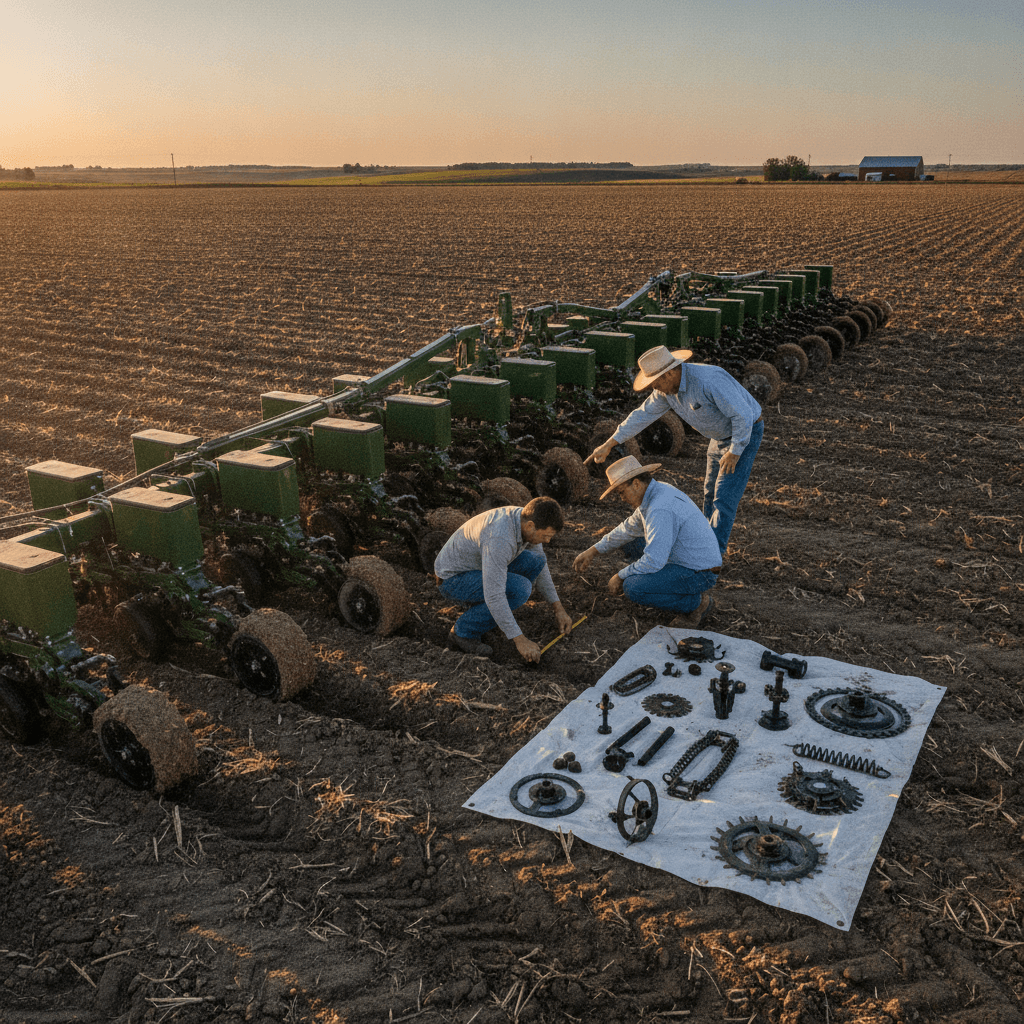
To actually diagnose this, you need to do a row-by-row depth check, not a spot check. Plant 200 feet, stop, and walk the whole width of the planter. Dig four to five seeds on every single row and write it down. Do this at the start of a field and again mid-field. What you’re looking for is not just average depth — you’re looking for which rows are consistently outliers.
How Gauge Wheel Design Affects Row-to-Row Uniformity at Scale
One thing that gets overlooked is how gauge wheel design affects your ability to maintain consistent depth across all rows when conditions change mid-field. An open-spoke gauge wheel sheds mud continuously as it rotates. A solid or semi-solid wheel accumulates it. When you’re planting variable soils near Pierre — going from lighter ground near draws to heavier clay on the flats — a wheel that can’t shed mud will start building up on certain rows faster than others, and your depth uniformity falls apart in real time.
Jung Enterprise’s Curved Spoked Gauge Wheels are built specifically to address this. The open-spoke design clears mud on every rotation instead of letting it accumulate. That means when you hit a wet patch mid-field, the wheel keeps rolling clean instead of packing up and pushing the row unit shallower. Field-tested to show only 1/16″ of wear after 13,000 planted acres over three years, these wheels hold their effective diameter long enough that row-to-row variation from uneven wear stays minimal across a full season.
The Tire Lip Problem and What Steel Rings Actually Do for Depth Consistency
Gauge wheel tires wear at the lip first. That’s where all the soil contact happens, and it’s where abrasive sand and grit in South Dakota soils do the most damage over time. Once the lip rounds off or wears unevenly, the wheel doesn’t sit in the same position relative to the disk opener — which means depth changes, and it changes differently on every wheel depending on how much that specific tire has worn.
The Steel Ring from Jung Enterprise mounts on the outside of the gauge wheel tire with six screws and covers that lip with a steel wear surface. It protects the lip from abrasion, doubles as a built-in scraper to knock clay and debris off the tire, and keeps the effective diameter of the wheel consistent over thousands of acres. Because it’s patented (US 11,707,013 B2 and related patents) and American-made, you’re not dealing with dimensional inconsistencies from overseas casting or stamping — each ring is manufactured to hold tight tolerances so every row unit is working with the same geometry.
You can learn more about the full product lineup at Jung Enterprise’s products page.
Practical Steps for Checking Row-to-Row Consistency Before Planting Season
Before you pull the planter out this spring, here’s a practical routine that takes less than an hour and tells you which row units need attention:
- Set all row units to your target planting depth on a flat, firm surface.
- Measure the effective gauge wheel diameter on every row — you’re looking for more than 1/8″ variation between rows as a red flag.
- Check each tire lip by running your finger along the contact edge. It should feel consistent, not rounded or grooved.
- Inspect all gauge wheels for flat spots, cracks, or obvious mud buildup from last season.
- Note which rows had issues last season based on your harvest data — those are your first suspects.
If you find three or more rows with worn tires or uneven lips, replacing gauge wheels across the full planter makes more sense than patching individual rows. Mixing old and new wheels is how you introduce the row-to-row variation you’re trying to eliminate.
Frequently Asked Questions
How much row-to-row depth variation is actually acceptable during planting?
Most agronomists flag anything beyond 1/4″ of variation between rows as worth investigating. At 1/2″ or more, you’re likely seeing stand count differences that affect yield. The tighter your target, the less margin you have.
Can monitor data tell me which rows are running at wrong depth?
Some advanced planting monitors can flag row-unit issues, but most systems don’t report actual seed depth per row in real time. Depth inconsistency from gauge wheel wear usually has to be caught manually with a ruler and seed excavation.
Do Jung Enterprise’s gauge wheels fit my planter brand?
Jung Enterprise’s Curved Spoked Gauge Wheels are compatible with planters, air seeders, and no-till drills across multiple OEM brands and gauge wheel sizes. Contact Jung Enterprise directly to confirm fitment for your specific equipment before ordering.
Will the Steel Ring fit over an existing gauge wheel tire, or does the tire need to be replaced first?
The Steel Ring mounts on the outside of the gauge wheel tire with six screws. If the tire is severely worn or cracked, it should be replaced before installing the ring. On a tire that still has structural integrity but a worn lip, the Steel Ring can extend its useful life significantly.
How does mud plugging affect row-to-row depth differently depending on row position on the planter?
Rows toward the center of wide planters can see different soil conditions than outer rows, especially on curved ground or field edges. Outer rows may also pick up more surface residue in no-till fields. Those factors mean mud accumulation isn’t always uniform across all rows — which is exactly why open-spoke gauge wheels that shed continuously matter more than their price difference suggests.
Ready to Fix Row-to-Row Depth Variation Before It Costs You Yield?
If you’re farming near Pierre or anywhere in central South Dakota and you’ve been running on the assumption that your planter is uniform row-to-row, it’s worth spending an hour this preseason to verify that. The parts that actually hold depth consistent — quality gauge wheels with open-spoke designs, steel rings that protect tire lips from wearing unevenly — are not expensive compared to the yield you leave in the field when three rows are quietly off all season.
Jung Enterprise is a family-owned manufacturer based in Ipswich, South Dakota, building patented, American-made gauge wheel parts that are field-tested in real Northern Plains conditions. If you want to talk through what your planter needs before spring, reach out to the team at Jung Enterprise — we’ll help you figure out what’s worth fixing and what can wait.