
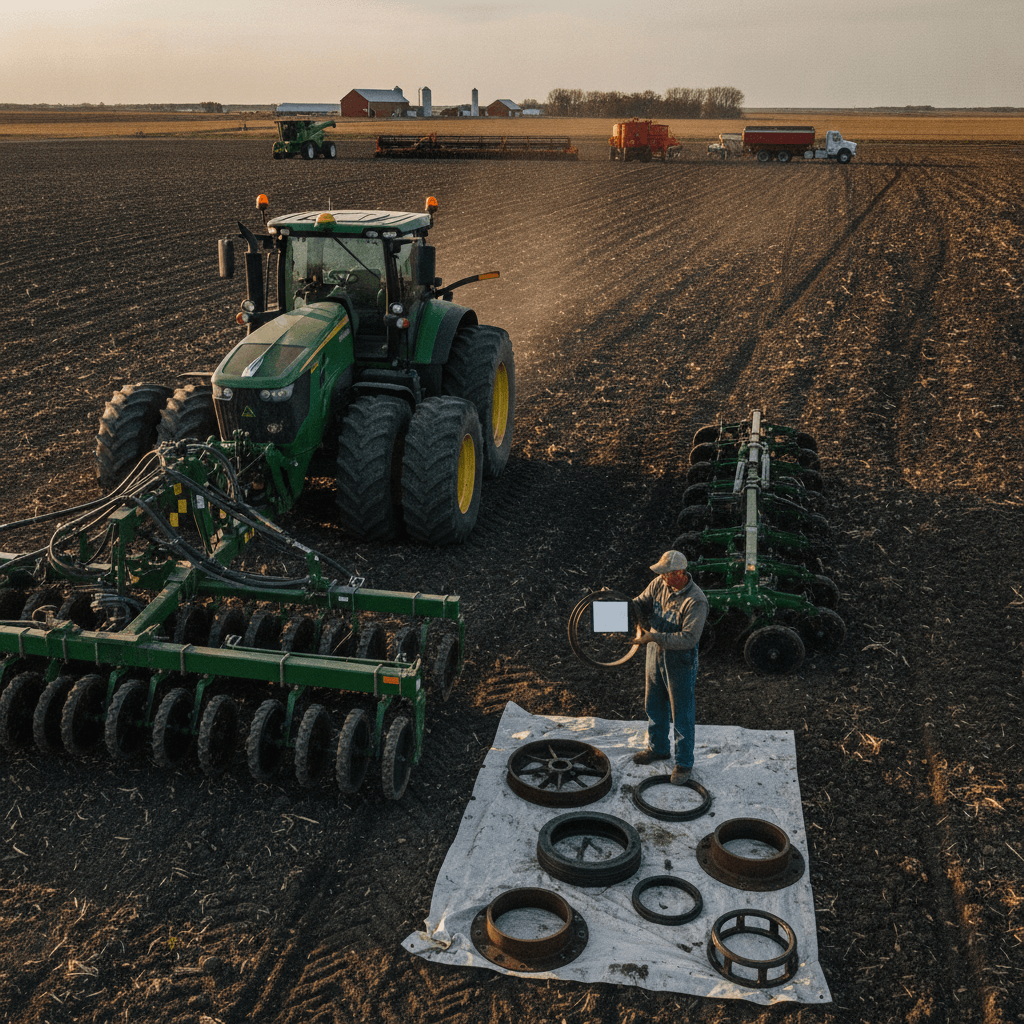
How Do Farmers Near Fargo Know Whether Their Planter’s Steel Ring Is Actually Compatible With Their Air Seeder — Or Built Only for a Standard Row Planter?
If you’re running an air seeder near Fargo and thinking about adding a steel ring to protect your gauge wheel tires, the first question isn’t which brand to buy — it’s whether the ring you’re looking at was actually designed for what you’re running. A lot of farmers in North Dakota and across the Red River Valley operate both a row planter for corn and soybeans and an air seeder for small grains or canola. Those machines have different gauge wheel geometries, different operating loads, and different mud-shedding demands. A steel ring that fits a standard corn planter may not mount flush, seat correctly, or scrape effectively on an air seeder gauge wheel. And a ring that doesn’t fit right causes more problems than running nothing at all.
Why Air Seeder Gauge Wheels Create a Different Set of Demands
Row planters and air seeders aren’t the same machine, and their gauge wheels reflect that. Air seeders typically run at higher acres-per-day rates, cover more ground per pass, and are often asked to handle heavier soil disturbance in no-till and minimum-till settings. The gauge wheels on an air seeder rank box or hoe opener are taking constant lateral pressure, ground contact at varying angles, and higher cumulative wear over a shorter calendar window — especially in the compressed spring planting season across North Dakota and Minnesota.
The tire lip on an air seeder gauge wheel takes a beating from that repeated side-loading. When the tire bead starts separating or the lip cracks, you lose the ability to hold consistent seeding depth. That’s not a small thing when you’re covering several thousand acres and counting on uniform emergence across a wide variety of field conditions — from the heavy clay gumbo around the Fargo area to sandier ground as you move west into the drier Northern Plains.
Mud plugging is also worse on air seeders than most farmers expect. The wider spacing between openers and the sheer width of a modern air seeder toolbar means mud doesn’t always have a clear exit path. A gauge wheel that plugs up mid-pass doesn’t just reduce accuracy — it can cause the whole opener assembly to ride high, dropping seeds too shallow or skipping contact altogether.
What Compatibility Actually Means When It Comes to Steel Rings
When you’re evaluating a steel ring for your air seeder, you need to look past the marketing language and ask a few concrete questions:
- Does it match your gauge wheel diameter? Steel rings are sized to fit specific gauge wheel diameters. A ring built for a 13-inch row planter wheel won’t seat correctly on a 14-inch air seeder wheel.
- Does the mounting hardware work with your gauge wheel hub and spoke configuration? The Jung Enterprise steel ring mounts with six screws. If your gauge wheel doesn’t have compatible spoke geometry or mounting points, a ring that looks close won’t stay put under field conditions.
- Is the scraper geometry designed for your wheel’s profile? Flat gauge wheels and dished gauge wheels scrape differently. A ring designed for one profile won’t clean the other effectively — and a steel ring that doesn’t scrape is just dead weight on your row unit.
- Is the ring built to handle the load cycles of an air seeder? Higher-acreage machines need parts built with that use case in mind, not just adapted from a row planter catalog.
The Jung Enterprise Steel Ring is built to address these points directly. It’s patented (US 11,707,013 B2 and related patents), American-made, and designed to protect the tire lip from wear while functioning as a built-in scraper — no separate scraper part to bolt on, lose, or forget to reinstall after service. It mounts with six screws and is available in sizes that cover planters, air seeders, and no-till drills across multiple OEM gauge wheel configurations. That compatibility across machine types is one of the reasons farmers running mixed fleets — a row planter for corn and soybeans alongside an air seeder for wheat or canola — can standardize on one part number rather than managing separate SKUs for each machine.
What the Competitors Don’t Tell You About Air Seeder Fitment
Here’s a gap worth pointing out directly: most of the major gauge wheel parts suppliers — Yetter, Schaffert, Copperhead Ag, and others — focus their content and product descriptions almost entirely on row planter applications. Corn. Soybeans. Standard 30-inch row planters. If you go to their websites looking for guidance on whether their steel ring or scraper solution works on an air seeder, you’ll find very little that addresses the specific geometry, load demands, or soil conditions that air seeders operate in.
That leaves farmers near Fargo and across North Dakota and Minnesota in a gray area. You can call a dealer and hope they know, or you can order a part and find out the hard way that it doesn’t fit. Neither option is good when you’ve got a five-day window to get your canola in the ground before the forecast turns wet again.
At Jung Enterprise, based in Ipswich, South Dakota, we work with farmers running both machine types and can confirm compatibility before you order. That’s not something you get from a product listing on a website that wasn’t written with air seeders in mind.
Durability Matters More on High-Acreage Air Seeder Operations
If you’re running an air seeder, you’re likely covering more acres per season than the average row-crop farmer. That means wear rates matter more, not less. The Jung Enterprise steel ring has been field-tested to just 1/16 inch of wear after 13,000 planted acres over three years. For an air seeder operation, that kind of durability translates to fewer mid-season replacements, less downtime during the planting window, and lower cost per acre over the life of the part compared to cheaper rings that wear out faster or don’t scrape cleanly enough to justify the install.
If you want to see how the full product lineup fits your specific machine, view all Jung Enterprise products here.
FAQ: Steel Ring Compatibility for Air Seeders Near Fargo
Does the Jung Enterprise steel ring fit air seeder gauge wheels, or only row planter wheels?
The Jung Enterprise steel ring is available in sizes that fit planters, air seeders, and no-till drills. Exact fitment depends on your gauge wheel diameter and spoke configuration — contact us directly to confirm compatibility for your specific machine before ordering.
My air seeder gauge wheels are a different diameter than my row planter. Do I need a different steel ring for each machine?
Potentially, yes. Steel rings are sized to match specific gauge wheel diameters. If your air seeder and row planter run different wheel sizes, you may need two different ring sizes. That’s worth sorting out before the season starts, not during it.
Will a steel ring designed for a row planter still work as a scraper on an air seeder?
Only if the ring seats correctly against the wheel profile. A ring that doesn’t fit flush won’t make consistent contact with the tire, which means it won’t scrape mud effectively. It may also come loose under the lateral loads common in air seeder operation. Fit matters more than brand.
How do I know if my air seeder gauge wheels are worn enough to need a steel ring for protection?
If the tire lip shows cracking, the bead is separating from the rim, or you’re seeing inconsistent depth across passes even after checking opener alignment, the gauge wheel tire is likely compromised. A steel ring prevents further wear on the tire lip — it doesn’t fix damage that’s already happened. The earlier you install one, the more tire life you protect.
Does it matter whether I’m doing no-till or conventional tillage on whether a steel ring is worth it?
No-till and minimum-till operations tend to see heavier mud plugging and more tire lip wear because the gauge wheels are running through residue and undisturbed soil without the benefit of prior tillage loosening things up. In those conditions — which are common across North Dakota and Minnesota — a steel ring with a built-in scraper pays for itself faster because it’s doing more work per acre than it would in a tilled field.
Talk to Jung Enterprise Before You Order
If you’re near Fargo or anywhere else across the Northern Plains and you’re not sure whether a steel ring is actually the right fit for your air seeder, don’t guess. We can help you confirm compatibility, walk through sizing, and make sure you’re getting a part that will actually work on your machine — not just one that looks close enough on a website.
Reach out to Jung Enterprise here or call us directly at (605) 281-0497. We’re based in Ipswich, South Dakota, and we work with farmers, custom operators, and ag dealers across South Dakota, North Dakota, Minnesota, and beyond. If you’re heading into fall planning or pre-season prep, now is the right time to get this sorted before the spring rush hits.