
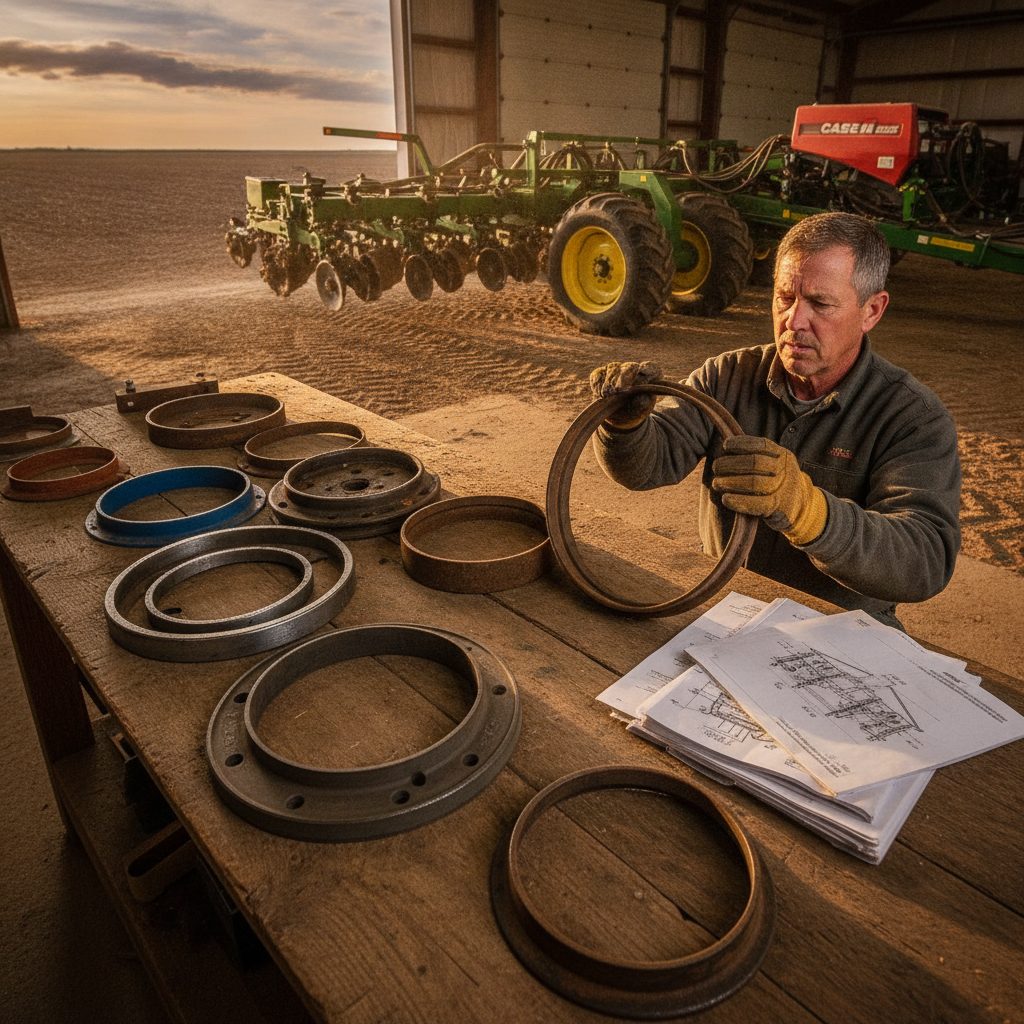
How Do Row-Crop Farmers Near Fargo Know Whether Their Planter’s Steel Ring Is Actually Compatible With Their Specific Gauge Wheel Brand — Or Just Assumed to Fit Because It Looks Close Enough?
If you farm near Fargo and you’ve ordered a steel ring based on a photo match or a parts catalog description that said “universal fit,” there’s a real chance you’ve ended up with a ring that technically mounts but doesn’t seal, doesn’t scrape, or works itself loose after a few hundred acres. Steel ring compatibility isn’t just about whether the ring slides onto the gauge wheel — it’s about whether the fit is tight enough to protect the tire lip, seat flush enough to scrape mud effectively, and mount securely enough to stay put through a full planting season in heavy North Dakota clay. Getting that wrong doesn’t just waste money on a part. It costs you the entire performance benefit the ring was supposed to deliver.
Why “Close Enough” Fitment Is a Real Problem in the Field
The Northern Plains — from Fargo down through South Dakota and across into Minnesota — runs some of the heaviest, stickiest soil conditions you’ll find in the Corn Belt. When those gumbo soils get wet in April and May, gauge wheels don’t just get dirty — they pack up hard and fast. A steel ring that isn’t seated correctly against the tire lip creates gaps where wet clay can wedge in and build up. Once that starts, the ring’s scraping function is gone and you’re back to the same plugging problem you were trying to solve in the first place.
The other issue is structural. A ring that’s slightly too large for the gauge wheel diameter won’t clamp down evenly across all six mounting points. That creates flex, and flex creates wear — on the ring, on the tire lip, and on the hardware. It also creates vibration, which loosens fasteners faster. In a wet spring where you’re already fighting the clock on a short planting window, stopping to re-torque or replace a ring that wasn’t right to begin with is exactly the kind of downtime you can’t afford.
What Actual Compatibility Means for Steel Rings on Planters and Air Seeders
Compatibility for a steel ring comes down to three things: gauge wheel outer diameter, tire lip geometry, and mounting hole pattern. Those three variables aren’t universal across OEM brands. John Deere, Kinze, Case IH, White, and other manufacturers each have their own gauge wheel specs — and even within a single brand, those specs can change between model years or row unit generations.
- Outer diameter: The ring has to match the gauge wheel tire’s outer diameter closely enough to seat flush against the lip. Even a small mismatch creates the gaps described above.
- Tire lip profile: Some gauge wheel tires have a wider lip flange than others. A ring designed for a narrow-lip tire won’t wrap and protect a wider one, and vice versa.
- Mounting hole pattern: Jung Enterprise’s Steel Ring mounts with six screws. That mounting pattern has to align with the gauge wheel’s existing geometry — or in some cases, the ring is designed to work with a specific mounting approach that doesn’t require pre-drilled holes on the wheel itself.
When you’re evaluating a steel ring, the right question isn’t “does this fit a gauge wheel?” It’s “does this fit my gauge wheel on my planter or air seeder?” Those are different questions, and the answer to the second one requires knowing your specific equipment.
What the Competitor Content Misses on This Topic
Most manufacturers — including several of the larger names farmers near Fargo are likely familiar with — publish compatibility information that’s either too broad to be useful or buried in a spec sheet that assumes you already know your wheel’s exact measurements. What’s almost entirely missing from the competitor landscape is a plain-language explanation of what to measure, where to measure it, and what to do when your gauge wheel falls between standard sizes.
That’s a real gap. Farmers running older planters, used equipment, or machines that have had wheels swapped out over the years often don’t have clean OEM documentation to reference. They’re measuring what’s on the machine and trying to figure out if a part will work. Good compatibility guidance should answer that question directly — not just list supported models and leave everyone else guessing.
At Jung Enterprise in Ipswich, that’s exactly the kind of question we can help you work through before you order. If you’re not sure whether a steel ring is going to fit your specific setup, reach out before planting season — not the morning you’re trying to get the planter out the door.
Durability Only Pays Off When the Fit Is Right
The Jung Enterprise steel ring has been field-tested to just 1/16″ of wear after 13,000 planted acres over three years. That’s a real durability number, and it matters — but only if the ring is correctly seated on the gauge wheel in the first place. A loose or mismatched ring won’t deliver that service life because it’s flexing, shifting, and wearing at the mounting points instead of riding steady against the tire lip the way it’s designed to.
The patented design (US 11,707,013 B2) also includes a built-in scraper function, which eliminates the need for a separate scraper attachment. But again — that scraper geometry only works as intended when the ring is flush against the tire lip. If the fit isn’t right, the scraper angle is off, and you lose the mud-shedding benefit that makes the ring worth running in the first place, especially in the heavy soils around Fargo and across North Dakota.
If you’re evaluating gauge wheel options alongside the steel ring, the Curved Spoked Gauge Wheels from Jung Enterprise are designed to work in combination with the steel ring system and feature an open-spoke design built to shed wet clay between passes — another detail that matters when you’re running through the kind of soils the Northern Plains can throw at you in a wet spring.
How to Verify Fitment Before You Order
Here’s a practical checklist before ordering a steel ring for your planter or air seeder:
- Know your gauge wheel’s outer diameter — measure it yourself if you’ve swapped wheels or can’t find the OEM spec
- Know your planter or drill brand, model, and row unit generation (this affects lip geometry)
- Check whether your gauge wheel tires have been replaced with an aftermarket option, since those may differ from OEM dimensions
- Ask the manufacturer directly whether their ring is validated for your specific wheel — not just “compatible with planters”
- If you’re a custom planter running multiple machine types, verify fitment for each one separately rather than assuming one ring covers everything
Farmers in Minnesota and across the Dakotas running multiple row units or multiple planter models in the same operation need to be especially careful here. What fits a Kinze 3600 is not automatically going to fit a John Deere 1770NT or a Case IH Early Riser. Assuming cross-compatibility without checking is how you end up with a pile of rings that work on three machines and don’t fit the fourth.
Frequently Asked Questions
Does the Jung Enterprise Steel Ring fit all gauge wheel brands?
The steel ring is designed to fit across a range of common gauge wheel sizes and planter brands, but fitment depends on your specific gauge wheel diameter and lip geometry. Contact Jung Enterprise with your planter brand, model, and row unit details before ordering to confirm the right fit for your setup.
What happens if I run a steel ring that’s slightly too large for my gauge wheel?
An oversized ring won’t seat flush against the tire lip. That creates gaps where mud and debris can pack in, reduces the scraping effectiveness, and puts uneven stress on the mounting hardware — which leads to accelerated wear and fastener loosening. Getting the right size from the start avoids all of that.
Can I use the Jung Enterprise Steel Ring on an air seeder or no-till drill, not just a row-crop planter?
Yes. The steel ring is compatible with air seeders and no-till drills in addition to row-crop planters, as long as the gauge wheel dimensions match. Farmers near Fargo running air seeders on heavy North Dakota soils see the same mud-plugging problems the ring is designed to solve — the application isn’t limited to corn and soybean planters.
Do I need a separate scraper if I’m running the Jung Enterprise Steel Ring?
No. The patented design includes a built-in scraper function. You don’t need to add a separate scraper component — the ring handles both tire lip protection and mud scraping in one part. That’s one of the key differences between this design and generic steel ring options on the market.
How do I know if my gauge wheel tires have already been replaced with an aftermarket size that might affect fitment?
The simplest approach is to measure the outer diameter directly on the wheel that’s on your planter right now, rather than relying on the original spec sheet. If the previous owner replaced the tires, the dimensions may differ from OEM. When in doubt, contact Jung Enterprise with your measurements and they can help you identify the correct ring size.
Get the Right Fit Before Planting Season Opens
If you’re farming near Fargo or anywhere across North Dakota and you’re not sure whether a steel ring will fit your specific gauge wheel setup, the worst time to find out is when you’re trying to get the planter in the field. Jung Enterprise is based in Ipswich, South Dakota, and ships across the Northern Plains — but more importantly, we can answer fitment questions directly before you order. No guesswork, no generic catalog matching.
Reach out through our contact page with your planter brand, model, and gauge wheel details, and we’ll confirm whether the steel ring is the right fit for your machine. That’s the kind of conversation that saves you a wasted part and a wasted trip back to the shop mid-season.