
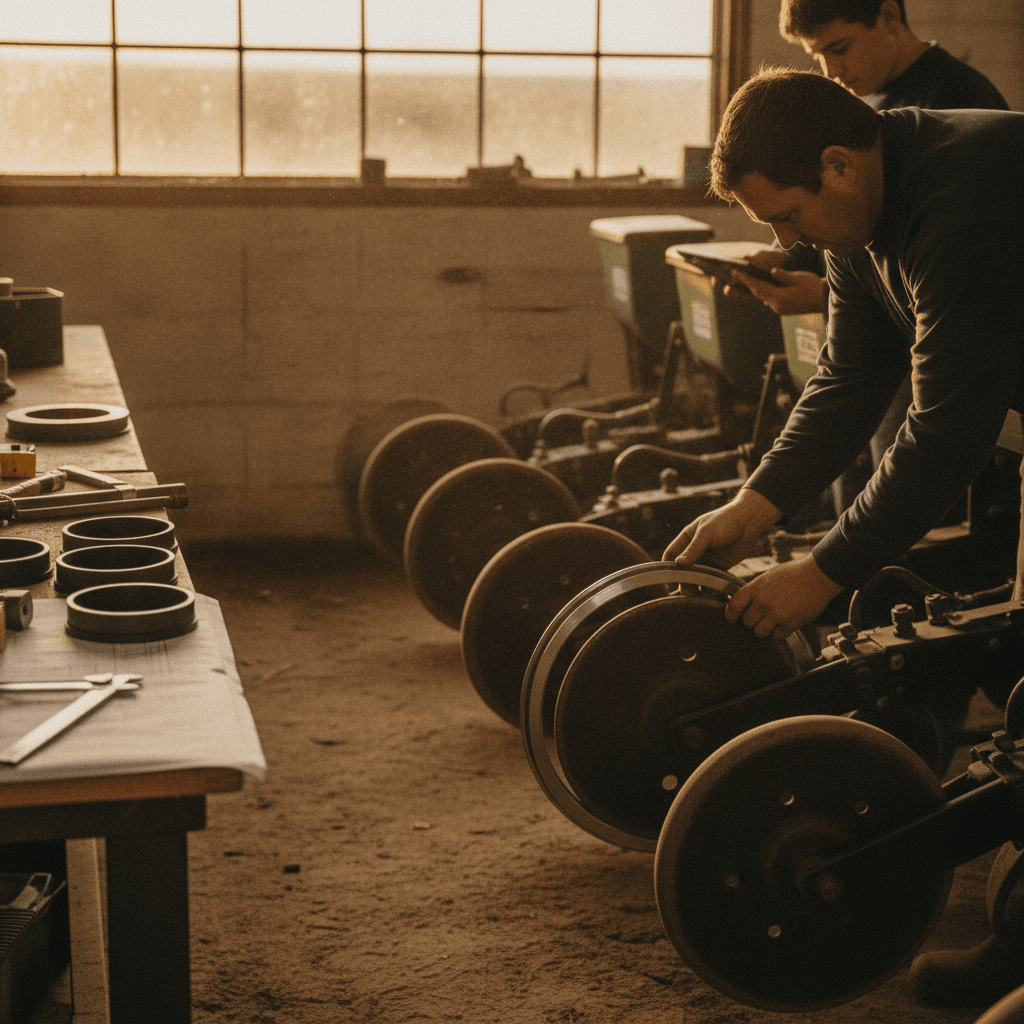
How Do Farmers Near Huron Know Whether Their Planter’s Steel Ring Is Actually the Right Fit for Their Gauge Wheel Size — Or Just Good Enough to Cause Problems?
If your steel ring isn’t sized correctly for your gauge wheel, you’re not getting the protection you paid for — and in some cases, you’re actively making things worse. Farmers near Huron deal with some of the heaviest spring soils in South Dakota, and when a steel ring fits loosely, shifts under load, or sits proud of the tire lip, it stops scraping and starts creating new wear points. Here’s what to check before you assume the ring you ordered is the ring that actually fits.
Why Gauge Wheel Size Matters Before You Ever Order a Steel Ring
Most conversations about steel rings focus on what they do — protect the tire lip, shed mud, act as a built-in scraper. Fewer conversations focus on what happens when the fit is off. And that’s the gap that costs farmers real money.
Gauge wheel tires aren’t all the same diameter. Common sizes run 15-inch and 16-inch depending on the planter brand and model year, but there are variations within those ranges that matter when you’re fitting a steel ring tight to the tire lip. A ring designed for one diameter won’t seat flush on another. When it doesn’t seat flush, it doesn’t scrape consistently. When it doesn’t scrape consistently, mud packs in — especially in the clay and gumbo soils common across central South Dakota from Huron west toward Mitchell.
The tire lip itself also varies. Some OEM gauge wheel tires have a more pronounced lip; others are nearly flush with the sidewall. A steel ring that’s designed to clamp around a defined lip won’t sit right on a flatter profile. And a ring spec’d for a flat profile will rattle and shift on a pronounced lip. Either way, you’ve got a fitment problem — and you’ll know it the first time you hit a wet field.
What the Competitors Don’t Tell You About Sizing
Here’s something worth noting: most competitor product pages list compatibility in general terms — “fits most planters,” “compatible with standard gauge wheels,” or a short brand list. What they don’t give you is a clear explanation of how to measure your existing gauge wheel to confirm fit before you buy. That leaves farmers guessing and returning parts, or worse, running the wrong ring for a full season without knowing it.
At Jung Enterprise in Ipswich, the Steel Ring is a patented design (US 11,707,013 B2 and related patents) built to mount securely with six screws directly to the gauge wheel tire. That mounting method matters because it’s what keeps the ring locked in position under field conditions — not friction, not a press fit, not a clamp that can loosen when you’re running through tough residue or wet ground. But the six-screw mount only works as designed when you’re starting with the right ring for the right wheel. Confirming that fit before you install is step one.
How to Measure Your Gauge Wheel Before You Order
You don’t need anything fancy. Here’s a straightforward way to verify your gauge wheel dimensions before ordering a steel ring:
- Measure the outer diameter of the tire at the widest point of the tread, not across the lip. Use a tape measure or caliper.
- Check the tire lip profile. Run your finger around the outer edge of the tire. Is there a defined raised lip, or does the tire taper flat to the edge? Note which you have.
- Look at your gauge wheel model or OEM part number. If you have the planter manual or the original parts tag, that number helps confirm sizing faster than measuring alone.
- Count the existing spoke configuration if you’re fitting to curved spoked gauge wheels — the spoke geometry affects how accessories seat and how mud sheds under load.
If you’re not sure what you have, call before you order. A two-minute conversation saves a return shipment and a week of downtime during planting.
What Happens When the Fit Is Wrong — In the Field
A steel ring that’s even slightly undersized for your tire diameter will ride high on the lip. Instead of sitting flush and scraping debris off the tire face as the wheel rotates, it catches and holds it. Mud packs between the ring and the tire sidewall. That packed material forces the tire lip outward over time — exactly the wear pattern you were trying to prevent.
An oversized ring has the opposite problem. It can’t clamp tight enough to stay in position, especially when you hit harder ground after a wet stretch. In fields east of Huron or north toward Aberdeen where you can go from saturated clay to hard-crusted soil in the same field, a loose ring will shift, expose the tire lip, and start wearing the mounting holes. At that point, you’re not protecting anything — you’re adding a failure point.
The Jung Enterprise Steel Ring has been field-tested across 13,000 planted acres over three seasons, showing only 1/16 inch of wear across that span. But that durability assumes correct installation on a correctly sized wheel. Fitment isn’t a secondary concern — it’s what makes the durability numbers possible.
Compatibility Across Planter and Air Seeder Brands
Corn and soybean farmers across South Dakota, North Dakota, and Minnesota are running a wide range of planter and air seeder brands — John Deere, Case IH, Kinze, White, Great Plains, and others. Gauge wheel dimensions vary across these brands and across model years within the same brand. That’s why compatibility isn’t a yes/no question — it’s a “which specific wheel on which specific machine” question.
If you’re running a no-till drill or air seeder alongside a row-crop planter, don’t assume the same steel ring fits both. Drill gauge wheels often run different diameters than planter gauge wheels, and the tire profiles can differ significantly. Check each machine separately before ordering.
Jung Enterprise’s full product lineup is built around compatibility with the equipment row-crop farmers in the Northern Plains are actually running. If you’re not sure whether your wheel is covered, reach out directly and we’ll help you figure it out before you order.
FAQ: Steel Ring Compatibility Near Huron and Surrounding Areas
How do I know which steel ring size fits my gauge wheel?
Start by measuring your tire’s outer diameter and checking the lip profile — whether it’s pronounced or relatively flat. Then cross-reference with your planter’s OEM gauge wheel part number if you have it. If you’re still unsure, contact Jung Enterprise directly at (605) 281-0497 and we can help confirm before you order.
Will a steel ring designed for a John Deere planter fit a Kinze or Case IH gauge wheel?
Not automatically. Gauge wheel dimensions vary by brand and model year. Always verify your specific wheel size rather than assuming cross-brand compatibility based on general descriptions.
Can I use the same steel ring on my planter and my no-till drill?
Possibly, but don’t count on it. No-till drill gauge wheels often differ in diameter and tire profile from row-crop planter gauge wheels. Measure both separately before ordering.
What happens if a steel ring is slightly oversized for my tire?
An oversized ring won’t clamp securely. It will shift during field operation, fail to scrape consistently, and can damage the mounting holes over time. Running the wrong size defeats the purpose of the ring and can create new wear problems.
Does the six-screw mount on Jung’s Steel Ring work on any gauge wheel tire?
The six-screw mount is designed to lock the ring in position regardless of field conditions — but it requires the ring to be correctly sized for the tire to begin with. Correct sizing is what allows the mount to work as intended and deliver the durability results we’ve documented in the field.
Ready to Confirm Fit Before Planting Season?
If you’re farming near Huron, running corn or soybeans in central South Dakota, or managing a custom planting operation across multiple fields and machines, don’t guess on steel ring sizing. A mismatch costs you the scraping performance you need in wet conditions and shortens the service life of the part and the tire underneath it.
Jung Enterprise is based in Ipswich and built around exactly these kinds of questions. We know what planting equipment farmers across South Dakota are running, and we can help you confirm compatibility before you buy. Reach out through our contact page or call (605) 281-0497 to talk through your gauge wheel setup before the next planting season gets here.